
Warfarin and Vitamin K Foods: How to Keep Your Diet Consistent for Safe Blood Thinning
Vitamin K Intake Consistency Checker
Keep Your INR Stable with Consistent Vitamin K
Track your daily vitamin K intake from common foods to maintain stable blood clotting while on warfarin
Tip: For stable INR levels, keep your daily vitamin K intake within ±10% of your usual amount. If you notice changes in your intake, consult your anticoagulation clinic within 3-5 days.
If you're taking warfarin, your diet isn't just about eating healthy-it's about eating consistent. One day you eat a big salad with spinach and kale, the next you skip greens altogether, and suddenly your blood clotting time goes off track. That’s not a coincidence. It’s science. And it’s why millions of people on warfarin are told the same thing: don’t change how much vitamin K you eat. Just keep it steady.
Why Vitamin K Matters When You’re on Warfarin
Warfarin works by blocking vitamin K’s role in making blood clot. Vitamin K helps your body produce proteins that allow your blood to thicken when needed-like after a cut. Warfarin slows this process down, keeping your blood thinner to prevent dangerous clots in your heart, lungs, or legs. But here’s the catch: if you suddenly eat a lot more vitamin K, your body has more of the stuff warfarin is trying to block. That makes the drug less effective. Your INR drops. Your blood clots faster. Risk of stroke or clot goes up.On the flip side, if you suddenly eat way less vitamin K-say, you go on a juice cleanse or cut out all veggies-warfarin works too well. Your INR spikes. You start bruising easily or bleed longer from small cuts. That’s just as dangerous.
It’s not about avoiding vitamin K. It’s about keeping it steady. The British Journal of Clinical Pharmacology found that people whose vitamin K intake varied by more than 50% from day to day were over three times more likely to have unstable INR levels. That’s why doctors don’t tell you to stop eating spinach. They tell you to eat the same amount every week.
What Foods Are High in Vitamin K?
Vitamin K1 (phylloquinone) is the main form in food, and it’s mostly in green leafy vegetables. Here’s what’s packed with it:- Cooked kale: 1,062 mcg per cup
- Cooked spinach: 889 mcg per cup
- Raw Swiss chard: 299 mcg per cup
- Cooked Brussels sprouts: 156 mcg per cup
- Raw broccoli: 85 mcg per cup
- Asparagus: 70 mcg per cup
- Green tea: 41-88 mcg per serving
Other sources include soybean oil, canola oil, and some fermented foods like natto (a Japanese soy dish), though those are less common in most diets. Vitamin K2, found in animal products and fermented foods, has less impact on warfarin than K1, so you don’t need to track it as closely.
The average adult needs about 90-120 mcg of vitamin K per day just to stay healthy. But if you’re on warfarin, your goal isn’t to hit that number-it’s to stay within your own personal range. One person might eat 100 mcg daily and be stable. Another might eat 200 mcg and be fine. The key? Don’t swing between them.
Consistency Over Restriction: The Real Rule
You’ll hear people say, “Just avoid spinach.” That’s wrong. The American Heart Association, the Anticoagulation Forum, and the Mayo Clinic all agree: don’t avoid vitamin K-rich foods-keep your intake consistent.Here’s how that works in real life. Say you normally eat one cup of cooked spinach twice a week. That’s your baseline. Don’t suddenly start eating three cups every day because you heard it’s “super healthy.” Don’t go a week without any greens because you’re “detoxing.”
A 2019 study in the Journal of Thrombosis and Thrombolysis showed that patients who got clear, consistent dietary advice had 37% fewer out-of-range INR tests over six months. That’s not magic. That’s routine.
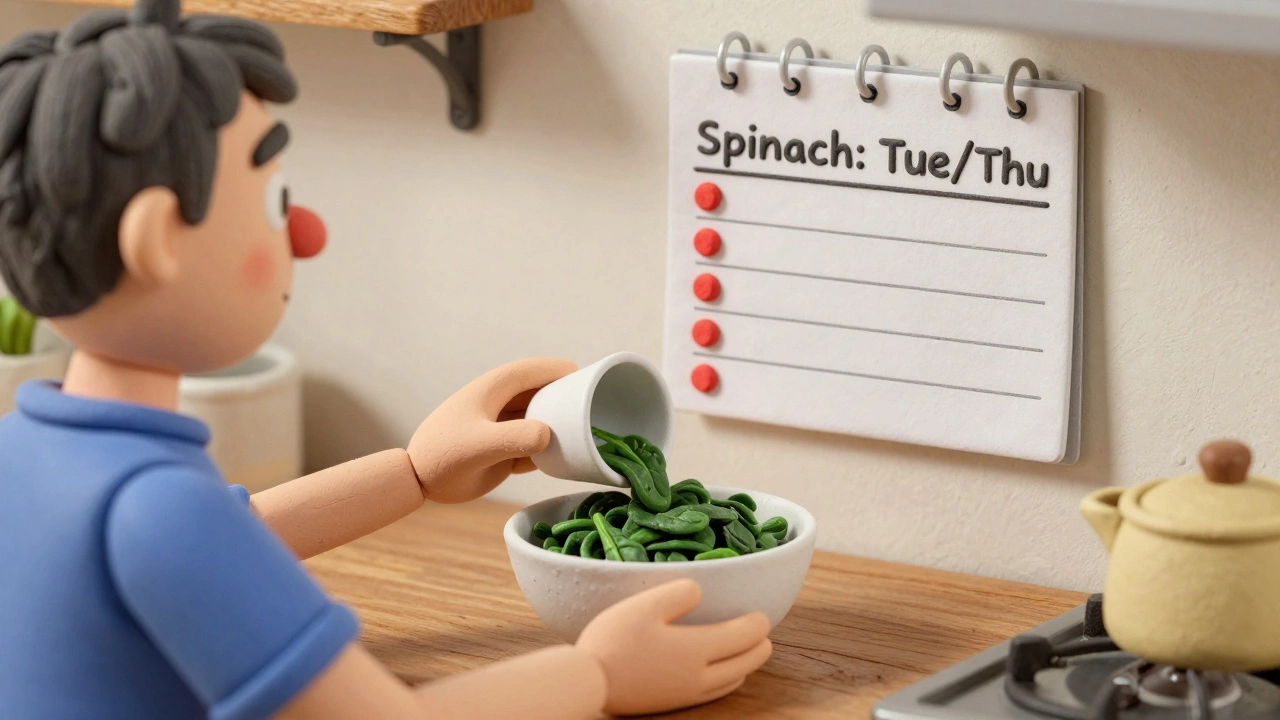
One patient in the Stop the Clot registry kept her INR stable for eight years by eating exactly two cups of cooked spinach every Tuesday and Thursday. No more. No less. She didn’t avoid it. She scheduled it.
What Happens When You Don’t Stay Consistent?
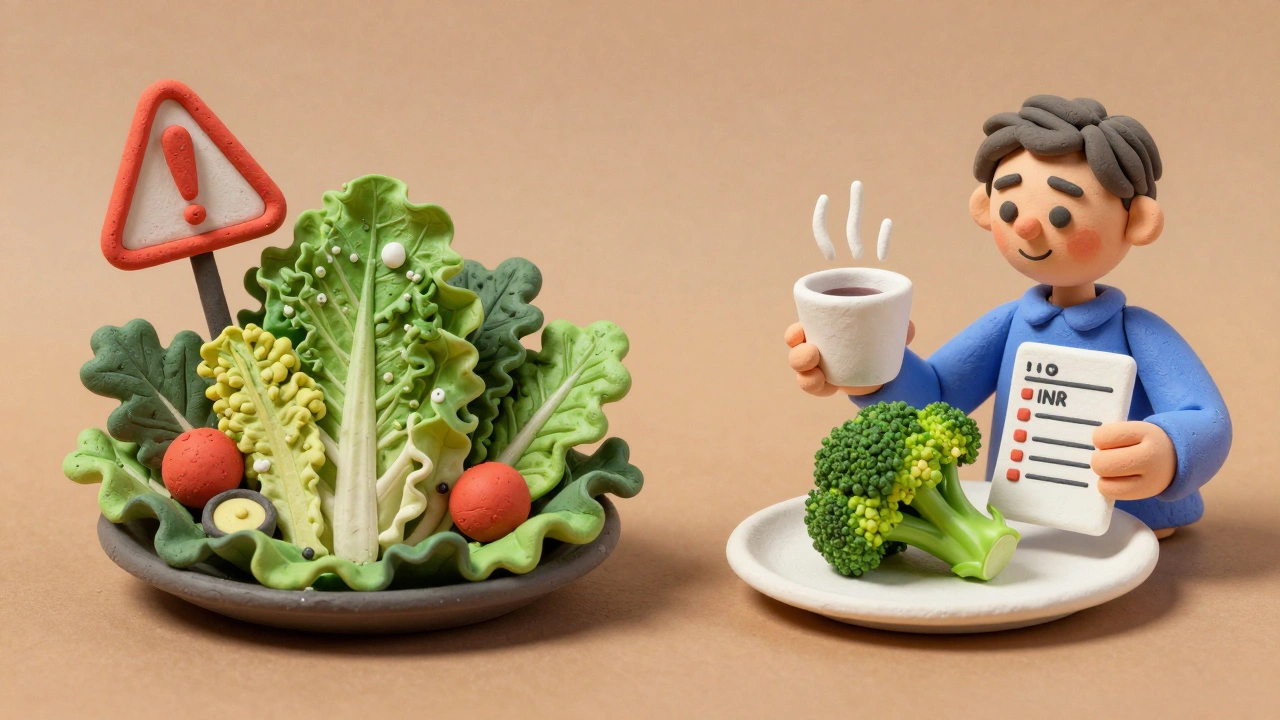
Real stories show how quickly things can go off track.A Reddit user reported his INR dropped from 2.8 to 1.9 after eating kale salads for three days straight during a cleanse. His doctor had to increase his warfarin dose by 15% to get back to safety. Another person switched to a vegan diet full of greens and ended up in the ER with a blood clot because his INR had fallen too low.
On the other side, someone who suddenly stopped eating greens after a hospital stay saw their INR jump from 2.5 to 5.1. They started bleeding from their gums and had nosebleeds. That’s a sign your blood is too thin. Too much warfarin, not enough vitamin K.
These aren’t rare cases. A survey of over 1,200 warfarin users found that 68% struggled with seasonal changes in produce availability. 45% had INR issues after starting a “healthy eating” plan packed with leafy greens. 32% had trouble with restaurant meals-because no one tells you how much kale is in that “healthy bowl.”
How to Keep Your Vitamin K Intake Steady
You don’t need to be a nutritionist. You just need a simple system.- Track your usual intake. For one week, write down how much vitamin K-rich food you eat. Use measuring cups. Don’t guess. If you eat one cup of cooked spinach three times a week, that’s your new normal.
- Stick to it. Eat the same amount every week. If you usually have spinach on Tuesdays and Thursdays, keep doing that. If you skip a day, make up for it the next day-not with a giant salad, but with the same portion you normally eat.
- Use the same brands and preparation methods. Cooking spinach reduces its volume but concentrates vitamin K. Raw vs. cooked matters. Frozen vs. fresh can vary. Pick one way and stick with it.
- Be careful with supplements. If you take a multivitamin, make sure it has the same amount of vitamin K every day. Some brands change their formulas. Check the label.
- Ask your dietitian. A registered dietitian who knows anticoagulation can help you build a meal plan that fits your life. Patients who work with one have 85% of their INR tests in range, compared to 65% with standard advice.
What About Eating Out or Traveling?
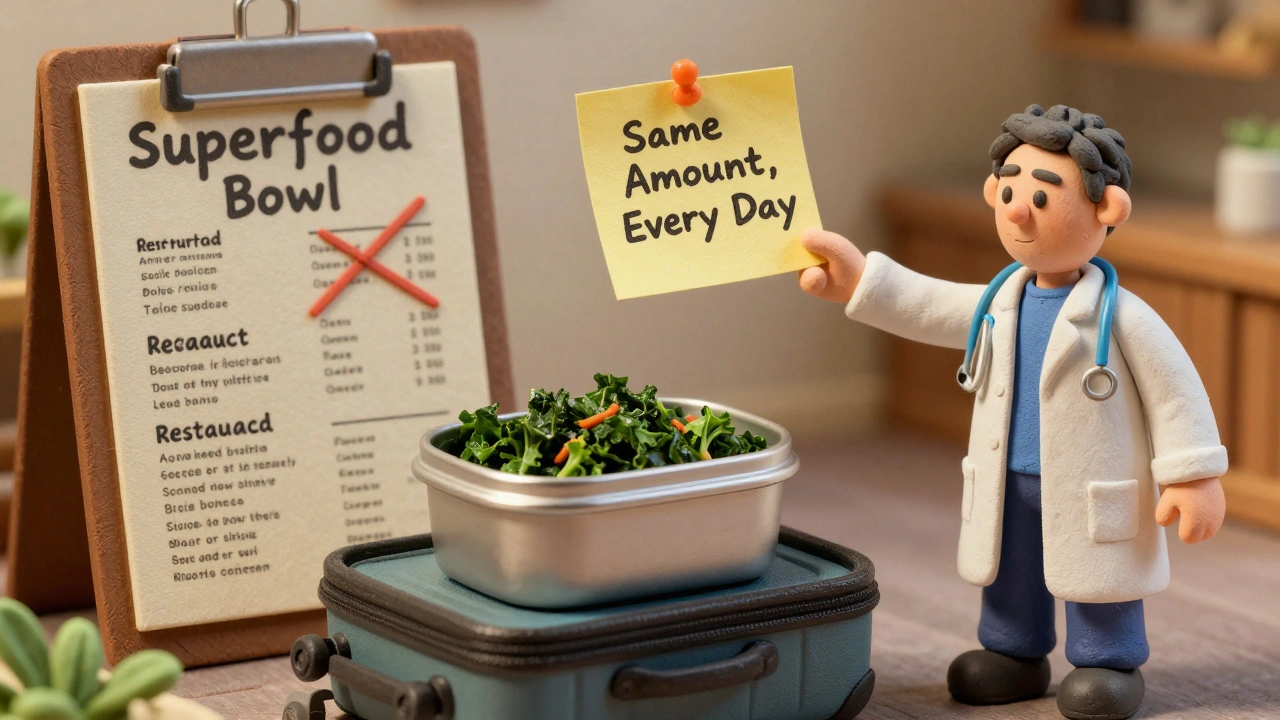
Restaurants are tricky. A “kale salad” could have 50 mcg or 500 mcg of vitamin K depending on the chef. When you’re eating out:- Ask for dressing on the side-oils like soybean or canola add vitamin K.
- Choose steamed or sautéed veggies instead of raw if you’re unsure of the portion.
- Stick to foods you know. If you usually eat chicken and rice, order that. Don’t try the “superfood bowl” unless you’re ready to adjust your warfarin dose.
Traveling? Pack your own spinach or kale if you can. Or plan ahead: if you’re going to eat more greens on vacation, tell your doctor. They might adjust your dose temporarily. Don’t wing it.
When to Call Your Doctor
You don’t need to panic over every salad. But if you:- Eat more than double your usual amount of vitamin K-rich food in one day
- Go a week without any leafy greens after eating them daily
- Start a new supplement, herbal tea, or diet plan
- Feel unusual bruising, bleeding, or dizziness
Call your anticoagulation clinic. They might want to check your INR sooner. If you eat a huge amount of vitamin K (like a big bowl of kale), your doctor might suggest increasing your warfarin dose by 10-20% the next day-but only under their guidance.
And if your INR goes above 10? That’s an emergency. Doctors can give you a small dose of vitamin K to bring it down quickly. But that’s not something you should try at home.
What About New Blood Thinners?
There are newer anticoagulants like apixaban (Eliquis), rivaroxaban (Xarelto), and dabigatran (Pradaxa). These don’t interact with vitamin K the way warfarin does. That’s why many people switch.But warfarin is still widely used because it’s cheap ($4-$30 a month), reversible if needed, and works well for people with mechanical heart valves or certain types of clots. If you’re on warfarin, you’re not behind. You’re just playing a different game-one where consistency is your best tool.
Bottom Line: Your Plate, Your Control
The CDC says it best: “It’s up to you to decide how much vitamin K you choose to eat… just keep it about the same amount each day.”You don’t have to eat a bland diet. You don’t have to give up your favorite veggies. You just need to make your intake predictable. Eat your spinach. Eat your broccoli. Just don’t eat a mountain one week and nothing the next.
Stable INR means fewer hospital visits. Fewer dose changes. Less stress. And most of all-safety.
Start today: look at your last week of meals. How much vitamin K did you eat? Now decide: what will your consistent amount be? Write it down. Stick to it. Your blood will thank you.
Can I eat kale if I’m on warfarin?
Yes, you can eat kale-but only if you eat the same amount every week. One cup of cooked kale has over 1,000 mcg of vitamin K. If you normally eat one cup twice a week, keep doing that. Don’t suddenly eat three cups a day. That can drop your INR and make warfarin less effective.
What happens if I eat too much vitamin K?
Eating too much vitamin K can make your blood clot faster, which lowers your INR. This increases your risk of stroke, heart attack, or dangerous clots. If you eat a huge amount-like a big kale salad-you may need a small warfarin dose increase. Always check with your doctor first.
Should I avoid all leafy greens on warfarin?
No. Avoiding leafy greens entirely can be just as dangerous as eating too many. The goal is consistency, not elimination. Many people stabilize their INR by eating a set amount of greens on a regular schedule. Your doctor or dietitian can help you find your balance.
How often should I get my INR tested if I change my diet?
If you make a significant change to your vitamin K intake-like starting a new diet or eating a lot more greens-you should get your INR tested within 3-5 days. Even small changes can shift your INR fast. Once you’re stable again, testing can return to every 2-4 weeks.
Can I take a vitamin K supplement while on warfarin?
Only if your doctor approves it-and even then, you must take the same dose every day. Supplements can vary in vitamin K content between brands and batches. If you take one, stick to the same brand and dose. Never start or stop a supplement without talking to your care team.
Does cooking affect vitamin K levels in food?
Yes. Cooking leafy greens like spinach or kale reduces their volume, which concentrates vitamin K. One cup of cooked spinach has far more vitamin K than one cup of raw spinach. If you switch from raw to cooked-or vice versa-your intake changes. Choose one method and stick with it.
Is it safe to drink green tea while on warfarin?
Yes, but keep your intake consistent. One serving of green tea contains 41-88 mcg of vitamin K. If you drink two cups daily, keep doing that. Don’t suddenly switch to five cups a day. That could lower your INR. Also, avoid herbal teas like ginseng or green tea extract supplements-they can interfere with warfarin more than regular tea.
Can I switch from warfarin to a newer blood thinner to avoid diet restrictions?
Some people do switch to newer anticoagulants like Eliquis or Xarelto because they don’t interact with vitamin K. But warfarin is still preferred for certain conditions, like mechanical heart valves. It’s also much cheaper. Talk to your doctor about whether switching is right for you-it’s not always an option.
Inna Borovik
December 6, 2025 AT 21:03Okay but let’s be real - most people can’t even track their coffee intake, let alone micrograms of vitamin K. I’ve been on warfarin for 7 years and I just eat one cup of spinach every Tuesday. No measuring. No apps. No panic. If my INR’s off, I adjust the dose with my doc, not my salad. Consistency doesn’t mean perfection, it means showing up.
Also, why do people think ‘healthy’ means ‘more kale’? That’s not nutrition, that’s virtue signaling.
Stop treating your diet like a biohacking experiment. Just eat the same damn thing every week.
Rashmi Gupta
December 8, 2025 AT 04:56Interesting how this post frames vitamin K as the enemy. What if the real issue is warfarin itself? Why are we still using a drug from the 1940s that requires you to become a human spectrophotometer just to eat a salad? Modern anticoagulants exist. They’re expensive, sure - but so is your ER visit when your INR spikes because you had a bad week with broccoli.
Maybe the real solution isn’t discipline. Maybe it’s upgrading the medication.
Andrew Frazier
December 8, 2025 AT 18:59LOL. You people are so weak. Back in my day we didn’t need no fancy diet plans. We took warfarin and ate what we wanted. If you’re too scared to eat greens, maybe you shouldn’t be on blood thinners at all. This is America. You want to live? Eat the spinach. Don’t whine about it.
Also, who the hell writes 1500 words about kale? Get a life.
Gwyneth Agnes
December 9, 2025 AT 08:09Consistency is the only rule. No more. No less.
Spinach. Tuesdays. Thursdays. One cup. Cooked.
That’s it.
Stop overthinking.
Just do it.
Katie O'Connell
December 9, 2025 AT 20:51While the article presents a clinically sound framework for dietary management in anticoagulation therapy, I find the casual tone and lack of citation to primary literature (e.g., randomized controlled trials on vitamin K variability) somewhat undermines its authority. The British Journal of Clinical Pharmacology reference is appropriately cited, yet the 37% reduction in out-of-range INR from the 2019 study is presented without effect size or confidence intervals - a critical omission in evidence-based communication.
Moreover, the assumption that patients can reliably self-monitor micronutrient intake without quantitative tools is, in my view, optimistic. A recent meta-analysis in the Journal of Thrombosis and Haemostasis (2023) demonstrated that digital dietary logging improved INR stability by 22% compared to verbal recall alone. Perhaps integrating such tools into standard care should be the next logical step.
Brooke Evers
December 11, 2025 AT 03:48I just want to say how much I appreciate this post. I’ve been on warfarin for 12 years and I used to stress out every time I ate out or traveled. Then I started keeping a little notebook - just one page a week. I write down what greens I ate and how much. I don’t need to be perfect. I just need to be predictable. My INR has been stable for over three years now.
And honestly? It’s not about restriction. It’s about freedom. When you know what works, you can enjoy your food without fear. I still eat kale. I still have green tea. I just do it the same way every week. And that’s enough.
If you’re struggling - you’re not alone. Talk to your anticoagulation clinic. They’ve seen it all. And they’re there to help, not judge. You’ve got this.
Saketh Sai Rachapudi
December 12, 2025 AT 19:01India has been eating dal and spinach for centuries and nobody dies from INR spikes. Why is this even a problem? Western medicine overcomplicates everything. We don’t need apps or measuring cups. We just eat. My uncle has been on warfarin since 2005 and he eats 2 bowls of saag every week. His INR is fine. Stop making it a science project.
Also, green tea? It’s just tea. Drink it. Stop overthinking.
Nigel ntini
December 14, 2025 AT 10:19This is one of the clearest, most compassionate explanations of warfarin and diet I’ve ever read. Thank you.
It’s not about fear. It’s about rhythm. Like a musician tuning their instrument - you don’t change the strings every day. You find the note that works, and you return to it.
For anyone reading this and feeling overwhelmed - start small. Pick one food. One day a week. Just keep it the same. Then add another. You don’t have to do it all at once. Progress, not perfection.
And if you’re lucky enough to have a dietitian who understands anticoagulation - hold onto them. They’re rare, and they’re gold.
pallavi khushwani
December 15, 2025 AT 05:59It’s funny how we treat food like a math problem when it’s supposed to be nourishment. I used to stress about every leaf of spinach like it was a bomb. Then I realized - my body doesn’t care if I ate 85mcg or 92mcg. It cares if I’m eating regularly, calmly, without guilt.
My grandma used to say: ‘Eat what you love, eat it often, but don’t chase extremes.’ That’s the wisdom here.
Warfarin isn’t the enemy. Fear is.
Just eat. Just be. Just stay steady.
Dan Cole
December 15, 2025 AT 21:11Let’s cut through the noise. This entire post is a glorified corporate pamphlet from Big Pharma’s warfarin division. Why? Because if everyone switched to Eliquis, the profit margins collapse. Warfarin is cheap. Warfarin is old. Warfarin is profitable because it requires constant monitoring - and monitoring means more lab visits, more doctor appointments, more prescriptions.
The ‘consistency’ narrative? It’s not about safety. It’s about sustaining a broken system.
Ask yourself: why are we still using a drug that was developed during the Great Depression? And why are we being told to eat the same damn kale every Tuesday like it’s a religious ritual?
Wake up. This isn’t medicine. It’s a business model.
Jackie Petersen
December 17, 2025 AT 12:12So… you’re telling me I can’t have my ‘superfood smoothie’ anymore? But it’s got kale, spinach, chard, matcha, and spirulina. That’s like 5000 mcg of vitamin K. My INR’s been fine for years. You think the government is hiding something? What if vitamin K isn’t the problem? What if it’s the warfarin? What if the real villain is the FDA’s outdated guidelines?
Also - who says I have to eat the same thing every week? Maybe my body likes variation. Maybe it’s adaptive. Maybe you’re all just sheep following a diet cult.
Geraldine Trainer-Cooper
December 19, 2025 AT 06:54Just eat the same amount of greens every week
That’s it
No apps
No measuring
No guilt
Just consistency
Done
Kenny Pakade
December 21, 2025 AT 04:28Yeah right. Like anyone actually remembers how much spinach they ate last Tuesday. This is just a way for doctors to make you feel guilty so you keep coming back. I eat what I want. My INR’s fine. If it’s not, I’ll just take more warfarin. Simple. Why make food a prison?
olive ashley
December 21, 2025 AT 06:07So… you’re telling me I can’t eat raw kale for breakfast, sautéed spinach for lunch, and a green tea latte after work? And I have to do it the same way every week? What if I want to change? What if I’m tired of kale? What if I’m not a robot? What if my body’s different? What if this whole thing is a scam to sell diet books?
Also - I heard vitamin K is a government mind-control additive. Just saying.