
Variceal Bleeding: How Banding, Beta-Blockers, and Prevention Save Lives
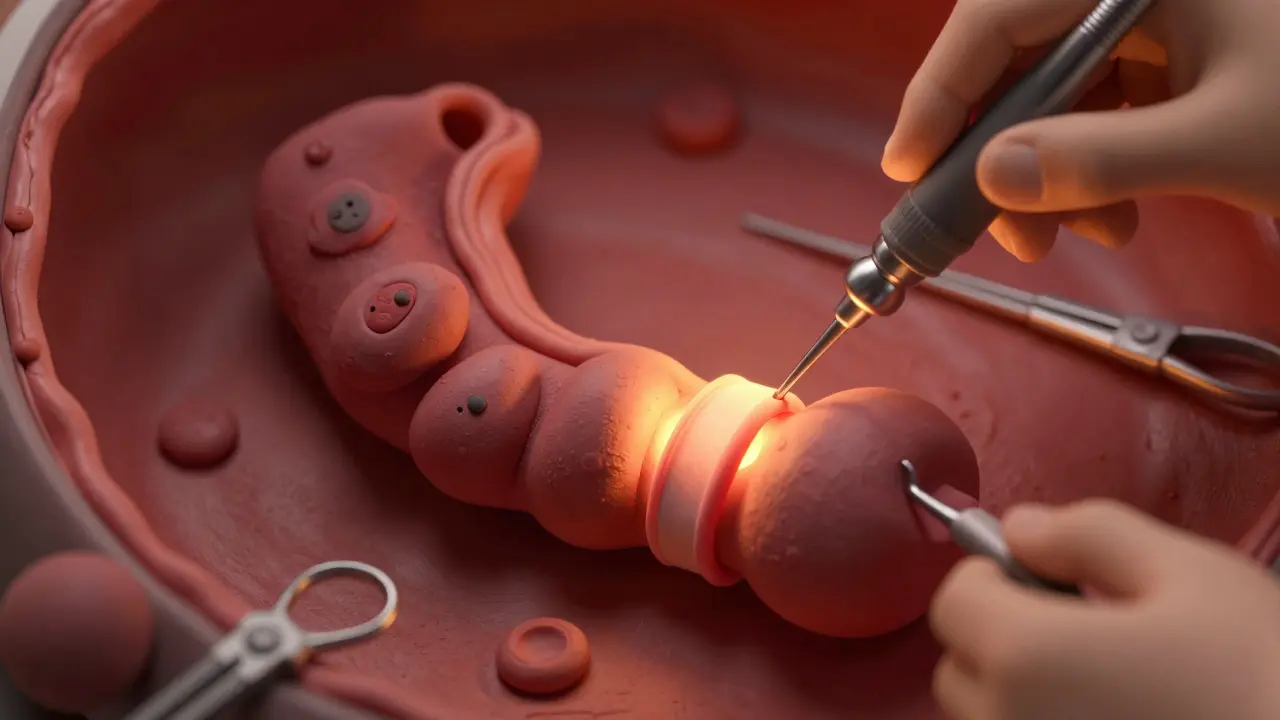
When your liver is damaged by cirrhosis, pressure builds up in the portal vein - the main blood vessel that carries blood from your gut to your liver. When that pressure hits 12 mmHg or higher, the veins in your esophagus or stomach swell like balloons, becoming varices. These aren’t just swollen veins. They’re ticking time bombs. If one ruptures, you can bleed out internally in minutes. This is variceal bleeding, and it kills 15-20% of people within six weeks. But it doesn’t have to. With the right combination of banding, beta-blockers, and prevention, survival rates jump dramatically.
What Happens During a Variceal Bleed?
It starts quietly. Most people with cirrhosis don’t feel anything until the bleeding starts. Then, symptoms hit fast: vomiting bright red blood, passing black, tarry stools, dizziness, rapid heartbeat. The body goes into shock. This isn’t a slow decline - it’s an emergency. Every minute counts.
Why does this happen? Cirrhosis scars the liver. That scar tissue blocks blood flow. Blood backs up. The pressure forces blood into smaller, weaker veins - the varices. These veins aren’t built to handle high pressure. They’re thin-walled and stretchy. When they burst, they bleed hard and fast. Without intervention, death is likely.
Endoscopic Band Ligation: The Gold Standard
For decades, doctors used chemicals to burn varices shut - a method called sclerotherapy. It worked, but it had risks: strictures, ulcers, infections. Then, in the mid-2000s, endoscopic band ligation (EBL) became the new standard. And it changed everything.
EBL uses a special endoscope with a tiny device that places rubber bands around the swollen veins. The band cuts off blood flow. The vein withers, scars, and disappears. No burning. No chemicals. Just physics.
Success rates? Around 90-95% at stopping active bleeding. The procedure must happen within 12 hours of arrival at the hospital - that’s the rule. Delay it, and mortality climbs. High-definition endoscopes and multi-band devices like the Boston Scientific Six-Shot system now let doctors place up to eight bands in one go, cutting procedure time by over a third.
But it’s not perfect. In massive bleeds, blood can obscure the view. In those cases, banding fails 10-15% of the time. Patients often need three to four sessions, spaced one or two weeks apart, to fully eliminate the varices. Each session costs between $1,200 and $1,800 in the U.S. But for many, it’s the difference between life and death.
Beta-Blockers: The Silent Shield
Band ligation stops the bleeding - but it doesn’t stop the pressure that caused it. That’s where non-selective beta-blockers (NSBBs) come in. Two drugs dominate: propranolol and carvedilol.
They work by slowing the heart and reducing blood flow to the liver. Less flow = less pressure. That’s it. Simple. But powerful.
Propranolol starts at 20 mg twice daily. It can be increased up to 160 mg a day. Carvedilol, a newer option, starts at 6.25 mg and can go up to 12.5 mg daily. Carvedilol reduces portal pressure more - about 22% versus 15% with propranolol. That’s why it’s now preferred for primary prevention in high-risk patients.
Both cut rebleeding risk by about half. But side effects are real. Fatigue. Dizziness. Low heart rate. About one in four patients can’t tolerate the dose needed to work. One Reddit user wrote, “Propranolol made me so tired I couldn’t get out of bed.” Switching to carvedilol helped - but it cost $35 a month. For people on fixed incomes, that’s a barrier.
Important note: NSBBs are NOT used alone to stop active bleeding. They’re for prevention - before the first bleed, or after to stop another. The European Association for the Study of the Liver says NSBBs alone stop bleeding in only 50-60% of cases. Combine them with banding? You’re looking at 90%+ success.

When Banding Isn’t Enough
Not all varices are the same. Esophageal varices respond well to banding. Gastric varices? Not so much. When bleeding comes from the stomach, banding alone fails more often. That’s where balloon-occluded retrograde transvenous obliteration (BRTO) steps in. It’s a catheter-based procedure that plugs the vein and injects glue to seal it. Studies show 30-day mortality drops from 6.2% with banding alone to 2.8% when BRTO is added.
Then there’s TIPS - transjugular intrahepatic portosystemic shunt. This is a metal mesh tube inserted through the liver to create a shortcut for blood, bypassing the high-pressure zone. It’s powerful. In high-risk patients (Child-Pugh C or active bleeding with Child-Pugh B), TIPS boosts one-year survival from 61% to 86%.
But it has a dark side: hepatic encephalopathy. Up to 30% of patients develop brain fog, confusion, even coma. It happens because toxins from the gut now bypass the liver entirely. TIPS isn’t for everyone. Only 45% of U.S. hospitals have the teams to do it within 24 hours. It’s a specialist’s tool.
Prevention: The Real Game-Changer
Most people don’t realize it, but the best treatment for variceal bleeding is preventing it before it ever starts.
For patients with cirrhosis and medium-to-large varices - even if they’ve never bled - doctors now recommend starting NSBBs early. Carvedilol is increasingly the first choice. Studies show it’s as effective as banding at preventing the first bleed, with fewer procedures and less discomfort.
For those who’ve already bled, the combo of NSBBs + banding is standard. Repeat banding every few weeks until the varices are gone. Keep the beta-blocker going indefinitely. Many patients stay on them for life.
But prevention isn’t just drugs and procedures. It’s lifestyle. No alcohol. No NSAIDs like ibuprofen. A low-sodium diet. Regular monitoring. Avoiding constipation (straining raises pressure). All of it matters.
And yet, 65% of patients still rebleed within a year. Why? Missed appointments. Poor adherence. Side effects. Financial strain. The system isn’t perfect.

What’s Next?
The future is getting smarter. In 2023, the FDA approved a monthly version of octreotide - a vasoactive drug that tightens blood vessels. It’s a game-changer for patients who can’t tolerate beta-blockers.
AI is being tested to predict who’s at highest risk of bleeding. One study suggests algorithms using liver scans, lab values, and blood pressure trends could spot danger weeks before it happens.
And new TIPS techniques - like percutaneous transsplenic access - could make the procedure available in 75% of U.S. hospitals by 2027, up from 45% today. That means faster care, more lives saved.
But the biggest challenge isn’t technology. It’s access. Uninsured patients have a 35% higher death rate than those with insurance. Rural areas lack endoscopists. Low-income patients can’t afford carvedilol. These aren’t medical problems - they’re social ones.
What You Need to Remember
- If you have cirrhosis, get screened for varices - even if you feel fine.
- Band ligation stops active bleeding faster than any drug. Time is critical - do it within 12 hours.
- Beta-blockers prevent rebleeding. Carvedilol is more effective than propranolol, but cost and side effects matter.
- For gastric varices or high-risk cases, TIPS or BRTO may be needed.
- Prevention works. Don’t wait for a bleed to start treatment.
- Adherence saves lives. Skipping doses or appointments increases your risk of dying.
Variceal bleeding is brutal. But it’s not inevitable. With the right tools, the right timing, and the right support, people survive - and live.
Richard Harris
March 13, 2026 AT 06:42Adam M
March 14, 2026 AT 07:40Elsa Rodriguez
March 15, 2026 AT 07:40Serena Petrie
March 15, 2026 AT 15:21Sally Lloyd
March 16, 2026 AT 08:53Aaron Leib
March 17, 2026 AT 20:22Amisha Patel
March 18, 2026 AT 13:08mir yasir
March 19, 2026 AT 02:00tamilan Nadar
March 19, 2026 AT 16:08Buddy Nataatmadja
March 21, 2026 AT 07:48