
Understanding Controlled Substance Labels and Schedule Codes
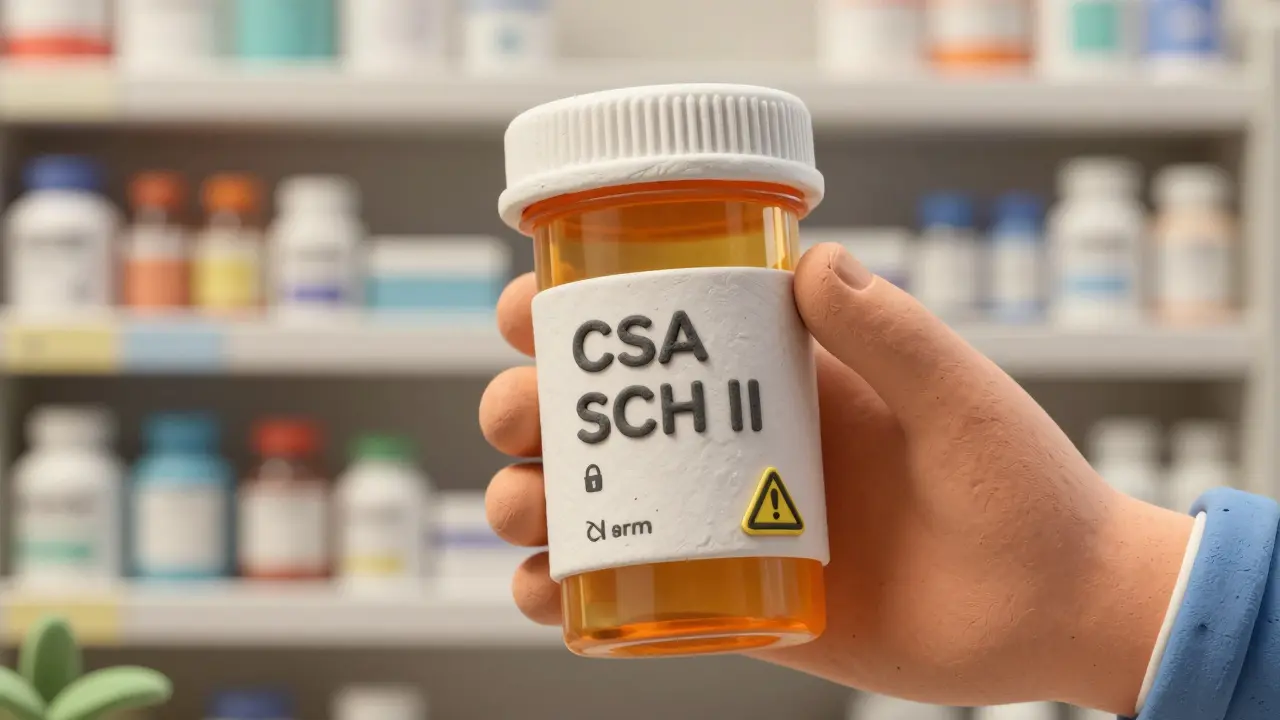
When you pick up a prescription at the pharmacy, the label on the bottle might look like any other. But if it’s a controlled substance, that label carries legal weight-and the tiny print holds critical information about how the drug is regulated, how many times you can refill it, and even how the pharmacy must store it. Understanding controlled substance labels and their Schedule codes isn’t just for doctors and pharmacists. It matters to anyone who takes medication for pain, anxiety, sleep, or ADHD.
What Are Controlled Substances?
Not every prescription drug is controlled. Aspirin? Not controlled. Antibiotics? Not controlled. But opioids like oxycodone, benzodiazepines like Xanax, stimulants like Adderall, and even some cough syrups with codeine? Those are controlled substances. They’re regulated under the U.S. Controlled Substances Act (CSA), a federal law passed in 1970. The goal? To prevent abuse while still letting patients access needed medications. The CSA doesn’t just ban drugs. It sorts them into five categories-called Schedules-based on three things: how likely they are to be abused, how addictive they are, and whether they have any accepted medical use. The Drug Enforcement Administration (DEA) manages this system, and every controlled substance gets a unique code number. That number shows up on pharmacy labels and in electronic prescribing systems.The Five Schedules Explained
Each Schedule has different rules. Here’s what they mean in plain terms:- Schedule I: No medical use. High abuse potential. Examples: heroin, LSD, marijuana (under federal law). These can’t be prescribed. Period.
- Schedule II: High abuse potential, but accepted medical use. These are the strongest painkillers and stimulants. Examples: oxycodone, fentanyl, morphine, Adderall, Ritalin. You can’t refill these. Each prescription is good for one fill only. The prescription must be written on special tamper-resistant paper in most states, or sent electronically with strict digital security.
- Schedule III: Moderate to low abuse potential. Medical use is clear. Examples: hydrocodone with acetaminophen (Vicodin), ketamine, anabolic steroids, tramadol. You can refill these up to five times in six months. Electronic prescriptions are allowed.
- Schedule IV: Low abuse potential. Examples: Xanax, Valium, Ambien, Soma. Same refill rules as Schedule III: five refills in six months. Most are prescribed electronically now.
- Schedule V: Lowest abuse potential. Often found in cough syrups or anti-diarrheal meds with tiny amounts of codeine or diphenoxylate. Some can be bought over-the-counter with pharmacist approval. Refills are usually allowed without limits.
Here’s the catch: the same drug can be in different Schedules depending on how it’s made. Codeine is a good example. Pure codeine? Schedule II. Codeine mixed with acetaminophen in a 15mg tablet? Schedule III. Codeine in a cough syrup with only 1.5mg per 5ml? Schedule V. That’s why the label must list the exact strength and formulation.
What’s on the Label? The Hidden Rules
A controlled substance label doesn’t just say “take one pill daily.” It includes legal requirements:- The DEA registration number of the prescribing doctor (starts with two letters, then six or seven numbers).
- The Schedule code: “CSA SCH II” or “CSA SCH IV.”
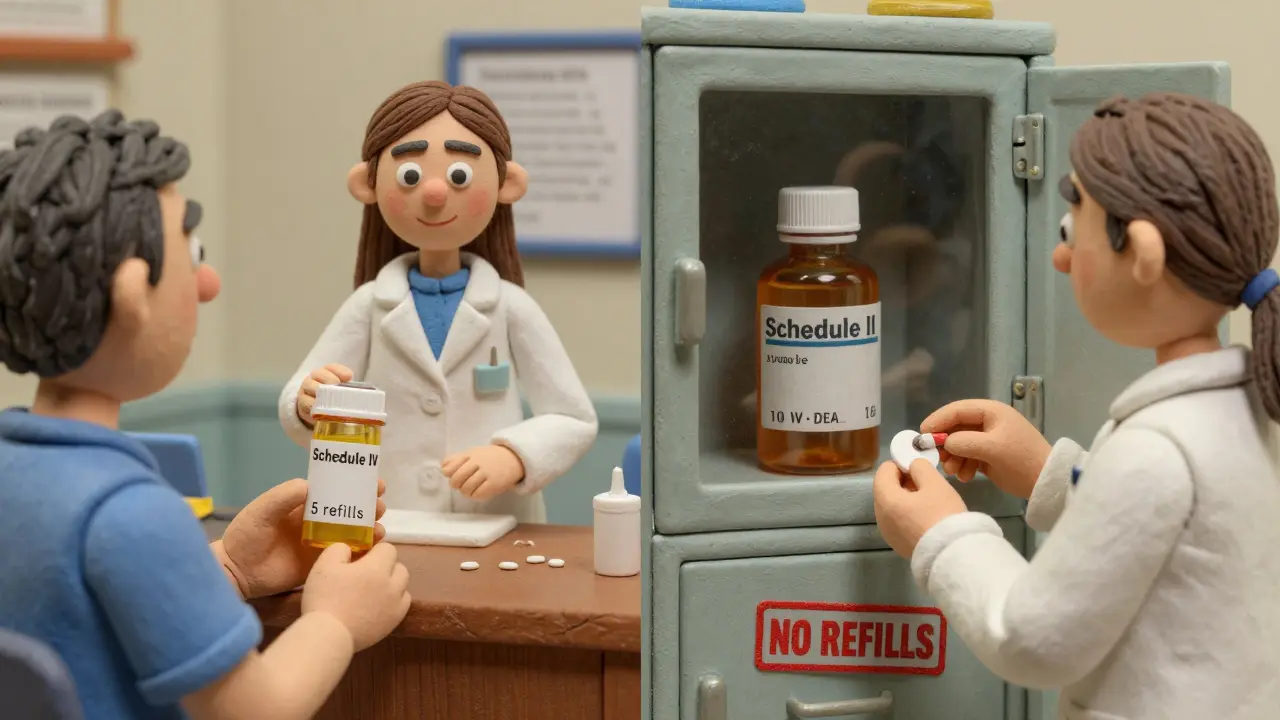
- Refill limits: “No refills” for Schedule II. “Refills: 5” for Schedule III or IV.
- A warning: “Federal law prohibits transferring this medication to another person.”
- Pharmacy-specific controls: “Store at room temperature. Keep away from children.” Some pharmacies even place Schedule II meds behind the counter in locked cabinets.
For Schedule II drugs, the original prescription must be physically signed by the prescriber. Electronic prescriptions are allowed, but they must meet strict DEA standards. In 47 states, you still need a paper copy for Schedule II-no email or text messages accepted. Pharmacists check the DEA number against their database before filling. If it’s invalid or expired, they won’t dispense the drug.
Why This System Exists-and Why It’s Controversial
The DEA says the system works. It tracks who’s prescribing, who’s dispensing, and how much is moving through the system. In 2022, pharmacists reported that Schedule III and IV drugs made up 92.7% of all controlled substance prescriptions filled. Hydrocodone combinations were the most common. That’s because they’re effective for moderate pain and less tightly restricted than Schedule II opioids. But the system has big flaws. Cannabis is still Schedule I under federal law-even though 38 states allow medical use. That creates legal confusion. A patient in California can legally use medical marijuana, but their doctor can’t prescribe it under federal rules. Pharmacies can’t legally stock it. Insurance won’t cover it. Experts are pushing for change. In August 2023, the Department of Health and Human Services recommended moving cannabis to Schedule III. If that happens, it would be the first major shift since 1970. That could open the door for insurance coverage, research, and legal pharmacy sales. Another issue? The system doesn’t always match the science. Some Schedule IV drugs, like benzodiazepines, carry high risks of dependence and withdrawal-even more than some Schedule III drugs. Meanwhile, drugs like tramadol (Schedule IV) are less addictive than many people think. Critics say the labels give false impressions. “People see ‘Schedule II’ and think it’s the most dangerous,” says a pharmacist in Ohio. “But some Schedule IV drugs are just as risky if misused long-term.”What You Need to Know as a Patient
If you’re taking a controlled substance:- Check the Schedule on the label. If it says “CSA SCH II,” you can’t refill it. You’ll need a new prescription every time.
- Never share your medication. Federal law says it’s a crime-even if you’re helping a friend with pain.
- Store it safely. Keep Schedule II and III drugs locked up, especially if kids or teens are in the house.
- Ask your pharmacist if you’re unsure. They can explain the refill rules and warn you about interactions.
- Don’t assume a higher Schedule means “stronger.” Schedule II drugs are more tightly controlled, not necessarily more powerful. A 10mg oxycodone tablet (Schedule II) might be stronger than a 50mg tramadol (Schedule IV), but it’s the risk of addiction that drives the classification.
Prescribers are under pressure too. One oncology nurse says processing a Schedule II prescription takes 15 minutes longer than a regular one-just to verify DEA numbers, check for duplicate fills, and document everything. That’s why some doctors avoid prescribing them, even when medically appropriate.
What’s Changing in 2026?
The DEA’s 2023 Strategic Plan aims to cut the time it takes to reschedule a drug from 24 months to 12 months by 2025. That’s a big deal. In recent years, they’ve fast-tracked emergency scheduling for new synthetic drugs like fentanyl analogs-adding 17 to Schedule I between 2022 and 2023. The biggest change coming? Cannabis. If it moves to Schedule III in 2026, it will reshape how millions of patients access it. Doctors could prescribe it. Pharmacies could stock it. Insurance might pay for it. That would be the most significant shift in U.S. drug policy in over 50 years.Final Thoughts
Controlled substance labels aren’t just paperwork. They’re the bridge between science, law, and patient care. The Schedule code tells you how risky the drug is-and how much the government trusts you to use it responsibly. It’s a system built to prevent abuse, but it’s also a system that’s outdated in places. Knowing what the labels mean helps you ask better questions. It helps you avoid mistakes. And it gives you power-because when you understand the rules, you can navigate them safely.What does it mean if my prescription says ‘CSA SCH II’?
It means your medication is a Schedule II controlled substance-like oxycodone, fentanyl, or Adderall. These drugs have a high risk of addiction and no refills are allowed. You must get a new, signed prescription from your doctor each time you need a refill. The pharmacy must verify your doctor’s DEA number before filling it. In most states, the prescription must be on special paper or sent electronically with strict security.
Can I get a Schedule II drug without a prescription?
No. Schedule II drugs cannot be sold over-the-counter under any circumstances. Even if you’ve taken them before, you need a new, valid prescription from a licensed prescriber with a DEA registration number. Attempting to obtain one without a prescription is illegal and can lead to criminal charges.
Why is marijuana still Schedule I if it’s legal in my state?
Marijuana is classified as Schedule I under federal law, meaning it’s considered to have no accepted medical use and high abuse potential. But individual states can pass their own laws allowing medical or recreational use. This creates a conflict: you can legally use it in your state, but federal law still treats it as illegal. That’s why banks won’t work with marijuana businesses, and why federal employees can’t use it-even if it’s legal where they live.
Can a pharmacist refuse to fill a controlled substance prescription?
Yes. Pharmacists are legally allowed to refuse to fill a controlled substance if they believe it’s fraudulent, inappropriate, or unsafe. Common reasons include: an expired DEA number, a prescription that looks forged, a patient requesting refills too soon, or signs of drug-seeking behavior. They don’t need to explain why, but they must document the refusal.
What happens if I lose my Schedule II prescription?
If you lose a Schedule II prescription, you cannot get a replacement. The DEA does not allow refills or copies. You must contact your prescriber and explain the situation. They may issue a new prescription, but they are not required to do so. This rule exists to prevent fraud and diversion. Always keep your prescriptions secure.
Are over-the-counter cough syrups with codeine really controlled?
Yes. Even cough syrups with small amounts of codeine (less than 200mg per 100ml) are Schedule V controlled substances. You can buy them without a prescription in most states, but only from a pharmacist, and only a limited quantity at a time. The pharmacist must record your name and ID. This is to prevent abuse-some people have used these syrups to get high by drinking large amounts.
Jay Amparo
January 11, 2026 AT 08:16Man, I never realized how much legal junk is hidden in those tiny pharmacy labels. I’ve been taking tramadol for years and just assumed it was ‘regular’ meds. Turns out I’m on Schedule III? That explains why my doc always makes me come in every 3 months. Feels like a bureaucracy dance, but I guess it’s better than ending up like those opioid horror stories.
Also, the part about codeine changing schedules based on concentration? Mind blown. I thought it was just ‘codeine’ full stop. Now I’m gonna read every label like a detective.
Big ups to the post - this is the kind of info that actually saves people from messing up.
Lisa Cozad
January 12, 2026 AT 22:55I work in a pharmacy in Ohio and this is spot on. We get so many people mad because they can’t refill their Xanax. They think we’re being difficult. But honestly? We’re just following the law. And yeah, Schedule IV drugs can be just as dangerous if misused long-term - I’ve seen people get addicted to Ambien and think they’re fine because it’s ‘just sleep meds.’
Also, the DEA number checks? Total pain in the ass. One typo and the whole prescription gets rejected. We spend more time verifying paperwork than talking to patients.
Saumya Roy Chaudhuri
January 13, 2026 AT 11:41Let me break this down for you all - this whole Schedule system is a farce. Schedule I includes marijuana but not alcohol? Alcohol kills 100,000 people a year. Marijuana? Zero overdose deaths. The DEA is running on 1970s fear porn. And don’t get me started on how they fast-track fentanyl analogs but ignore the fact that benzodiazepines are quietly destroying lives.
Also, why is ketamine Schedule III? It’s a dissociative hallucinogen that can cause psychosis. But Adderall? Schedule II because it’s ‘stimulant’? Bro, I’ve seen kids on Adderall who are more addicted than any opioid user. This system is broken. It’s not science - it’s politics dressed up as pharmacology.
Ian Cheung
January 14, 2026 AT 07:55So I’ve got a Schedule II script for oxycodone after surgery and I lost the paper. Doc says no replacements. No emails. No texts. No nothing.
So I’m in pain. Can’t move. And the pharmacy says ‘tough luck.’
Meanwhile my cousin in Canada just texts his doctor and gets a refill in 20 minutes. Why are we stuck in the stone age? This isn’t protecting anyone. It’s just making people suffer.
Also - why does my pharmacist look at me like I’m a junkie every time I walk in? I’m not stealing. I’m just trying not to scream.
McCarthy Halverson
January 14, 2026 AT 17:18Check the label. Know the schedule. Don’t share. Store safe. That’s it.
If you’re confused ask your pharmacist. They’re trained for this. They want you to be safe.
Simple.
Jake Kelly
January 16, 2026 AT 08:46It’s wild how much trust we’re supposed to put into a tiny code on a pill bottle. Schedule II = no refills. Schedule IV = five refills. But what if I’m a chronic pain patient who needs the same dose for years? The system doesn’t account for that. It treats everyone like they’re one bad decision away from becoming a statistic.
I get the intent. But the execution feels like a sledgehammer trying to fix a broken watch.
Ashlee Montgomery
January 17, 2026 AT 03:15What does it mean when a society decides that a drug’s danger is determined by its chemical structure rather than its actual impact on human behavior?
Why does the law care more about the molecule than the context?
Is addiction a medical issue or a moral failing? The Schedule system pretends it’s the former but acts like the latter.
And if cannabis belongs in Schedule III, why not alcohol? Why not nicotine?
There’s a pattern here. It’s not about science. It’s about who we fear.
neeraj maor
January 17, 2026 AT 20:29They say Schedule II drugs can’t be refilled. But what if the DEA is lying? What if they’re using this to track you? Every time you fill a script, your name, address, doctor, and prescription details go into a federal database. They’re building a profile. And when they decide you’re ‘at risk’ - what happens next?
They take your guns. They flag your bank. They watch your kids. They call your employer.
And you think this is about safety?
It’s about control.
They did the same thing with cigarettes in the 80s. Now they’re doing it with opioids. Next? ADHD meds. Then antidepressants.
Wake up. This isn’t medicine. It’s surveillance.
Paul Bear
January 19, 2026 AT 06:19It’s worth noting that the Controlled Substances Act’s scheduling criteria are explicitly defined in 21 U.S.C. § 811(b), requiring evaluation of abuse potential, pharmacological effects, and scientific evidence of medical utility. The current classification of cannabis as Schedule I is a clear violation of these statutory criteria, given the FDA-approved cannabinoid-based therapeutics (e.g., Epidiolex) and over 30 years of peer-reviewed clinical data demonstrating therapeutic efficacy.
Furthermore, the DEA’s own administrative record from 2016 acknowledged that cannabis meets the criteria for Schedule III. The continued classification is therefore an administrative failure, not a scientific one.
Pharmacists, prescribers, and patients deserve evidence-based policy - not political expediency masquerading as regulation.
Jaqueline santos bau
January 20, 2026 AT 02:40Okay but like… why do I feel like I’m being treated like a criminal just because I need pain meds?
I had a knee surgery. Got oxycodone. Walked into the pharmacy. The pharmacist looked me up and down like I was gonna rob the place. Asked if I ‘had a good reason’ for needing it. Like I’m some kind of addict trying to score.
My grandma died of cancer and never got enough morphine because doctors were scared of ‘overprescribing.’ Now I’m getting side-eye for taking 5mg after a real surgery?
It’s not fair. And it’s not helping anyone.
Also - who decided that a person’s worth is measured by how much they can endure? I’m not a martyr. I just want to not scream when I walk.
Aurora Memo
January 20, 2026 AT 10:41I’m a nurse and I’ve seen the fear on patients’ faces when they hear ‘Schedule II.’ Like they’ve been branded. Like they’ve done something wrong.
But they haven’t. They’re just sick. They’re just in pain.
The system should protect people - not shame them.
Maybe we need labels that say ‘This is for healing’ instead of ‘This is dangerous.’
It’s not the drug. It’s the stigma.
chandra tan
January 21, 2026 AT 11:18Back in India, we don’t have this Schedule thing. You walk into any pharmacy, ask for tramadol or codeine syrup, and they hand it over. No questions. No DEA numbers. No paper.
People hoard it. Kids drink cough syrup to get high. Doctors don’t even know the difference between Schedule III and IV.
But here? You need a PhD just to get a refill.
So… which system is better?
I don’t know. But I miss the simplicity.
Dwayne Dickson
January 22, 2026 AT 02:57As a healthcare professional with over a decade of experience in clinical pharmacology, I must emphasize that the current scheduling framework, while imperfect, remains the most robust regulatory mechanism available for mitigating public health risks associated with psychoactive substances. The DEA’s classification is grounded in epidemiological data, pharmacokinetic profiles, and longitudinal abuse patterns - not anecdotal sentiment.
Moreover, the proposed rescheduling of cannabis to Schedule III, while politically expedient, introduces significant regulatory complexities regarding interstate commerce, insurance reimbursement, and pediatric exposure - none of which have been adequately modeled.
While empathy for patient suffering is warranted, policy must be guided by evidence, not emotion. The alternative - deregulation - has already been tested in jurisdictions with lax controls, and the outcomes are unambiguously deleterious.