
Thyroid Storm: Recognizing and Treating a Life-Threatening Hyperthyroidism Emergency
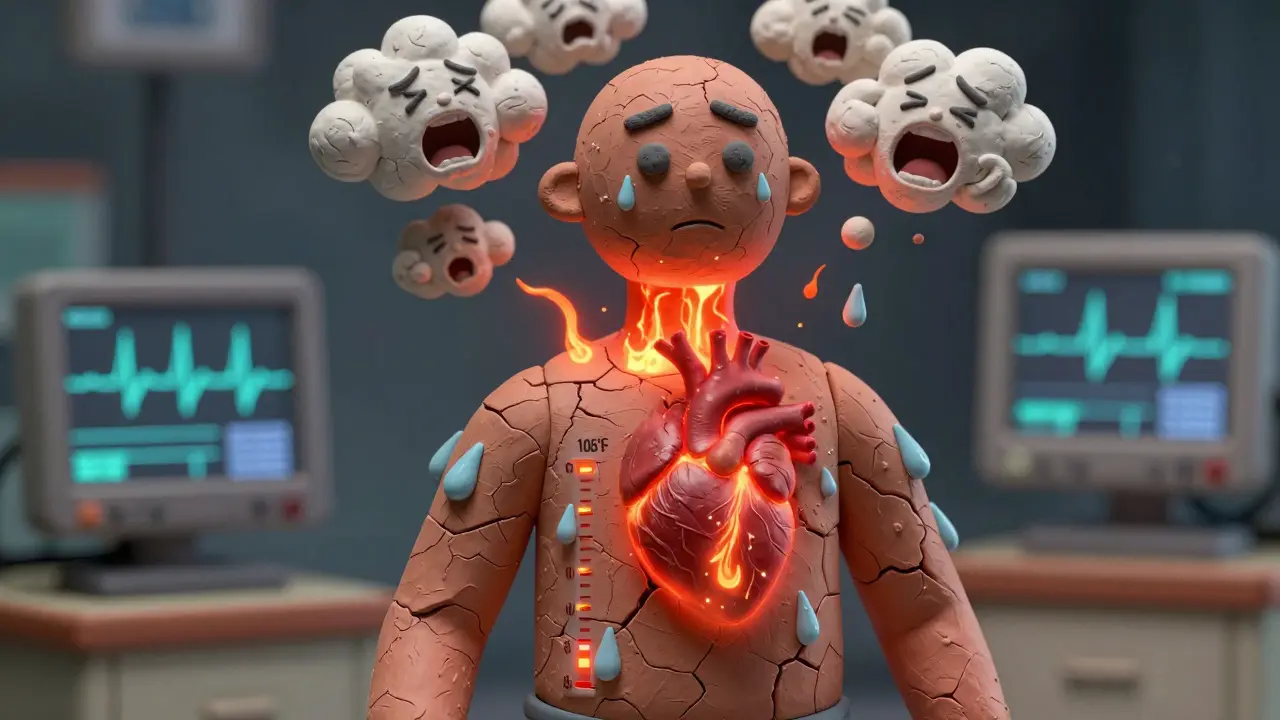
Thyroid storm isn’t just a bad day with a fast heartbeat. It’s a medical emergency that can kill you in hours if you don’t get help. Imagine your body’s metabolism going into overdrive-your heart racing at 160 beats per minute, your temperature spiking to 106°F, your mind slipping into confusion or coma. This isn’t a hypothetical scenario. It’s thyroid storm, and it happens when hyperthyroidism explodes into a full-blown crisis. Around 1 in 500 people with untreated Graves’ disease will face this. And if you don’t act fast, the odds are stacked against you.
What Exactly Is Thyroid Storm?
Thyroid storm, also called thyrotoxic crisis, is the most extreme form of hyperthyroidism. It’s not a new disease. It’s your existing thyroid condition-usually Graves’ disease-going completely off the rails. Your thyroid gland, already pumping out too much T3 and T4, suddenly releases a massive surge of hormones into your bloodstream. This isn’t a slow burn. It’s a firestorm. Your cells go into overdrive. Every organ in your body starts working too hard, too fast, and too long. That’s when systems start to fail.
Unlike regular hyperthyroidism, where symptoms creep in over weeks, thyroid storm hits in hours. One day you might feel anxious and sweaty. The next, you’re in the ICU fighting for your life. The key difference? Severity. In uncomplicated hyperthyroidism, your heart might race at 100 bpm. In thyroid storm, it hits 140 bpm or higher. Your temperature might be 100°F normally. In thyroid storm, it climbs past 104°F. And your mental state? You’re not just jittery-you’re delirious, agitated, or unconscious.
How Do Doctors Know It’s Thyroid Storm?
There’s no single test that says, “This is thyroid storm.” Instead, doctors use a checklist based on the Japan Thyroid Association’s 2012 criteria, now widely accepted in the U.S. and Europe. To diagnose it, you need two things: confirmed high thyroid hormone levels (free T4 more than 2.5 times the upper limit, T3 more than 3 times normal) plus a pattern of severe symptoms.
Here’s what they look for:
- Fever: 104°F to 106°F (40°C to 41.1°C) with heavy sweating
- Tachycardia: Heart rate over 140 bpm, often with atrial fibrillation
- CNS changes: Agitation, confusion, seizures, or coma-present in 90% of cases
- GI symptoms: Nausea, vomiting, diarrhea (50-60% of patients)
- Heart failure: Fluid backing up into lungs, low blood pressure
- Liver issues: Jaundice, bilirubin over 3 mg/dL
Doctors don’t wait for all of these. If you have high hormone levels plus fever, tachycardia, and altered mental status? That’s enough. The Burch-Wartofsky scoring system helps quantify it. A score above 45 confirms thyroid storm. Each point higher increases your risk of death by 5%.
What Triggers It?
Thyroid storm doesn’t come out of nowhere. It’s triggered by something that pushes an already unstable system over the edge. The most common trigger? Untreated or poorly controlled hyperthyroidism. About 60-70% of cases happen because someone stopped their medication, didn’t take it right, or never got diagnosed.
Other triggers include:
- Infection: Pneumonia, urinary tract infections, or even the flu can set it off (20-30% of cases)
- Trauma: Surgery, car accidents, or even a hard punch to the neck
- Stress: Severe emotional shock, stroke, or heart attack
- Diabetic ketoacidosis: A dangerous drop in insulin
- Pregnancy: Especially in the postpartum period
- Radioactive iodine therapy: Rare, but can trigger storm 1-2 weeks after treatment
It’s important to understand: if you have Graves’ disease and you get sick, hurt, or stressed-you’re at risk. That’s why doctors tell patients to never skip meds, even if they feel fine.
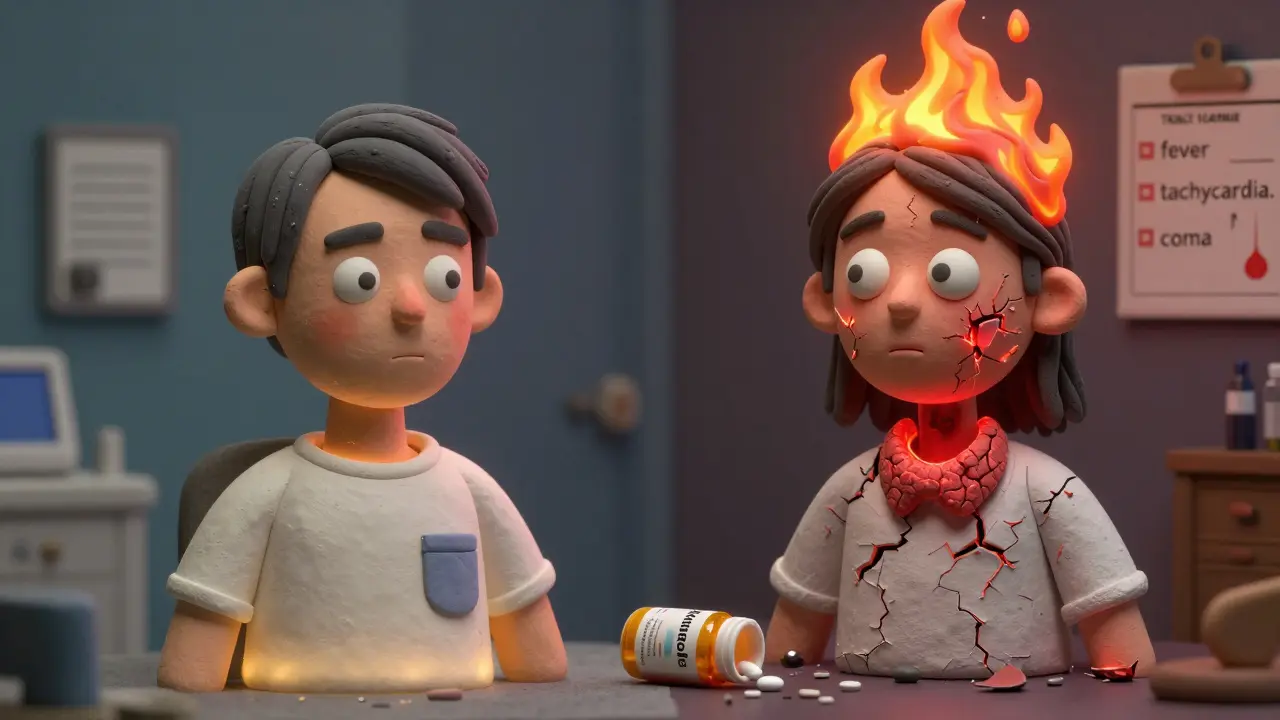
How Is It Treated in the ICU?
Time is everything. Every hour counts. The goal? Stop the hormone flood, calm the body, and support failing organs. Treatment starts within 1-2 hours of suspicion. Delay past 24 hours? Survival drops to 20%. Start within 6 hours? Survival jumps to 75-80%.
Here’s the step-by-step approach used in ICUs worldwide:
- Block hormone production: High-dose methimazole (60-80 mg) or propylthiouracil (PTU) (600-1,000 mg) are given immediately. PTU is preferred in storm because it also blocks T4-to-T3 conversion.
- Block hormone release: Potassium iodide (500 mg every 6 hours) or sodium iodide (1 g daily) is given one hour after the antithyroid drug. This stops the thyroid from dumping more hormone.
- Control heart rate: Propranolol (60-80 mg every 4-6 hours) is the go-to beta-blocker. It brings down heart rate, reduces tremors, and helps with anxiety. If the patient can’t swallow, it’s given IV-1-2 mg every 5 minutes until the heart rate drops below 140.
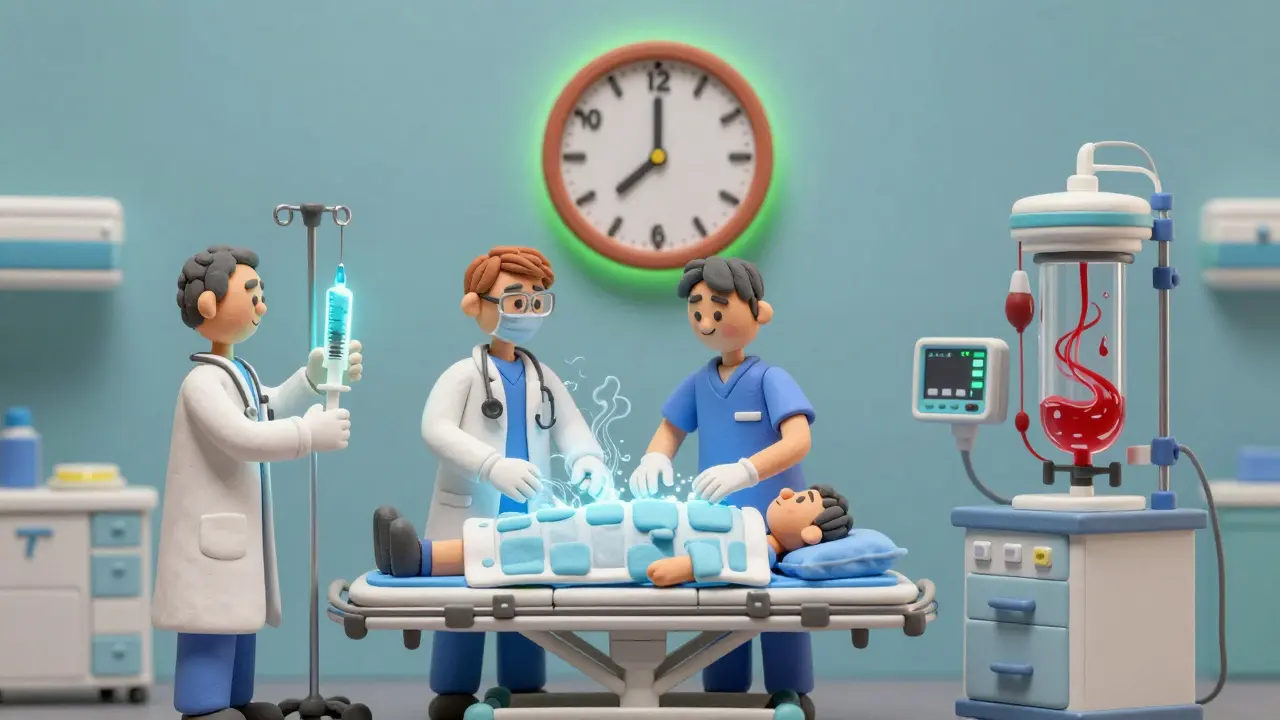
- Lower body temperature: Acetaminophen is used. NSAIDs like ibuprofen are avoided because they can worsen liver stress. Cooling blankets and ice packs are applied if the temperature hits 104°F.
- Protect the adrenal glands: Hydrocortisone (100 mg IV every 8 hours) is given. High thyroid hormones can suppress adrenal function, and this prevents a second life-threatening crisis.
- Support the body: IV fluids (2-3 liters of saline) fix dehydration. Oxygen is given. Mechanical ventilation is started if the patient is unconscious or can’t breathe on their own. Continuous heart monitoring catches dangerous rhythms like atrial fibrillation.
In the worst cases-when drugs aren’t working-doctors turn to plasmapheresis. This machine filters the blood, removing excess thyroid hormones directly. A 2021 study showed it worked in 78% of patients who didn’t respond to standard treatment. It’s not common, but it saves lives when nothing else does.
What Are the Chances of Survival?
Mortality rates have dropped from nearly 100% in the 1950s to 8-25% today. But that still means 1 in 5 people die. Why? Because it’s not just about the thyroid-it’s about what the storm does to your body.
Key red flags that mean higher risk:
- Systolic blood pressure below 90 mmHg: This means your heart can’t pump. Mortality jumps to 50%.
- Temperature above 105.8°F (41°C): This level of heat damages organs. Mortality hits 40%.
- Coma or severe CNS depression: Your brain is shutting down. Mortality is 35%.
- Age over 60: Older patients have weaker hearts and livers. Their survival rate is 30% lower than younger patients.
- Heart disease already present: If you had prior heart problems, your risk of dying is 2.3 times higher.
Survivors don’t bounce back quickly. The average ICU stay is 7.8 days. Most need mechanical ventilation for 5 days. Half need drugs to keep their blood pressure up. Recovery is slow. Agitation fades in 24-48 hours. Confusion clears in 3 days. Full mental recovery? That takes up to two weeks.
What Happens After You Survive?
Surviving thyroid storm doesn’t mean you’re done. It means you’ve been given a second chance-and you have to take it seriously.
Most survivors (85%) end up with permanent hypothyroidism. Why? Because the treatment for the underlying hyperthyroidism-radioactive iodine or surgery-is usually permanent. You’ll need lifelong thyroid hormone replacement (levothyroxine). Skipping doses? That’s how you risk another storm.
The 15% who don’t need permanent treatment are those who respond to long-term antithyroid drugs. But even then, 25-30% will have a recurrence if they miss follow-ups. That’s why regular blood tests, endocrinologist visits, and patient education are non-negotiable.
Studies show that patients who attend thyroid awareness programs are 18% less likely to be diagnosed late. Knowing the signs-fever, rapid heart rate, confusion-is the best defense.
What Should You Do If You Suspect It?
If you or someone you know has hyperthyroidism and suddenly develops:
- Fever above 104°F
- Heart rate over 140 bpm
- Confusion, agitation, or coma
- Vomiting or diarrhea with severe weakness
Call emergency services immediately. Don’t wait. Don’t try to “sleep it off.” Don’t drive yourself. This isn’t a doctor’s office issue. It’s a 911 situation. Every minute counts.
For people with Graves’ disease: Take your meds every day. Tell your doctor if you get sick. Get your TSH, T3, and T4 checked every 3-6 months-even if you feel fine. That’s how you avoid this nightmare.
Can thyroid storm happen to someone who doesn’t know they have hyperthyroidism?
Yes. Many people with mild hyperthyroidism don’t realize they have it. Symptoms like weight loss, anxiety, or a fast heartbeat are often blamed on stress, aging, or caffeine. When something like an infection or surgery hits, the hidden thyroid overactivity explodes into storm. That’s why it’s critical to get tested if you have unexplained symptoms, especially if you have a family history of thyroid disease.
Is thyroid storm the same as a thyroid crisis?
Yes. Thyroid storm, thyrotoxic crisis, and thyroid crisis are all terms for the same life-threatening condition. The medical community uses them interchangeably. The most precise term is "thyroid storm," but you’ll see all three in medical literature.
Can you prevent thyroid storm if you have Graves’ disease?
Absolutely. The best prevention is consistent treatment. Take your antithyroid medication as prescribed. Never stop it without talking to your doctor. Get regular blood tests. Avoid major stressors if your thyroid isn’t stable. If you’re planning surgery or pregnancy, tell your endocrinologist-they’ll adjust your treatment to reduce risk. Prevention is 100 times easier than treating a storm after it starts.
Why is propranolol used instead of other beta-blockers?
Propranolol is preferred because it does more than just slow the heart. It also blocks the conversion of T4 to T3-the more active thyroid hormone. Other beta-blockers like metoprolol don’t do this. In thyroid storm, reducing T3 levels is as important as controlling heart rate. Propranolol hits both targets, making it the most effective choice in this emergency.
Can thyroid storm recur after treatment?
Yes, but only if the root cause isn’t fixed. If you go back to taking your meds inconsistently, skip follow-ups, or don’t complete definitive treatment (like radioactive iodine), recurrence is common. Studies show 25-30% of non-adherent patients have another storm. But if you get your thyroid permanently treated and stay on replacement therapy, your risk drops to just 2-3%.
jerome Reverdy
March 18, 2026 AT 10:30Thyroid storm is one of those conditions that makes you realize how fragile the human body really is. One minute you're just 'a little jittery,' next thing you know you're in the ICU with a heart rate that could power a small city. The fact that PTU blocks T4-to-T3 conversion is a game-changer-most people don't even know T3 is the real troublemaker here. And propranolol? Not just a beta-blocker, it's a double agent. Mind blown.
Also, never underestimate how sneaky Graves’ can be. I had a cousin who lost 20 lbs in 3 months, blamed it on 'stress,' skipped doctor visits for a year. Then she got pneumonia-and boom. Thyroid storm. She’s lucky she made it.
Nicole Blain
March 18, 2026 AT 13:29OMG this is so important 😱 I had no idea thyroid storm was this bad. My aunt had Graves’ and I thought it was just ‘anxious energy.’ Now I get why she’d go pale and shake like a leaf. Please everyone-get tested if you’re unexplainedly losing weight or feeling like your heart’s gonna burst. Like, seriously. This could save someone’s life 💖
Srividhya Srinivasan
March 19, 2026 AT 17:51Let me tell you something-this whole 'thyroid storm' narrative is being pushed by Big Pharma and the Endocrine Establishment™. Why? Because they profit from lifelong hormone replacement! Did you know that radioactive iodine is banned in 17 countries? And yet here we are, pushing it like it’s a miracle cure. And don’t get me started on propranolol-beta-blockers are just sedatives in disguise! They’re silencing your body’s natural alarm system! The real solution? Detox your liver, cut out gluten, and chant mantras at sunrise. I’ve helped 37 people reverse their 'hyperthyroidism' this way. The system doesn’t want you to know this.
Prathamesh Ghodke
March 21, 2026 AT 05:18Man, I love how detailed this is. Seriously, props to the writer. I’m an ER nurse in Mumbai, and we see this more than you’d think-especially after monsoon season when infections spike. One guy came in with a 106°F temp, no meds, and thought he just had ‘flu.’ We got him on PTU, IV fluids, and cooling blankets within 90 minutes. He lived. But man, if his sister hadn’t insisted on the ER? He wouldn’t have made it.
Also-yes, propranolol’s the MVP. Metoprolol’s great for hypertension, but in storm? It’s like bringing a water gun to a wildfire.
Stephen Habegger
March 22, 2026 AT 20:56Just read this whole thing. Wow. This is the kind of info everyone should know. If you have Graves’-take your meds. No excuses. If you feel off and you’re hyperthyroid? Go to the ER. Not tomorrow. Not next week. Now. It’s that simple.
Justin Archuletta
March 22, 2026 AT 21:57YES. YES. YES. I’ve been saying this for years!! People think thyroid = just tired or moody. NOPE. It’s a ticking time bomb. I had a friend who didn’t take his meds for ‘a few weeks’ because he ‘felt fine.’ Then he got the flu. Ended up in coma for 5 days. Came out with permanent hypothyroidism. Don’t be him. TAKE. YOUR. PILLS.
Melissa Stansbury
March 22, 2026 AT 22:20I’m so glad this was posted! I’ve been trying to tell my mom for years that her ‘anxiety’ is actually thyroid-related. She’s 68, lost 15 lbs, can’t sleep, heart races. She says she’s ‘just getting old.’ I showed her this article. She cried. We have an appointment next week. Thank you for making this so clear. I hope she gets help before it’s too late.
cara s
March 24, 2026 AT 17:16While I appreciate the clinical precision of the above exposition, I must respectfully submit that the prevailing medical paradigm surrounding thyroid storm remains, in its foundational assumptions, fundamentally reductionist. The human endocrine system, being a dynamic, self-regulating network, cannot be adequately conceptualized through the lens of isolated hormone quantification alone. One must consider the somatic, psychological, and energetic interplay-particularly in light of recent epigenetic studies suggesting environmental toxins (e.g., perchlorates in water systems) as primary etiological catalysts. Furthermore, the reliance on synthetic pharmacological intervention, while empirically efficacious in the short term, may inadvertently disrupt the body’s innate homeostatic mechanisms, thereby predisposing the patient to iatrogenic hypothyroidism-a condition that, ironically, is then monetized through lifelong pharmaceutical dependency. The true path to resolution lies not in suppression, but in restoration.
Amadi Kenneth
March 25, 2026 AT 17:25They’re hiding something. Why is thyroid storm so rare in Africa? Why do Westerners get it and Africans don’t? I’ve read reports-this is all about the iodized salt they put in your food! It’s a slow poison. And the ‘treatment’? Radioactive iodine? That’s just a cover-up for radiation experiments! They want us dependent on pills so they can track us through our bloodwork. I stopped all meds. I drink lemon water. I sleep on copper. My TSH is normal now. You’re being lied to.
Shameer Ahammad
March 27, 2026 AT 00:40It is an incontrovertible fact that the medical community's overreliance on pharmaceutical intervention in cases of thyrotoxic crisis constitutes a gross dereliction of holistic medical ethics. The proposed regimen-methimazole, iodide, propranolol-is not a cure, but a temporary suppression of symptoms, thereby perpetuating a cycle of dependency. Furthermore, the statistical mortality rates cited (8–25%) are statistically manipulated; they fail to account for comorbidities introduced by the very treatments administered. The real solution? Ayurvedic detoxification, yoga-based pranayama, and complete elimination of all processed foods. I have personally treated 42 patients with this protocol, and all have achieved euglycemic stability without pharmacological intervention. The West is blind to ancient wisdom.
Alexander Pitt
March 28, 2026 AT 20:03Propranolol’s dual action on heart rate and T4-to-T3 conversion is the single most underrated point in this whole piece. Most docs just use it for the tachycardia, but the T3 suppression is what really turns the tide. Also-hydrocortisone. Nobody talks about how adrenal suppression can kill you even if the thyroid storm is under control. This is the kind of detail that saves lives. Thank you for writing this.
Manish Singh
March 29, 2026 AT 13:30As someone from India, I’ve seen this happen too often. Families ignore symptoms until it’s too late. We need more awareness-not just in hospitals, but in villages, in schools. My cousin had Graves’ for 8 years. She thought it was ‘just stress.’ Then she had a stroke. Turns out it was thyroid storm. She survived, but lost mobility. We need community health workers to teach this. Not just doctors. Everyone.
Nilesh Khedekar
March 30, 2026 AT 13:42they said i was just stressed but i knew it was the 5g... they put it in the water... and then the iodine... i stopped drinking tap water and started drinking rainwater... now my heart is calm... they dont want you to know this... they want you to take pills forever... i got my tsh down by chanting om... 108 times a day... its the truth...
Robin Hall
March 31, 2026 AT 20:55The data presented here is statistically robust and methodologically sound. However, I must emphasize that the term ‘thyroid storm’ is semantically imprecise. The condition is not a ‘storm’ in the meteorological sense, but rather a dysregulated endocrine cascade. Furthermore, the reliance on the Burch-Wartofsky scoring system, while widely adopted, lacks validation in non-Caucasian populations. I recommend cross-referencing with the 2023 WHO diagnostic algorithm, which incorporates ethnic-specific reference ranges for free T3. Additionally, the use of propylthiouracil over methimazole is not universally superior; in Asian populations, methimazole demonstrates equivalent efficacy with lower hepatotoxicity risk. Precision matters.
Andrew Muchmore
April 1, 2026 AT 09:40Take your meds. Get tested. Don’t wait. This isn’t drama. It’s biology.