
Soy Products and Levothyroxine: What You Need to Know About Absorption Interference

Levothyroxine & Soy Timing Calculator
Soy products can reduce levothyroxine absorption by 20-40% if taken too close together. This tool helps you determine if your soy consumption timing is safe based on the recommended 3-hour separation rule.
If you're taking levothyroxine for hypothyroidism, what you eat could be quietly sabotaging your treatment. It’s not coffee, not calcium, not even fiber. It’s something most people think is healthy: soy.
Every day, millions of people take levothyroxine to replace the thyroid hormone their body no longer makes. It’s simple, effective, and usually works well. But if you’re eating soy - whether it’s tofu, soy milk, edamame, or even hidden in your granola bar - your body might not be absorbing the full dose. And that can mean your TSH levels creep up, your fatigue gets worse, and your thyroid symptoms return - even if you’re taking your pill exactly as prescribed.
How Soy Interferes with Levothyroxine
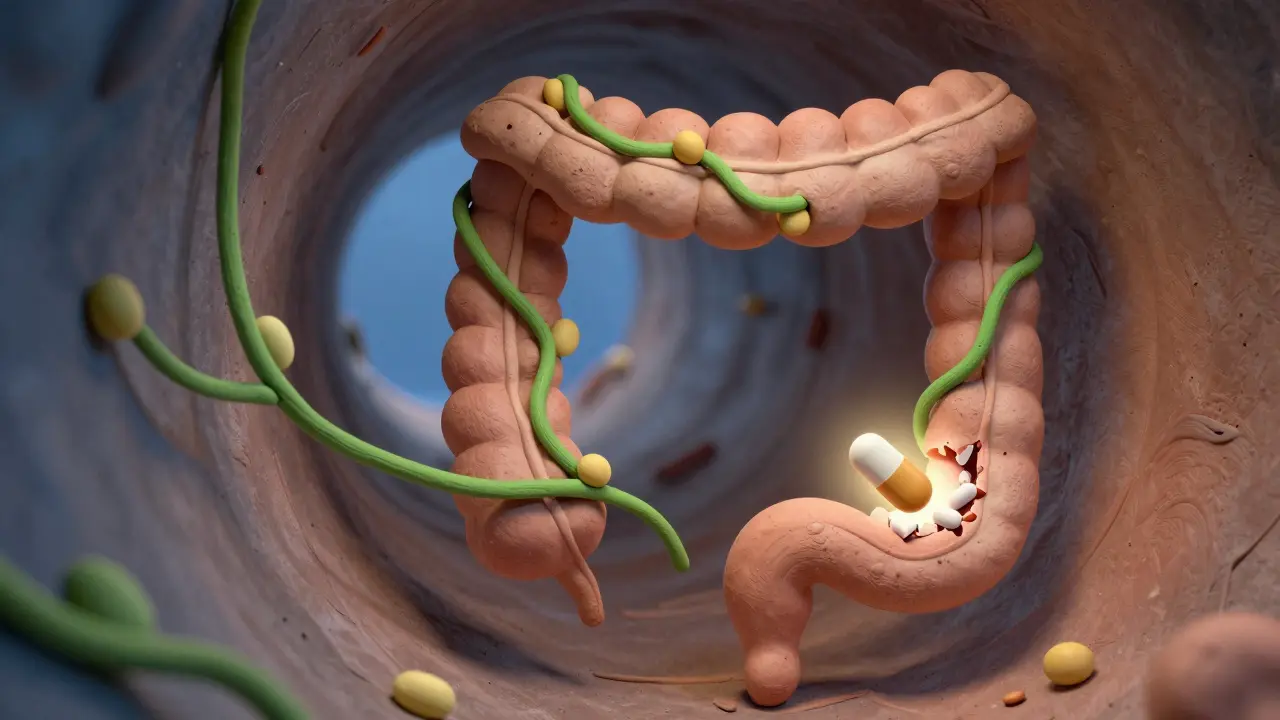
Soy doesn’t cancel out levothyroxine. It doesn’t make it toxic. It just blocks your gut from absorbing it properly. The culprits are isoflavones - plant compounds called genistein and daidzein - found in high amounts in soy products. These molecules bind to levothyroxine in your stomach and intestines, forming a chemical handshake that prevents the hormone from entering your bloodstream.
Studies using advanced lab techniques show this isn’t theoretical. When people take levothyroxine within hours of eating soy, their peak hormone levels drop by about 22%, and the total amount absorbed falls by nearly 19%. That’s not a small glitch. That’s enough to push someone from a normal TSH level into hypothyroid territory.
And it doesn’t matter if you take Synthroid, Levoxyl, or a generic. All levothyroxine tablets work the same way here. Unlike coffee, which affects some formulations more than others, soy messes with every version equally.
How Much Soy Is a Problem?
You don’t need to quit soy cold turkey. But you do need to understand how much you’re consuming and when.
A single serving of soy - like a cup of soy milk or half a block of tofu - can contain 30 to 100 milligrams of isoflavones. That’s enough to cut absorption by 20-40%. Two servings? That’s closer to 40%. And if you’re eating soy protein isolate - common in vegetarian burgers, protein bars, or meal replacements - you might be getting 40 grams of soy protein in one go. That’s been shown to reduce levothyroxine absorption by over 35%.
It’s not just obvious soy foods. Soy lecithin is in 70% of packaged foods in the U.S. - from chocolate bars to salad dressings. But here’s the good news: soy lecithin has almost no isoflavones. It’s not a problem. The real issue is soy protein, soy flour, tofu, tempeh, soy milk, and edamame.
Tempeh? It’s got 45 mg of isoflavones per 100 grams. Tofu? Around 25 mg. Soy milk? Up to 70 mg per cup. So if you’re sipping soy milk with your pill, you’re not just having breakfast - you’re making your medication less effective.
Who’s at Highest Risk?
This isn’t just a “maybe” issue. It’s a documented medical emergency for some groups.
Infants with congenital hypothyroidism are the most vulnerable. A 2012 study tracked two newborns who were given the right dose of levothyroxine - but also fed soy formula. Their TSH levels shot up to over 200 µIU/mL (normal is under 10). One baby’s free T4 dropped below 0.4 ng/dL - a level that can cause permanent brain damage if not corrected fast. These weren’t outliers. They were textbook cases of what happens when soy and thyroid meds collide.
Older adults are another high-risk group. As we age, stomach acid drops. That already makes levothyroxine harder to absorb. Add soy on top, and you’re stacking the odds against your body. Nearly half of all levothyroxine users in the U.S. are over 65. Many of them eat soy-based meals daily.
And then there’s the vegetarian and vegan population. Over 78% of vegetarians in the U.S. consume soy at least three times a week. For them, avoiding soy entirely isn’t realistic. But timing it right? That’s doable.
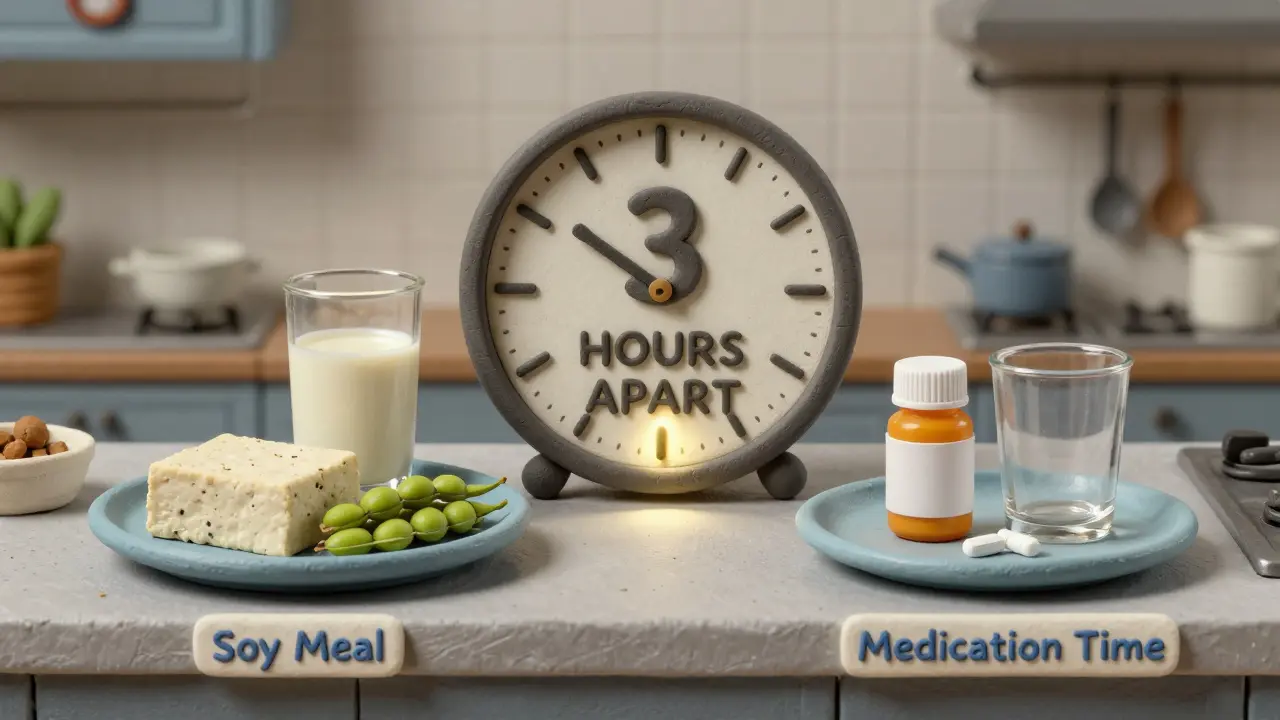
How to Fix It: The 3-Hour Rule
The solution isn’t elimination. It’s separation.
Medical guidelines from the American Thyroid Association, the Endocrine Society, and the Mayo Clinic all agree: wait at least 3 hours after eating soy before taking your levothyroxine. Some experts say 4 hours to be safe. Either way, the goal is to let your stomach empty before the pill hits it.
Here’s how to make it work:
- Take your levothyroxine first thing in the morning, on an empty stomach, with water.
- Wait at least 3 hours before eating soy - or any other food that interferes (calcium, iron, fiber).
- Don’t have soy milk with breakfast. Have it with lunch or dinner.
- If you eat tofu at dinner, take your pill the next morning before eating anything.
- Keep a food journal for a week. Note when you eat soy and when you take your pill. You might be surprised how often they overlap.
One woman in Sydney told her endocrinologist her TSH kept jumping from 2.1 to 8.7. She was taking her pill at 7 a.m. and having soy yogurt at 8 a.m. She switched to soy yogurt at 1 p.m. - and her TSH dropped back to 2.3 within six weeks. No dose change. Just timing.
What About Other Foods?
Soy isn’t the only troublemaker. Calcium supplements, iron pills, and high-fiber meals also block absorption. But soy is unique because it’s everywhere - and it’s not labeled as a “supplement.”
Here’s how soy stacks up against other common interferents:
| Interferent | Absorption Reduction | Recommended Separation |
|---|---|---|
| Calcium supplements | 35.2% | 4 hours |
| Iron supplements | 32.1% | 4 hours |
| Soy products | 25.3% | 3 hours |
| Coffee | 21.4% | 60 minutes |
| High-fiber foods | 17.8% | 2 hours |
| Tea | 15.3% | 1 hour |
Notice something? Soy is right up there with calcium and iron - the two biggest offenders. And unlike those, you can’t just stop taking soy. It’s part of your diet, your culture, your values. So you adapt.
What If You Can’t Avoid Soy?
If you’re vegan or have allergies to dairy or gluten, soy might be your protein backbone. You don’t have to quit.
Some patients switch to Tirosint - a softgel form of levothyroxine. In a 2020 trial, it absorbed 18.3% better than tablets when taken with soy. That’s not a cure, but it’s a buffer.
There’s also new research on Levo-Sorb®, an experimental formulation with a special coating that blocks isoflavones from binding. In a 2023 trial, 92% of patients maintained normal absorption even when eating soy at the same time. It’s not on the market yet, but it’s coming.
For now, the best tool is awareness. And consistency.
The Hidden Danger: Processed Foods
Most people think they’re avoiding soy if they skip tofu and soy milk. But soy protein isolate is in 68% of vegetarian meat alternatives. Soy flour is in gluten-free breads. Soy oil is in salad dressings. Soy lecithin? It’s everywhere.
Here’s the catch: only the protein-heavy forms matter. Soy oil and lecithin? Safe. Soy flour and isolate? Problematic.
Read labels. Look for: soy protein isolate, textured vegetable protein (TVP), soy flour, soy grits. If you see those, treat it like a soy meal. Wait 3 hours before your pill.
What Your Doctor Should Be Asking
Too often, doctors don’t ask about diet. They check TSH, adjust the dose, and move on. But if your TSH keeps fluctuating for no clear reason - and you eat soy - that’s a clue.
Ask your endocrinologist: “Could soy be affecting my absorption?” If they say no, ask them to check the 2021 Wiesner review or the 2020 American Thyroid Association guidelines. This isn’t outdated advice. It’s current, evidence-based, and backed by case studies, not just theory.
And if you’re a parent of a child on levothyroxine? Don’t let anyone tell you soy formula is fine. The American Academy of Pediatrics says: if your baby isn’t responding to treatment, stop the soy formula - immediately.
Final Reality Check
Some people swear they’ve taken soy and levothyroxine together for years with no issues. Maybe they’re one of the lucky ones. Maybe their gut absorbs differently. Maybe their dose is already high enough to compensate.
But you’re not them. You don’t know your absorption rate. You don’t know how much soy is in your food. And you can’t afford to guess.
Levothyroxine isn’t just a pill. It’s your body’s lifeline. When you take it, your body needs every molecule to work. Soy doesn’t destroy it. It just hides it. And if your TSH is creeping up, fatigue is returning, or your mood is off - this could be why.
So try this: for the next two weeks, take your pill at least 3 hours before eating any soy. No exceptions. Then get your TSH checked. You might be surprised how much better you feel - and how simple the fix was.
Can I eat soy if I take levothyroxine?
Yes, you can eat soy, but not at the same time as your medication. Soy interferes with how your body absorbs levothyroxine. To avoid this, wait at least 3 hours after eating soy before taking your pill. The best practice is to take levothyroxine on an empty stomach in the morning, and eat soy at lunch or dinner.
Does all soy affect thyroid medication?
Not all soy products are equal. Whole soy foods like tofu, tempeh, soy milk, and edamame contain high levels of isoflavones (30-100 mg per serving) and can reduce absorption by 20-40%. Processed forms like soy lecithin, soy oil, and soy sauce have almost no isoflavones and do not interfere. Always check the ingredient list - look for soy protein isolate, soy flour, or textured vegetable protein as red flags.
How long should I wait after eating soy before taking levothyroxine?
Wait at least 3 hours. Some experts recommend 4 hours for extra safety. This gives your stomach time to empty and reduces the chance of the soy compounds binding to the medication. Taking your pill first thing in the morning - before any food - and having soy later in the day is the easiest way to follow this rule.
Is there a type of levothyroxine that works better with soy?
Yes. Tirosint, a softgel formulation of levothyroxine, has been shown to absorb better than tablets when taken with soy. In a clinical trial, it improved absorption by 18.3% compared to standard tablets. If you struggle with soy interference despite timing, talk to your doctor about switching. It’s not a cure, but it can help.
Why do some people say soy doesn’t affect their thyroid meds?
Individual metabolism varies. Some people naturally absorb levothyroxine more efficiently, or their dose is already high enough to compensate for minor interference. Others may not be eating soy close to their pill time. But just because it works for one person doesn’t mean it’s safe for everyone. If your TSH levels are unstable, soy could be the hidden cause - even if you’ve never noticed symptoms before.
Emma Nicolls
March 13, 2026 AT 19:02I took levothyroxine for years and never knew soy was a problem until my TSH jumped to 8.5 last year
Switched my soy milk to after lunch and boom my levels dropped back to normal in 6 weeks
So simple but no one talks about it
Jimmy V
March 14, 2026 AT 03:13Soy is the silent killer of thyroid patients. Not coffee. Not calcium. Not fiber. It’s the damn tofu in your vegan burrito. I’ve seen 3 patients in my clinic this month with TSH over 10 because they thought ‘natural’ meant ‘safe.’ Wake up.
Richard Harris
March 14, 2026 AT 14:07Interesting post. I’ve been vegan for 12 years and took levothyroxine for 8. I never had issues but I always took my pill at 5am and had soy later. Maybe that’s why. Still, good reminder.
Kandace Bennett
March 15, 2026 AT 11:09OMG I’m so glad someone finally said this 😭
My cousin in California was on 150mcg and still exhausted - turned out she was drinking soy lattes with her morning pill 🤦♀️
Now she takes it at 6am and eats tofu at 1pm - energy’s back, mood’s stable, she’s basically a new person 💪
Tim Schulz
March 16, 2026 AT 04:09Oh wow. So the whole ‘soy is healthy’ cult has been quietly poisoning thyroid patients? 🤡
Next they’ll tell us kale is a miracle food and vitamin D cures cancer.
Meanwhile, real science says: separate your damn pills from your plant proteins. Simple. Not sexy. But true.
douglas martinez
March 16, 2026 AT 12:01As a healthcare provider, I appreciate the evidence-based clarity in this post. The 3-hour rule is consistently supported by clinical guidelines. I routinely counsel patients on soy timing, especially those with persistent TSH fluctuations. Consistency in timing and dietary awareness significantly improves outcomes. I encourage all patients to track their intake and medication schedule for at least one week.
Sabrina Sanches
March 17, 2026 AT 22:55I didn’t realize soy was the problem until my doctor said ‘maybe your tofu’ and I almost cried
Because I eat tofu every day
And now I know why I was so tired
And why my hair kept falling out
And why I felt like a zombie
Thank you for this
Shruti Chaturvedi
March 18, 2026 AT 22:50As someone from India where soy is not common in daily diet but growing fast I think this is crucial info
Many young people here are going vegan and taking thyroid meds
They need to know this before it’s too late
Thank you for sharing
Katherine Rodriguez
March 19, 2026 AT 23:03Why is this even a thing? Why does my body need to be so fragile? I eat soy every day. I’m not changing my life for a pill. If the drug doesn’t work with real food then maybe the drug is the problem
Jimmy V
March 20, 2026 AT 12:47That’s exactly why you need to take the pill right. Not the food. The pill is a hormone replacement. It’s not a suggestion. It’s a lifeline. You don’t get to choose which parts of biology you respect. If you want to eat soy? Fine. But don’t pretend your body doesn’t have rules.