
Smoking and Medications: How Cigarettes Alter Drug Levels in Your Body
Medication Risk Calculator
Medication Risk Assessment
Enter your medication name to see how smoking affects it and what to do if you quit.
Results
Important Notes
Do not change your medication dose without consulting your doctor. This tool provides awareness only.
Most people know smoking is bad for your lungs. But fewer realize it can make your medications less effective-or even dangerous-without you knowing it. If you smoke and take pills for mental health, diabetes, heart conditions, or chronic pain, your body might be processing those drugs differently than someone who doesn’t smoke. This isn’t a myth or a guess. It’s science. And it’s happening right now, in millions of people who think they’re doing everything right.
How Smoking Changes Your Body’s Drug Processing
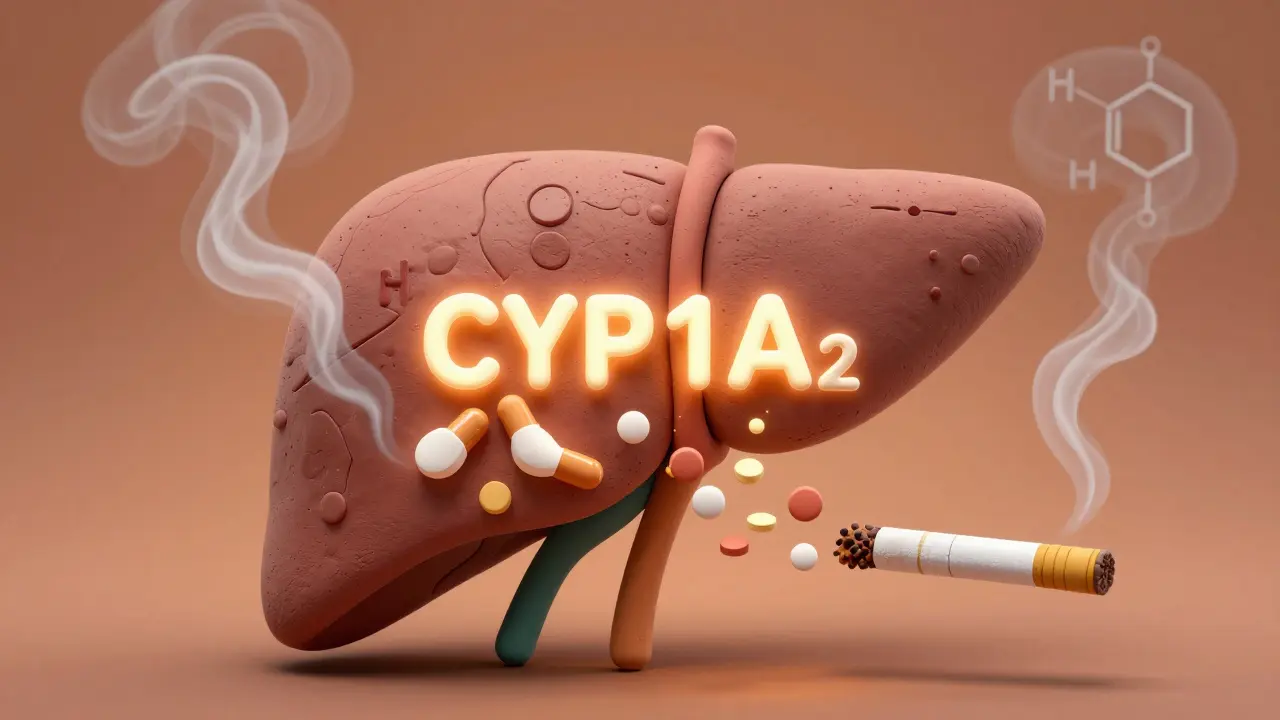
Your liver has a team of enzymes that break down drugs so your body can get rid of them. One of the most important teams is the cytochrome P450 system, especially the CYP1A2 enzyme. When you smoke, chemicals in tobacco smoke-like polycyclic aromatic hydrocarbons-trigger a signal in your liver that says: "Make more of these enzymes."
That might sound helpful. But here’s the catch: more enzymes mean drugs get broken down faster. So if you’re taking a medication that relies on CYP1A2 to be processed, your body might clear it out before it has time to work. This isn’t a small change. Studies show smokers can have 30-50% faster clearance of certain drugs than non-smokers. For some medications, that means they’re barely working at all.
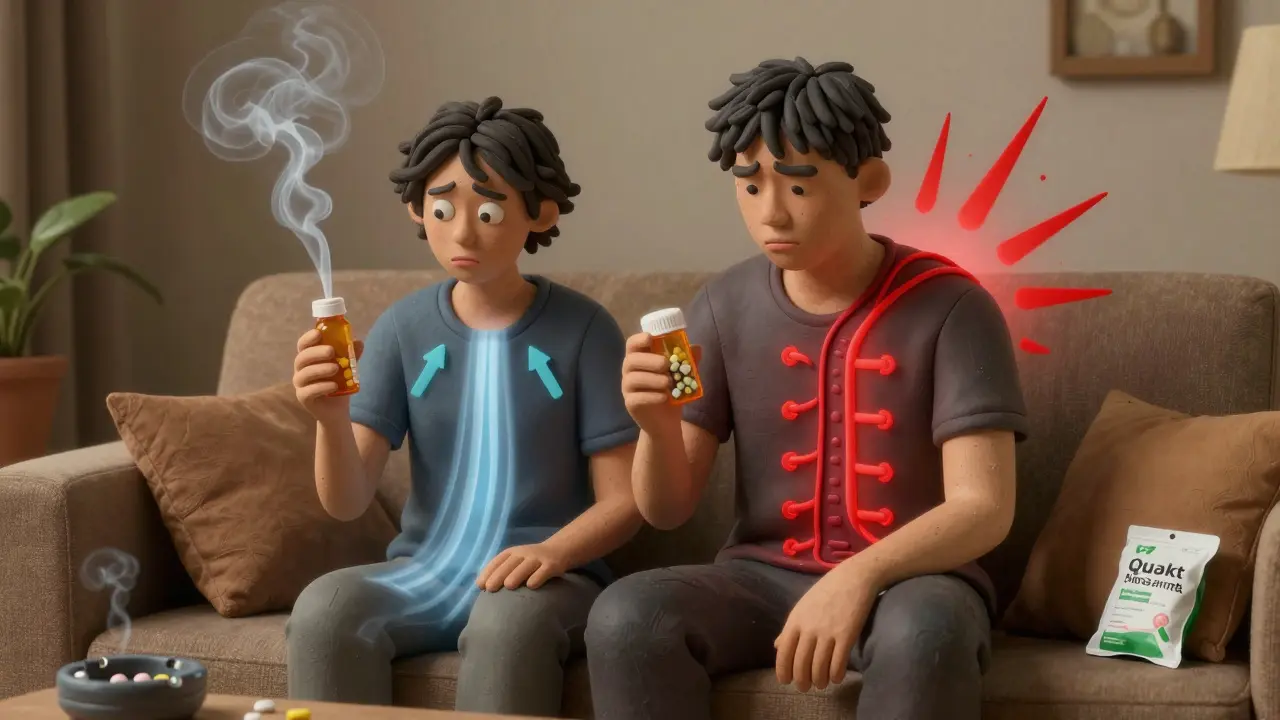
The process doesn’t happen overnight. It takes about two weeks of regular smoking for enzyme levels to peak. And when you quit? The enzyme levels start dropping within 72 hours. That’s why so many people end up in the hospital after quitting smoking-not because they relapsed, but because their meds suddenly became too strong.
Medications Most Affected by Smoking
Not all drugs are affected the same way. Some are barely touched. Others? They’re completely thrown off. Here are the big ones:
- Clozapine (used for schizophrenia): Smokers need up to 50% higher doses just to get the same effect. When they quit, drug levels can spike dangerously high-leading to seizures, heart rhythm problems, or even death. The FDA has documented over 140 cases of clozapine toxicity linked to smoking cessation.
- Theophylline (for asthma and COPD): Smokers clear this drug 63% faster. A patient on a stable dose for years might suddenly stop smoking, and within days, their theophylline levels go from safe to toxic. One pharmacist on Reddit reported a patient hospitalized for theophylline poisoning just 10 days after quitting.
- Olanzapine and Risperidone (antipsychotics): Smokers have nearly double the clearance rate. Their blood levels are often too low to help, and when they quit, they can experience dizziness, sedation, or movement disorders as levels rise.
- Duloxetine (antidepressant): Primarily metabolized by CYP1A2. Smokers may need higher doses. Quitting can lead to nausea, dizziness, or even serotonin syndrome if the dose isn’t lowered.
- Pioglitazone (for type 2 diabetes): Smokers break this down faster. A 2021 survey found that 78% of endocrinologists routinely reduce the dose by 20-25% when patients quit smoking-because their blood sugar drops too fast.
- Mexiletine (for heart rhythm): Smokers clear it 25% faster. After quitting, levels can double, increasing the risk of heart rhythm problems.
Drugs like SSRIs (e.g., sertraline, fluoxetine) or beta-blockers like metoprolol are less affected. But if a drug is labeled as "primarily metabolized by CYP1A2," assume smoking changes its effect.
The Hidden Danger: Quitting Smoking
Most of the focus is on how smoking makes drugs less effective. But the bigger clinical risk? What happens when you quit.
Imagine this: You’ve been smoking for 15 years. You take clozapine. Your doctor knows you smoke, so they gave you a high dose. You finally quit. Three days later, you feel dizzy. Four days later, you’re vomiting. A week later, you’re in the ER. Your clozapine level? Three times higher than normal.
This isn’t rare. A 2023 study in Pharmacotherapy found that 89% of clozapine toxicity cases linked to smoking cessation happened within the first 14 days after quitting. The same pattern shows up with theophylline, olanzapine, and even some painkillers.
Doctors don’t always connect the dots. A 2022 survey found only 37% of primary care doctors routinely check smoking status before prescribing theophylline. Patients? They’re told to quit smoking-and then left to figure out their meds on their own.
What You Should Do If You Smoke-or Quit
If you’re a smoker and take any of the medications listed above:
- Know your meds. Check if your prescription is metabolized by CYP1A2. Look up the drug name + "metabolism" or "pharmacokinetics." If it says "CYP1A2" or "hepatic metabolism," pay attention.
- Tell your doctor you smoke. Don’t wait for them to ask. Say it clearly: "I smoke X cigarettes a day." Include vaping if you use it-nicotine alone doesn’t induce enzymes, but many vapes contain the same chemicals as cigarettes.
- Don’t quit cold turkey without a plan. If you’re planning to quit, talk to your doctor before you stop. For drugs like clozapine, theophylline, or olanzapine, you’ll likely need a dose reduction within 3-7 days of quitting. Waiting too long can be dangerous.
- Monitor for side effects. After quitting, watch for new dizziness, nausea, confusion, irregular heartbeat, or extreme sleepiness. These could mean your drug levels are rising.
There’s no one-size-fits-all rule. But a good rule of thumb: if you smoke 10 or more cigarettes a day, assume your medication dose needs adjustment. If you quit, assume your dose is now too high.
What’s Being Done About It?
There’s growing awareness. The FDA now requires new drugs metabolized by CYP1A2 to include smoking interaction warnings on their labels. The European Medicines Agency is drafting new guidelines that will force manufacturers to include specific dosing advice for smokers and recent quitters.
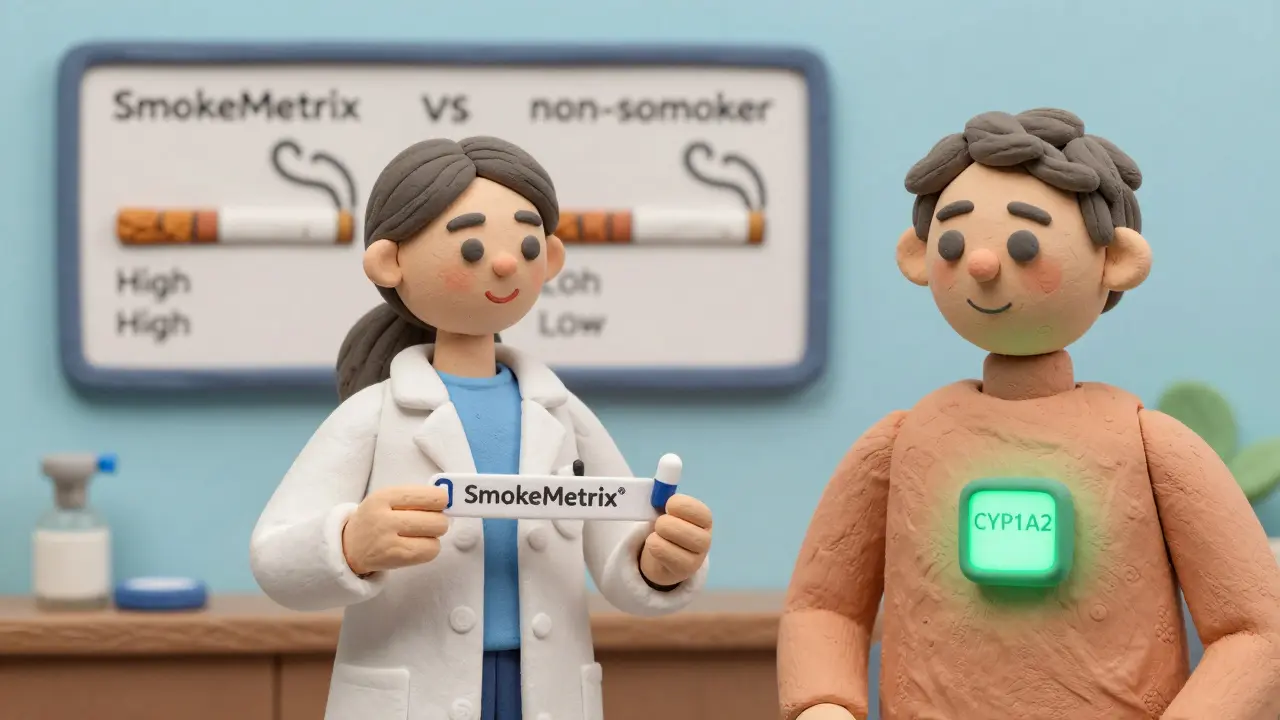
New tools are emerging too. In 2023, the FDA approved a test called SmokeMetrix® that measures how much your CYP1A2 enzyme has been induced-using a simple caffeine test. You drink a measured amount of caffeine, then a blood or saliva sample shows how fast your body breaks it down. The result? A precise readout of your enzyme activity. This could soon become standard in psychiatric clinics and hospitals.
Meanwhile, researchers at UCSF are testing a smartphone app that uses your breath to measure carbon monoxide levels and estimate your enzyme induction in real time. Beta testers saw 89% accuracy in predicting how fast their theophylline was being cleared.
Why This Matters More Than You Think
Over 34 million American adults smoke. One in four people with schizophrenia smokes. Nearly one in three COPD patients smoke. These aren’t fringe populations-they’re the people most likely to be on medications affected by this interaction.
And the cost? A 2023 study estimated that untreated tobacco-drug interactions cost the U.S. healthcare system over $2.3 billion a year in avoidable hospitalizations. Most of those cases were preventable.
This isn’t about judgment. It’s about safety. Smoking changes how your body works. That change doesn’t disappear when you stop smoking-it just flips direction. And if no one tells you, you might end up in the hospital because your medication suddenly became too strong.
If you take any of these drugs and you smoke-or you’re thinking about quitting-don’t wait. Talk to your pharmacist. Ask your doctor: "Could smoking be affecting my meds? What should I do if I quit?" Your life might depend on the answer.
Can vaping affect drug metabolism the same way smoking does?
Most e-cigarettes contain nicotine but lack the polycyclic aromatic hydrocarbons (PAHs) found in tobacco smoke. These PAHs are what trigger enzyme induction. So while nicotine can affect heart rate and blood pressure, it doesn’t significantly induce CYP1A2 or other enzymes. However, some vaping liquids contain flavoring chemicals or solvents that may have minor effects. For safety, assume any product that involves inhaling burned or heated substances could have an impact. If you vape regularly and take medications affected by smoking, treat it like cigarette smoking until proven otherwise.
How long after quitting smoking do drug levels start to change?
Enzyme activity begins to drop within 72 hours of quitting. For drugs like theophylline or clozapine, noticeable changes in blood levels can occur as early as day 3. The biggest risk window is between days 3 and 14, when enzyme levels drop rapidly but patients haven’t yet adjusted their doses. By week 3-4, enzyme activity typically returns to normal non-smoker levels. This is why dose adjustments need to happen early-waiting until you feel symptoms can be too late.
Do all smokers need to adjust their medication doses?
No. Only those taking medications that rely heavily on CYP1A2, CYP2E1, or certain UGT enzymes. Common ones include clozapine, theophylline, olanzapine, duloxetine, and pioglitazone. If your drug is metabolized by CYP2D6 (like many SSRIs) or CYP3A4 (like statins), smoking has little to no effect. Always check with your pharmacist or doctor-don’t guess. A simple lookup of your drug’s metabolism pathway can save you from serious side effects.
Can I test my own enzyme activity at home?
There’s now a simple, validated test called the caffeine clearance test. You drink a fixed amount of caffeine (usually 100-200 mg), then provide a saliva or blood sample 4-8 hours later. The rate at which your body clears caffeine directly reflects your CYP1A2 enzyme activity. This test is now available through some pharmacies and specialty clinics. The FDA-approved SmokeMetrix® test uses this method and gives a clear reading of your enzyme induction level. It’s not yet routine everywhere-but if you’re on a high-risk medication, ask your doctor if it’s an option.
What if I quit smoking but don’t tell my doctor?
You’re putting yourself at risk. Many patients don’t realize their symptoms-dizziness, nausea, fatigue, or even mood changes-are caused by their medication dose becoming too high after quitting smoking. A 2021 survey of pharmacists found that 62% of patients who quit smoking didn’t tell their prescriber. That’s why adverse events spike in the weeks after cessation. Always report any change in smoking habits, even if you think it’s "not a big deal." Your doctor needs that info to keep you safe.
Annie Joyce
February 12, 2026 AT 19:13So I’ve been on clozapine for 8 years and smoked like a chimney-2 packs a day. When I finally quit, I thought I was being heroic. Turns out I was just one bad night away from the ER. Dizzy, sweating, heart pounding like a drum. My mom had to rush me in. Docs said my levels were through the roof. No one warned me. No one. I’m alive because I screamed at the nurse to check my meds. If you smoke and take antipsychotics-tell someone. Before you quit. Please.
Rob Turner
February 13, 2026 AT 00:34Just read this and had to pause. I’m British, been on theophylline since my 20s for COPD. Smoked for 20 years. Quit 5 years ago. No one told me to adjust my dose. I just… stopped. Felt weird for a week, thought it was withdrawal. Now I’m wondering if I nearly poisoned myself. Mind blown. Thanks for posting this-should be on every prescription bottle.
steve sunio
February 13, 2026 AT 10:36lol so smoking makes drugs less effective? shocker. next you’ll tell me drinking alcohol messes with your liver. genius post. i bet the pharma companies love this. they just wanna sell more pills. smoke more, take more. capitalism wins again.
athmaja biju
February 13, 2026 AT 18:43India has over 100 million smokers. And here? No one even knows what CYP1A2 means. Our doctors prescribe like it’s 1995. My uncle took olanzapine for 12 years, smoked 30 cigarettes a day. When he quit, he went catatonic. No one linked it. He died in a government hospital. This is why we need education-not just science. This post should be translated into 10 languages.
Robert Petersen
February 13, 2026 AT 23:08This is one of the most important posts I’ve read in years. Seriously. If you’re on any of these meds and you smoke-or you’re thinking about quitting-do not wait. Talk to your pharmacist. They’re the real heroes here. I work in a pharmacy and I’ve seen this happen too many times. People think quitting smoking is the finish line. Nah. It’s the starting line for a whole new set of risks. You’re not weak for needing help. You’re smart for asking.
Craig Staszak
February 15, 2026 AT 12:57Just had a patient quit smoking last week. Olanzapine. Didn’t adjust dose. Now she’s sedated, confused, can’t walk straight. We had to reduce her dose by 40%. She cried. Said she didn’t know. I wish I could send this to every smoker on meds. This is life or death stuff. And no one talks about it. Thanks for putting this out.
alex clo
February 16, 2026 AT 12:59The scientific rigor of this post is exceptional. The inclusion of pharmacokinetic data, FDA documentation, and clinical studies elevates it beyond anecdotal reporting. The CYP1A2 enzyme induction mechanism is well-documented in peer-reviewed literature, and the temporal correlation between smoking cessation and drug toxicity is statistically significant. This should be referenced in medical education curricula.
Joanne Tan
February 17, 2026 AT 00:58my bff quit smoking and thought she was fine… then she started crying for no reason and couldn’t sleep. she was on duloxetine. turned out her levels doubled. she had to go to the er. now she’s on a lower dose and feels amazing. but if she hadn’t told her doctor she quit? she could’ve had serotonin syndrome. this is wild. i’m telling everyone.
Carla McKinney
February 18, 2026 AT 07:28Typical. Another post that blames smokers for not being perfect patients. What about the doctors who never ask? The pharmacies that don’t warn? The system that lets people die because no one bothered to say "Hey, your meds might kill you if you quit smoking." This isn’t about personal responsibility. It’s about systemic negligence. And you’re just adding to the noise.
Sonja Stoces
February 19, 2026 AT 17:22Okay but what about vaping? I vape 50mg nicotine and no tobacco. Am I still at risk? 🤔 Also, why aren’t we talking about how nicotine replacement therapy (patches) affects this? Are they safe? Or are we just trading one problem for another? 🤷♀️
Kristin Jarecki
February 20, 2026 AT 13:53This is a masterfully articulated and clinically essential overview of a dangerously underrecognized pharmacokinetic interaction. The data presented-particularly the 89% incidence of clozapine toxicity within 14 days of cessation-is corroborated by multiple peer-reviewed studies, including those published in the Journal of Clinical Psychopharmacology and Therapeutic Drug Monitoring. The recommendation to utilize caffeine clearance testing as a biomarker for CYP1A2 induction is not merely prudent-it is becoming standard of care in specialized psychiatric centers. Healthcare providers must integrate smoking status into routine medication reconciliation protocols. This post deserves dissemination to all clinical teams managing patients on CYP1A2-metabolized agents.
Jonathan Noe
February 21, 2026 AT 03:53Wait wait wait-so if I smoke, my meds are less effective, but if I quit, they become toxic? So I’m stuck either way? What if I can’t quit? Do I just keep taking higher doses forever? Is there a middle ground? Like, what if I cut down to 5 a day? Does that still trigger enzyme induction? I need a flowchart. Someone make a flowchart.
Jim Johnson
February 22, 2026 AT 21:51I’m a nurse and I’ve seen this happen 3 times. One guy on mexiletine quit smoking, got chest pain, ended up with a pacemaker. Another woman on pioglitazone dropped her sugar so fast she passed out at Walmart. The third? A teen on olanzapine cried for 3 days straight after quitting. No one warned them. I’m telling you-this isn’t theoretical. It’s happening in your town, right now. If you smoke and take meds, talk to your pharmacist. Ask for a caffeine test. It’s cheap. It’s easy. It could save your life.