
Sleep Medications: Safety, Dependence, and Effective Alternatives

More than 1 in 10 adults over 80 take prescription sleep meds every month. That’s not just a number-it’s a reality for millions who wake up hoping tonight will be different. But what happens when the pill becomes the only thing standing between you and a full night’s rest? Sleep medications might help you fall asleep tonight, but they don’t fix why you can’t sleep in the first place. And the longer you use them, the more dangerous they become.
How Sleep Medications Actually Work
Sleep pills don’t make you tired. They slow down your brain. Most prescription sleep aids-like Ambien (zolpidem), Lunesta (eszopiclone), and Sonata (zaleplon)-target GABA receptors, the same ones alcohol affects. This dampens brain activity enough to push you into sleep. But it’s not natural sleep. It’s chemically induced. Your brain doesn’t cycle through the deep, restorative stages the way it should. That’s why you wake up feeling foggy, even after 8 hours.
Benzodiazepines like lorazepam and clonazepam work the same way but are even more likely to cause dependence. They were once the go-to for insomnia, but doctors now avoid them for sleep unless absolutely necessary. Then there are the off-label options: trazodone, doxepin, even antihistamines like Benadryl. These aren’t FDA-approved for insomnia, but they’re prescribed anyway because they’re cheap and easy to write. The problem? Diphenhydramine, the active ingredient in Benadryl and Unisom, is a powerful anticholinergic. Long-term use raises your risk of dementia by 54%, according to a 2015 JAMA Internal Medicine study. That’s not a small risk. It’s a silent one.
The Hidden Dangers You’re Not Being Told
Most people think the worst that can happen is a hangover. But the real dangers are stranger-and scarier.
Complex sleep behaviors are real. People have driven cars, cooked meals, and even had sex while fully asleep after taking zolpidem. The FDA added a boxed warning to Ambien in 2019 because of this. It’s rare-about 0.5% of users-but when it happens, it’s life-changing. One woman in a 2022 case report woke up with a broken wrist, no memory of how it happened, and a police report for driving the wrong way on a highway.
Next-day impairment isn’t just feeling groggy. It’s equivalent to having a blood alcohol level of 0.05-0.08%. That’s legally impaired in most states. A 2022 Sleep Medicine survey found 27% of users reported trouble concentrating at work the next day. For truck drivers, nurses, or anyone operating machinery, that’s a safety hazard.
And then there’s dependence. After just 4-6 weeks of regular use, up to one-third of people on benzodiazepines become physically dependent. Z-drugs have a lower rate-5-10%-but it’s still real. When you stop, your brain doesn’t bounce back. It goes into overdrive. Rebound insomnia hits hard: you sleep worse than before you started. That’s why so many people say, “I can’t quit.” It’s not weakness. It’s neurochemistry.
Who’s Most at Risk?
It’s not just older adults, though they’re the most likely to use these drugs. The CDC says 13.2% of people 80 and older take prescription sleep aids. That’s because doctors often default to pills for elderly patients who complain of insomnia. But here’s the catch: the American Geriatrics Society Beers Criteria calls all sleep medications “potentially inappropriate” for seniors. Why? Because they increase fall risk by 50-60%. A single fall can break a hip. And for someone over 80, that’s often the beginning of the end.
Women are 50% more likely than men to be prescribed sleep meds. Partly because they report insomnia more often, partly because they metabolize zolpidem slower. That’s why the FDA lowered the recommended dose for women from 10mg to 5mg in 2019. But many prescriptions still start too high.
And if you’re taking other meds-antidepressants, painkillers, even antacids-the interaction risk climbs. Alcohol? That triples your chance of overdose. Mixing sleep pills with opioids is deadly. The CDC links over 1,500 deaths annually to this combination.
What Works Better Than Pills
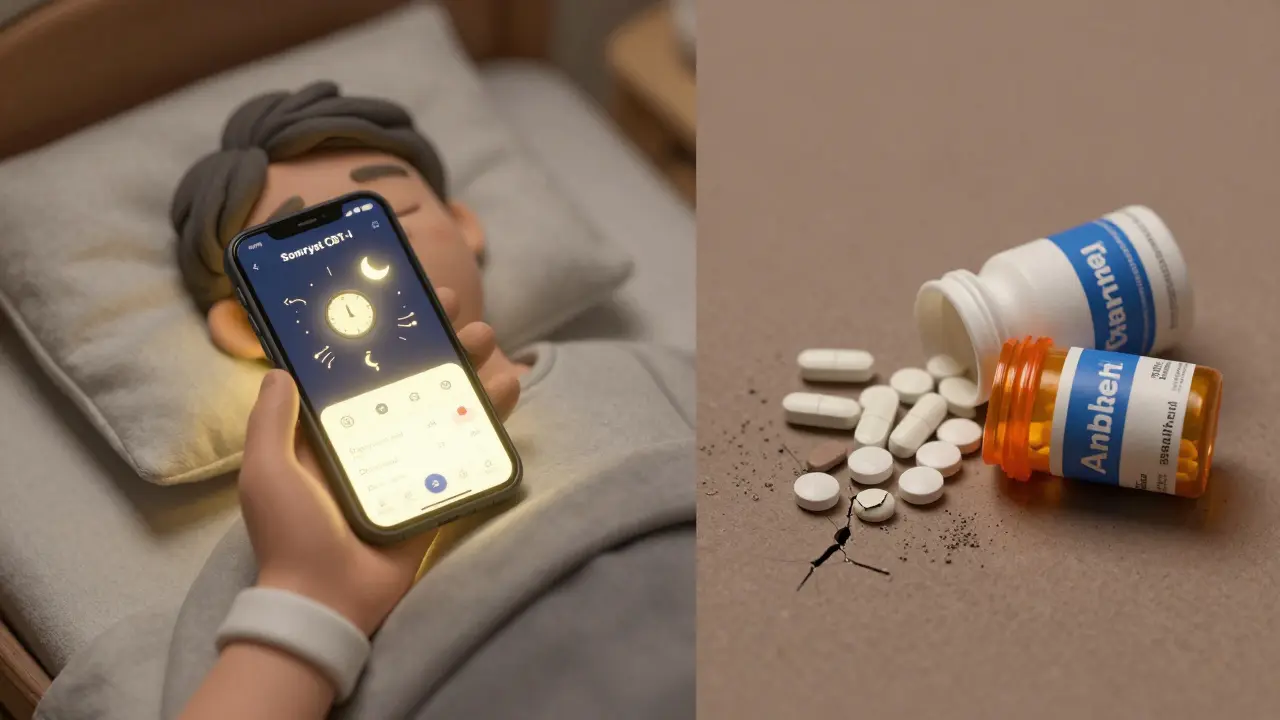
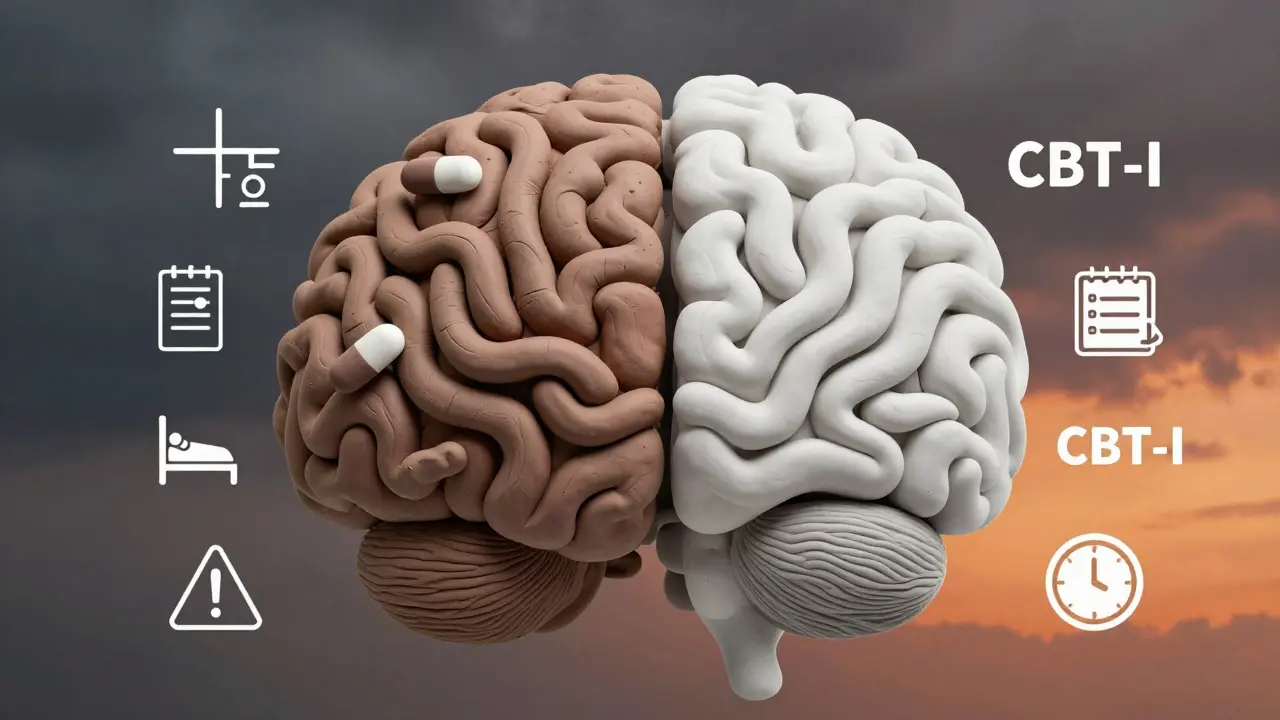
There’s a treatment that works better than any pill. It’s called CBT-I-Cognitive Behavioral Therapy for Insomnia. It doesn’t cost a fortune. It doesn’t require a prescription. And it doesn’t come with a warning label.
CBT-I isn’t just “sleep hygiene.” It’s not about cutting caffeine or taking a warm bath. It’s a structured, evidence-based program that rewires how you think about sleep. It teaches you to stop lying in bed awake for hours. To stop checking the clock. To stop fearing sleep. It uses stimulus control (only use bed for sleep and sex), sleep restriction (limit time in bed to match actual sleep), and cognitive restructuring (challenging thoughts like “If I don’t sleep tonight, I’ll fail tomorrow”).
Studies show CBT-I works for 70-80% of people. That’s higher than any medication. And the benefits last. Five years later, people who did CBT-I still sleep better. People who took pills? They’re back to square one-or worse.
Now, there’s a digital version: Somryst, an FDA-approved app that delivers CBT-I through your phone. In clinical trials, 60% of users achieved full remission of insomnia after 6 weeks. No pills. No side effects. Just your phone and your commitment.
What About Natural Supplements?
Melatonin gets a bad rap. People think it’s a magic sleep pill. It’s not. It’s a hormone that tells your body it’s time to wind down. It’s useful for jet lag or shift work. But for chronic insomnia? The evidence is weak. Most studies show it reduces sleep onset time by 7-10 minutes. That’s not nothing, but it’s not a cure.
And don’t trust the hype. Many melatonin supplements contain way more than they claim. A 2017 University of Toronto study found some products had up to 478% more melatonin than labeled. Others had serotonin or even the sleep drug zolpidem-contaminants you didn’t sign up for.
Valerian root? Magnesium? Chamomile? They’re safe for most people, but there’s no strong proof they fix insomnia. They might help you relax, but they won’t fix the mental habits keeping you awake.
How to Get Off Sleep Medications Safely
If you’ve been on a sleep pill for more than a few weeks, quitting cold turkey is dangerous. Withdrawal can cause rebound insomnia, anxiety, tremors, and even seizures in extreme cases.
The safest way is to taper slowly. Reduce your dose by 25% every two weeks. For example, if you’re taking 10mg of zolpidem, go to 7.5mg for two weeks, then 5mg, then 2.5mg. Work with your doctor. Don’t just stop.
During the taper, start CBT-I. Use the app. Read a book like “The Sleep Solution” by W. Chris Winter. Keep a sleep diary. Track when you go to bed, when you wake up, how long you’re awake in the night. This helps you see patterns and break the cycle.
And don’t be surprised if the first week feels awful. You might not sleep at all. That’s normal. Your brain is relearning. It’s not failing. It’s adapting.
The Future of Sleep Treatment
The tide is turning. In 2022, the FDA approved Quviviq (daridorexant), a new class of drug called an orexin receptor antagonist. Unlike zolpidem, it doesn’t sedate. It blocks the brain’s wake signal. Early data shows less next-day grogginess and lower dependence risk. It’s not perfect, but it’s a step forward.
Medical schools are finally teaching CBT-I. The American Medical Association passed a policy in 2021 urging training in non-drug sleep treatments. Hospitals now require doctors to refer patients to CBT-I before prescribing sleep meds for more than 30 days.
But change moves slowly. Prescription sleep aid sales are still $5.4 billion a year. The market for digital CBT-I? Just $150 million-but growing at 17% annually. That’s the future. Not another pill. But a better way to sleep.
When Medication Might Still Make Sense
Let’s be real. Sometimes, you need a pill. If you’re recovering from surgery, grieving a loss, or in the middle of a severe depressive episode, short-term use can be a bridge. The key is intention. Use it for days, not months. Pair it with therapy. Set a quit date. Write it down. Stick to it.
Dr. Rachel Salas at Johns Hopkins says it best: “Sleep meds can help you get through a rough patch. But they’re not the solution. CBT-I is.”
You don’t have to live with insomnia. And you don’t have to rely on pills to survive the night. There’s a better path. It takes work. It takes time. But it’s the only one that lasts.
Can sleep medications cause dementia?
Yes, long-term use of certain sleep aids-especially over-the-counter antihistamines like diphenhydramine (Benadryl, Unisom)-is linked to a 54% higher risk of dementia, according to a 2015 JAMA Internal Medicine study. This is due to their strong anticholinergic effects, which interfere with memory and learning. Even prescription benzodiazepines and Z-drugs may contribute to cognitive decline over time, especially in older adults.
Is it safe to take sleep meds every night?
No. Clinical guidelines from the American Academy of Sleep Medicine recommend sleep medications only for short-term use-typically 2 to 5 weeks. Taking them nightly increases dependence risk, worsens rebound insomnia, and raises the chance of side effects like falls, memory problems, and next-day impairment. Long-term nightly use is not medically supported and can do more harm than good.
What’s the best alternative to sleeping pills?
Cognitive Behavioral Therapy for Insomnia (CBT-I) is the most effective, long-lasting alternative. It’s recommended as the first-line treatment by major medical organizations. Digital CBT-I apps like Somryst are FDA-approved and proven to help 60% of users achieve full remission. Unlike pills, CBT-I teaches your brain to sleep naturally without chemicals.
How long does it take to get off sleep medication?
Tapering off usually takes 4 to 12 weeks, depending on the drug and how long you’ve been using it. A safe approach is reducing the dose by 25% every two weeks. Withdrawal symptoms like rebound insomnia, anxiety, or vivid dreams are common but temporary. Working with a doctor and starting CBT-I during the taper improves success rates.
Can melatonin help with insomnia?
Melatonin can help with sleep timing-like jet lag or shift work-but it’s not a strong treatment for chronic insomnia. Most studies show it only reduces sleep onset time by 7-10 minutes. Also, many over-the-counter melatonin supplements contain doses far higher than labeled, and some are even contaminated with other drugs. It’s safe for short-term use but not a substitute for proven therapies like CBT-I.
Why do doctors still prescribe sleep meds if they’re risky?
Doctors prescribe them because they’re fast, easy, and patients ask for them. Many clinicians aren’t trained in CBT-I, and access to sleep therapists is limited. Insurance often doesn’t cover behavioral therapy. But guidelines are changing: hospitals now require CBT-I referrals before prescribing long-term sleep meds, and medical schools are starting to teach non-drug approaches.
If you’ve been relying on sleep meds for months-or years-you’re not alone. But you don’t have to stay stuck. The path out isn’t through another pill. It’s through understanding your sleep, changing your habits, and giving your brain the chance to heal. It takes patience. But it’s worth it.
Roshan Gudhe
February 3, 2026 AT 23:30There's something deeply human about this post. We're not just talking about sleep-we're talking about the quiet desperation of a mind that refuses to turn off. I've seen friends go from melatonin to Ambien to clonazepam in under a year. No one wakes up saying, 'I want to be dependent.' It creeps in like fog. And CBT-I? It's not sexy. No pill. No quick fix. But it works. Not because it's magic, but because it respects the brain's intelligence. We don't need to sedate ourselves into rest. We need to relearn how to rest naturally. It takes patience. It takes humility. And honestly? It takes courage.
Janice Williams
February 5, 2026 AT 02:10While I appreciate the thoroughness of this piece, I must respectfully challenge the near-deification of CBT-I. It is not a panacea. It requires access to trained practitioners, consistent time investment, and cognitive stability-all of which are luxuries for many. For a single mother working three jobs, recovering from trauma, or managing chronic pain, CBT-I is not a viable first-line treatment. To dismiss pharmacological intervention entirely is not evidence-based-it is elitist. Medication is not failure. It is sometimes survival.
Joy Johnston
February 5, 2026 AT 06:42Janice raises a valid point, but I think we're missing the real issue: access. CBT-I isn't the problem. The healthcare system is. Insurance won't cover it. Therapists are booked for months. Meanwhile, doctors hand out prescriptions like candy because it's the path of least resistance. I work in primary care. I see it every day. We're not choosing pills over therapy-we're forced into pills because therapy doesn't exist for most people. We need systemic change, not just individual solutions.
Kunal Kaushik
February 6, 2026 AT 08:32Been there. Took Ambien for 3 years. Thought I needed it. Then I tried CBT-I via Somryst. First week? I slept 2 hours. Felt like I was dying. Second week? 4 hours. Third week? 6. Now? I don't even think about sleep anymore. It just happens. The pill wasn't helping me sleep. It was helping me escape the fear of not sleeping. Once I stopped running from the fear, my brain finally relaxed. No magic. Just time. And a little patience.
Caleb Sutton
February 6, 2026 AT 09:00They’re lying. All of them. The FDA? The AMA? The ‘experts’? This is all a pharmaceutical cover-up. Sleep meds are safe. The real danger is sleep deprivation being weaponized to keep people docile. Who benefits? Corporations. Governments. The sleep industry wants you dependent so you keep buying pills. CBT-I? It’s a distraction tactic. Don’t fall for it. Get your meds. Stay strong.
Jamillah Rodriguez
February 6, 2026 AT 13:01Ugh. I read this whole thing. So... melatonin is sketchy, CBT-I is great, but also maybe not for everyone? I just want to sleep. Why does everything have to be so complicated? 😑
Susheel Sharma
February 7, 2026 AT 20:25The narrative here is beautifully articulated, yet dangerously oversimplified. CBT-I’s 70-80% efficacy rate is cherry-picked from controlled trials-real-world adherence hovers near 30%. Meanwhile, the $5.4B sleep med market isn't fueled by ignorance; it's fueled by function. People sleep. They function. They pay taxes. They show up. Medication isn't a failure-it's a tool. The real tragedy? We treat insomnia as a moral failing rather than a neurological condition. Shame doesn't restore REM cycles.
Rachel Kipps
February 8, 2026 AT 05:15I've been on trazodone for 5 years. My doctor says it's fine. But lately I've been forgetting names. My husband says I'm zoning out. I didn't connect it until I read this. I'm scared. I don't know how to stop. I'm not ready. I'm so tired all the time. I think I need help. But I don't know where to start.
Katherine Urbahn
February 9, 2026 AT 08:09Let me be unequivocal: the claim that diphenhydramine increases dementia risk by 54% is misleadingly presented. The study referenced was observational, not causal. Correlation ≠ causation. Furthermore, the term ‘anticholinergic burden’ is poorly defined across studies. To suggest that all sleep medications are inherently dangerous ignores the nuanced pharmacology of individual agents. This post, while emotionally compelling, borders on fearmongering. A responsible discourse requires precision-not polemics.
Shelby Price
February 10, 2026 AT 01:25Just started CBT-I last week. I’m on week 2. I didn’t sleep at all Monday. Tuesday? 3 hours. Today? 5.5. I’m not ‘fixed.’ But I’m not panicking anymore. I stopped checking the clock. I stopped forcing it. Weirdly? It’s working. I still take melatonin sometimes. But now I know it’s not the answer. Just a Band-Aid. And that’s okay.
Jesse Naidoo
February 11, 2026 AT 18:14I’ve been taking Ambien for 8 years. I can’t stop. I tried. I had panic attacks. My hands shook. I cried for three days. My doctor said, ‘Just keep taking it.’ I don’t want to be this person. But I don’t know how to be anyone else.