
Pharmacist Concerns About NTI Generics: Why Small Dose Changes Matter
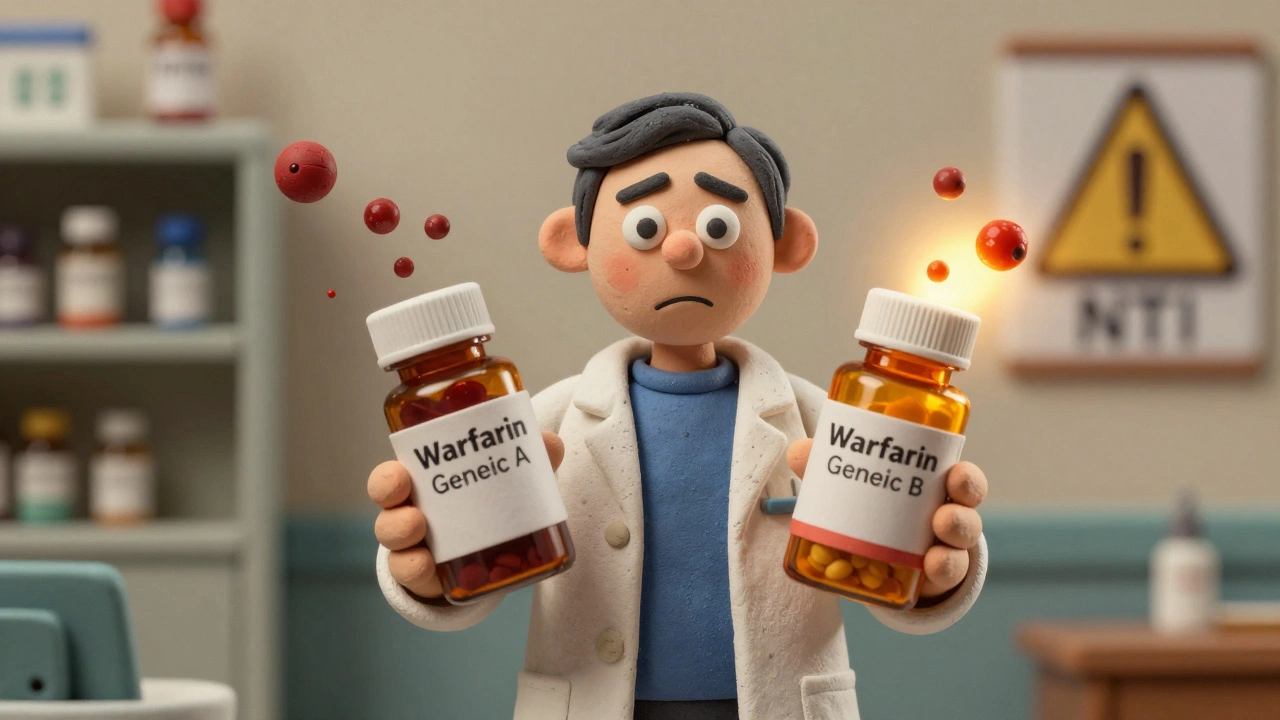
When a pharmacist hands you a pill bottle labeled as a generic version of your brand-name medicine, most of the time, it’s safe and saves you money. But for a small group of drugs-those with a narrow therapeutic index (NTI)-that switch can be risky. These aren’t just any medications. They’re the ones where even a tiny change in how much drug gets into your bloodstream can mean the difference between healing and hospitalization. Pharmacists are sounding the alarm, and their concerns aren’t theoretical. They’re based on real patient harm, inconsistent supply chains, and outdated regulatory standards.
What Makes a Drug an NTI Drug?
NTI drugs have a very narrow window between being effective and being dangerous. A small drop in blood levels might mean the drug doesn’t work. A small increase might cause toxicity. Think of it like walking a tightrope-there’s no room for error. Common examples include warfarin (a blood thinner), levothyroxine (for thyroid disorders), phenytoin (for seizures), and carbamazepine (for epilepsy and nerve pain). These aren’t obscure medications. Millions of people rely on them daily.
The FDA doesn’t publish an official list, but it does flag NTI drugs in the Orange Book with special therapeutic equivalence codes. Even then, the agency’s bioequivalence standards for generics-normally allowing 80% to 125% of the brand’s blood concentration-are too loose for NTI drugs. For these, the FDA recommends a tighter range: 90% to 111%. But not all manufacturers follow this. And when they don’t, patients pay the price.
Why Pharmacists Are Worried
Pharmacists aren’t resisting generics. They’re resisting unpredictability. A 2024 survey by the American Society of Health-System Pharmacists found that 68% of pharmacists have serious concerns about substituting NTI generics. Why? Because switching between different generic versions-even if they’re all technically "equivalent"-can cause dangerous fluctuations.
One hospital pharmacist in Ohio reported three cases in 18 months where switching warfarin generics led to INR levels spiking or crashing, requiring emergency hospital visits. Another in Florida described a patient on levothyroxine who went from feeling fine to experiencing heart palpitations and weight loss after a pharmacy switched to a different generic. Blood tests showed a 20% drop in drug concentration. That’s outside the FDA’s recommended 90-111% range.
These aren’t rare. The FDA’s adverse event database recorded 1,247 incidents linked to NTI generic substitutions between 2020 and 2024. For non-NTI generics, that number was 382. And it’s not just about one bad batch. It’s about switching between multiple manufacturers. The FDA reported that 23% of NTI drug shortages were worsened by hospitals and pharmacies bouncing between different generic suppliers. Each switch introduces a new variable-and patients become the lab rats.
The Cost-Saving Trap
Generics save money. That’s the whole point. NTI generics cost 80-85% less than brand-name versions. For patients on long-term therapy, that’s hundreds of dollars a year. But here’s the catch: cost savings don’t matter if the drug doesn’t work-or if it makes you sick.
One community pharmacy owner in Arizona told a story of a Medicare patient who stopped filling her levothyroxine prescription after a generic switch caused fatigue and weight gain. She couldn’t afford the brand, but she couldn’t tolerate the generic either. The pharmacist had to call the doctor repeatedly to get the original brand. Eventually, the patient got a prior authorization-but only after two months of feeling unwell.
It’s not just individual stories. The IQVIA Institute found that while NTI drugs make up only 5.3% of all prescriptions, they account for nearly 10% of total drug spending. That’s because patients and providers are willing to pay more for stability. And when supply chains break down-like when 80% of NTI generics are finished in foreign countries-the pressure to cut costs pushes pharmacies toward cheaper, less reliable sources.

Regulatory Gaps and State Confusion
Here’s the messy part: rules vary wildly by state. As of January 2025, only 28 states have laws that restrict automatic substitution of NTI generics. In some places, pharmacists can swap out a patient’s levothyroxine without telling the doctor. In others, the prescriber must specifically say "dispense as written." Six states ban automatic substitution entirely. That means a patient moving from Texas to New York might get a different version of the same drug-and have no idea why their symptoms changed.
Pharmacists are caught in the middle. They know the risks, but they’re often legally required to substitute unless the prescription says otherwise. A 2024 American Pharmacists Association survey found that 61% of pharmacists want state laws to require prescriber notification before switching NTI drugs. Only 29% wanted that for non-NTI drugs. The disconnect between policy and practice is growing.
What Pharmacists Are Doing About It
Despite the system’s flaws, pharmacists are stepping up. Hospitals with strong pharmacy teams now follow strict protocols: pick one generic manufacturer and stick with it. If a patient is stable on a specific brand or generic, don’t switch unless absolutely necessary. The ASHP’s 2025 toolkit recommends this approach-and 63% of hospital systems have adopted it.
Pharmacists are also using therapeutic drug monitoring more aggressively. For warfarin, that means checking INR levels more often after a switch. For levothyroxine, it’s TSH tests every 6-8 weeks after a new generic. That’s extra work, extra cost, extra time. But it’s the only way to catch problems early.
Training has improved too. Eighty-one percent of pharmacy residency programs now include specialized NTI drug management. Pharmacists are learning how to interpret bioequivalence data, recognize subtle signs of instability, and communicate risks to prescribers and patients. It’s no longer enough to just count pills. You have to understand what’s happening inside the body.
The Bigger Picture: Supply Chains and Policy
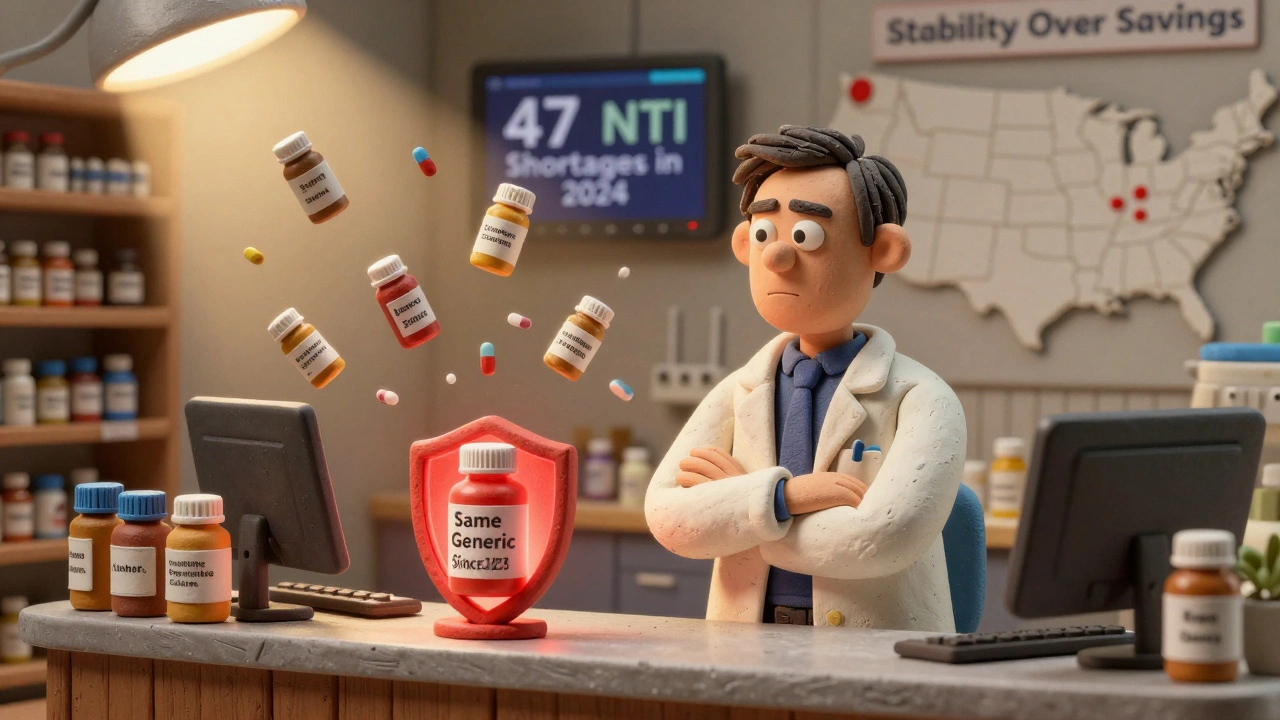
The real crisis isn’t just about bioequivalence-it’s about supply. The FDA reported 47 NTI drug shortages in 2024, making up 17.4% of all shortages. That’s disproportionate. Why? Because these drugs are often made by fewer manufacturers, and production is concentrated overseas. When a factory in India or China shuts down for inspection, there’s no backup.
Even worse, the new Medicare Drug Price Negotiation Program, starting in 2026, includes three NTI drugs among its first ten targets. Pharmacists fear the 21-day reimbursement delay will hurt small pharmacies that can’t afford to stock expensive NTI drugs without immediate payment. Lisa Schwartz of the National Community Pharmacists Association warned this could lead to stockouts, forcing patients to go without or switch brands mid-treatment.
The FDA’s April 2025 announcement of a new bioequivalence framework for critical dose drugs is a step forward. It plans to tighten standards for 12 high-priority NTI drugs by 2026. But many pharmacists say it’s too little, too late. They want mandatory reporting of bioequivalence data, real-time tracking of generic switches, and a national NTI drug registry. Until then, the burden falls on the pharmacist at the counter.
What Patients Should Know
If you take warfarin, levothyroxine, phenytoin, or another NTI drug, here’s what you need to do:
- Ask your pharmacist: "Is this the same generic I’ve been taking?" If it’s different, ask if you can stick with the original.
- Monitor your symptoms. Fatigue, dizziness, irregular heartbeat, or mood changes after a switch could signal a problem.
- Request regular blood tests if you’re on warfarin or phenytoin. Don’t wait for your next routine visit.
- Ask your doctor to write "dispense as written" on the prescription if you’ve had stability issues.
- Keep a list of the generic manufacturer’s name on your pill bottle. If you notice a change, report it.
You don’t have to accept random switches. You have the right to ask questions-and to demand consistency.
What’s Next?
The future of NTI generics is uncertain. On one hand, cost pressures and global supply chains will keep pushing pharmacies toward cheaper alternatives. On the other, the evidence of harm is mounting. More healthcare systems are planning pharmacist-led NTI drug stewardship programs by 2027. That means pharmacists won’t just be dispensers-they’ll be guardians of stability.
For now, the system is a patchwork of good intentions and dangerous gaps. Pharmacists are doing their best with limited tools. But patients shouldn’t have to be the canaries in the coal mine. Real change requires better standards, transparent supply chains, and laws that protect-not just profit margins, but lives.
Dematteo Lasonya
December 5, 2025 AT 13:30My grandma’s on levothyroxine and switched generics last year-she got dizzy and lost 8 lbs in two weeks. Took three months to get her old brand back. No one told us it could be the pill.
Rudy Van den Boogaert
December 5, 2025 AT 15:55I work in a hospital pharmacy and we stopped switching NTI generics entirely after two patients had seizures. Now we lock in one manufacturer per patient. It’s extra work, but it’s worth it. Lives over savings.
Gillian Watson
December 7, 2025 AT 12:19Over in the UK we don’t even have this problem-our NHS has strict protocols for NTI meds. No automatic swaps. Maybe we’re just less obsessed with cutting costs at the expense of safety.
Jordan Wall
December 9, 2025 AT 10:45LOL so now pharmacists are the new priests of bioequivalence? 😂 Next they’ll be blessing our pills with holy water. FDA’s standards are fine, stop being dramatic. It’s just a pill.
Gareth Storer
December 10, 2025 AT 18:04Wow, another ‘pharmacist knows best’ sob story. Next you’ll tell me nurses should be running the FDA. Maybe if people didn’t take meds like candy, this wouldn’t be an issue.
Pavan Kankala
December 12, 2025 AT 13:40This is all a Big Pharma scam. The real reason they’re scared of generics is because they want to keep you hooked on expensive brand names. The FDA is in their pocket. You think they care about your INR? They care about quarterly profits.
Martyn Stuart
December 13, 2025 AT 20:09It’s critical to understand that bioequivalence is not therapeutic equivalence-especially for NTI drugs. The 80–125% range is statistically acceptable for non-critical meds, but for warfarin or phenytoin, even a 5% deviation can trigger a cascade of physiological instability. That’s why many academic centers now require batch-specific tracking and TDM protocols. Pharmacists are not being ‘dramatic’-they’re applying pharmacokinetic principles.
Jessica Baydowicz
December 13, 2025 AT 23:34Y’all are killing it with this post!! 🙌 I’m a nurse and I’ve seen so many patients crash after a switch-fatigue, brain fog, heart racing. It’s not ‘just a pill,’ it’s their whole life. Let’s push for better laws!! 💪
Shofner Lehto
December 14, 2025 AT 22:35My brother’s on carbamazepine. He’s been stable for 7 years on one generic. Last month, the pharmacy switched him without warning. He had a seizure two weeks later. The pharmacist didn’t even call the doctor. That’s not healthcare-that’s roulette.
Yasmine Hajar
December 16, 2025 AT 08:38Why is this even a debate? If you wouldn’t swap out your car’s engine for a random knockoff part, why are you okay swapping your life-saving meds? We treat pets better than we treat people on NTI drugs. This is a moral failure.
Karl Barrett
December 17, 2025 AT 07:46The real issue isn’t bioequivalence-it’s the commodification of health. When you reduce a human being’s physiological stability to a cost-per-pill metric, you’re not running a pharmacy-you’re running a supply chain. We’ve lost sight of the fact that medicine isn’t a product-it’s a relationship between patient, drug, and body.
Jake Deeds
December 18, 2025 AT 17:36I used to be a pharmacist. I quit because I couldn’t stomach handing out pills I knew might kill someone just to hit a quarterly savings target. The system is broken. And no, I don’t miss it. 😌
val kendra
December 20, 2025 AT 16:54My mom’s on warfarin. We keep a notebook: brand name, generic maker, lot number, date switched. We call the pharmacy every time. It’s annoying-but it saved her life last year when they tried to swap again. Don’t wait for the system to fix itself. Be your own advocate.
Isabelle Bujold
December 22, 2025 AT 02:36There’s a deeper layer here that no one’s talking about: the global pharmaceutical supply chain is now a fragile, single-threaded network. Over 80% of active pharmaceutical ingredients for NTI drugs come from just two countries-India and China. Any geopolitical disruption, regulatory audit, or natural disaster in those regions creates a domino effect. The FDA’s 2025 framework is a start, but what we need is a national stockpile of critical NTI generics, like we have for vaccines or antibiotics. And we need to incentivize domestic manufacturing-not just for security, but for quality control. Right now, we’re betting our patients’ lives on the integrity of factories we can’t inspect and regulators we can’t access. That’s not innovation. That’s negligence dressed up as efficiency.
Libby Rees
December 23, 2025 AT 18:23Thank you for sharing this. As someone who works with elderly patients, I’ve seen too many fall through the cracks because no one explained the switch. A simple note on the script-‘dispense as written’-could prevent so much suffering. Let’s make that standard, not the exception.