
Never Use Household Spoons for Children’s Medicine Dosing: Why Accuracy Saves Lives
Every year, more than 10,000 calls are made to poison control centers in the U.S. alone because a child was given the wrong amount of liquid medicine. And in most of those cases, the mistake wasn’t caused by a pharmacy error or a doctor’s typo. It was caused by a teaspoon-the one sitting in your kitchen drawer.
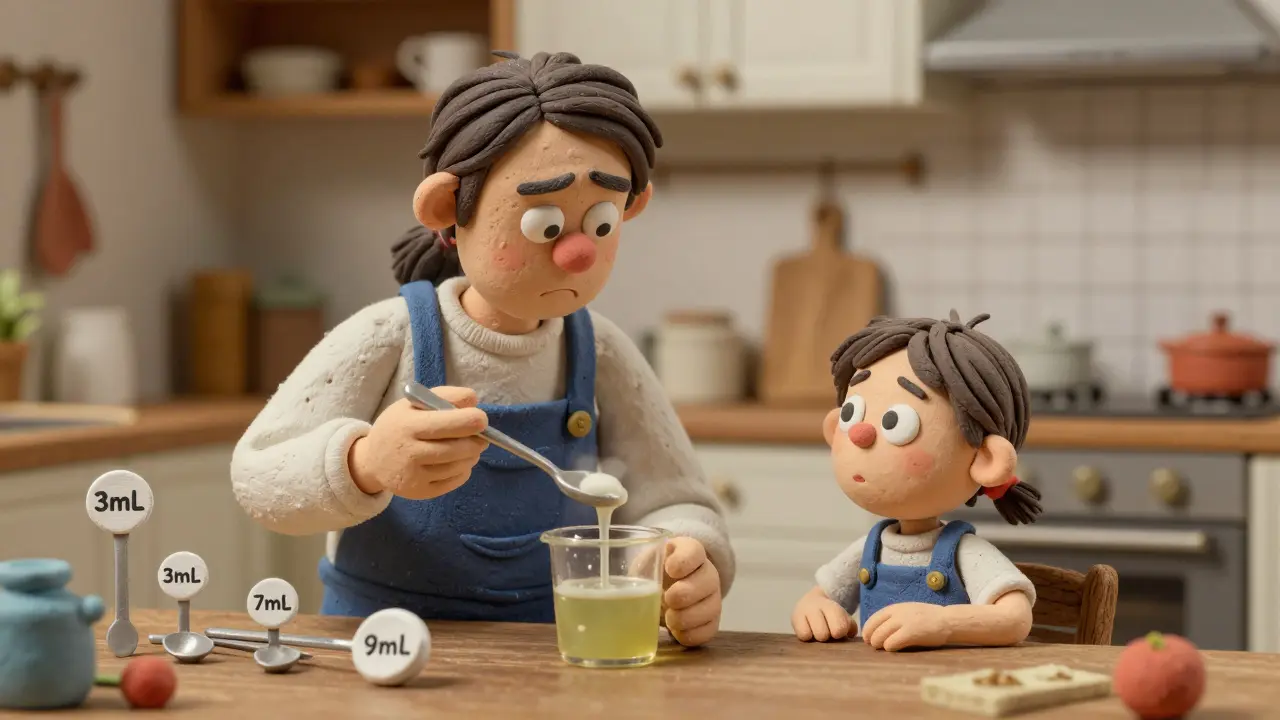
You’ve probably done it. Your child has a fever. The doctor says, "Give 5 mL every six hours." You grab a spoon from the drawer, fill it to the brim, and think you’re doing fine. After all, a teaspoon is a teaspoon, right? Wrong. That spoon you’re using might hold 3 mL. Or 7 mL. Or even 9 mL. And that tiny difference? It could mean the difference between your child getting better and ending up in the ER.
Why Household Spoons Are Dangerous for Medicine
Not all teaspoons are created equal. A medical teaspoon is exactly 5 milliliters (mL). But your kitchen spoon? It varies. Studies show household teaspoons hold anywhere from 3 mL to 7 mL-up to 40% off from what’s supposed to be the standard. That means if your child needs 5 mL, and you use a spoon that holds 7 mL, you’re giving them almost 40% too much. If your spoon only holds 3 mL, they’re getting less than half the dose they need.
And it gets worse. Many parents confuse teaspoons with tablespoons. If you think you’re giving "one teaspoon" but grab a tablespoon instead? That’s three times the dose. A tablespoon holds 15 mL. If your child was supposed to get 5 mL, you just gave them 15 mL. That’s not a mistake. That’s a risk of overdose.
According to research published in Pediatrics, nearly 40% of parents mismeasure doses when using kitchen spoons. Over 41% make errors even when trying to follow the label. And it’s not because they’re careless. It’s because the system is set up to fail them.
The Science Behind the Numbers
Children aren’t small adults. Their bodies process medicine differently. Even small errors can cause serious side effects-vomiting, drowsiness, seizures, or organ damage. For antibiotics, underdosing means the infection doesn’t clear. That leads to longer illness, antibiotic resistance, and more doctor visits.
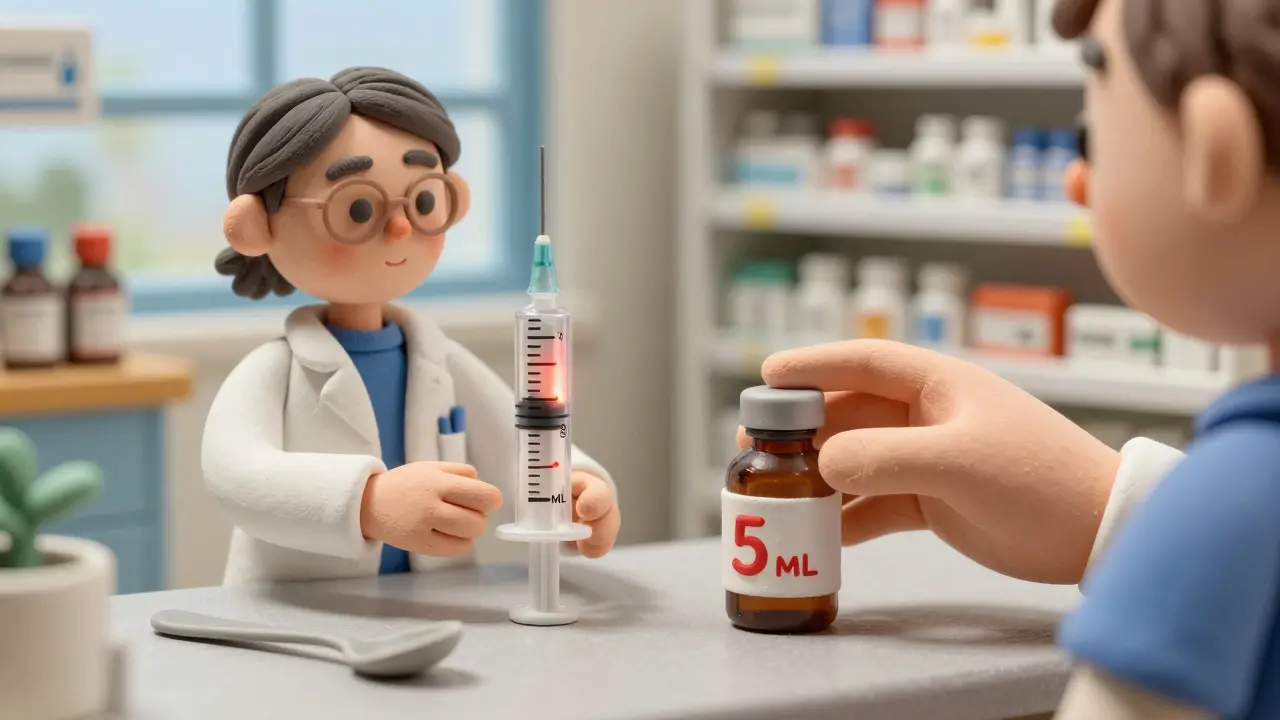
Oral syringes, the kind with clear milliliter markings, are the gold standard. They measure as precisely as 0.1 mL. That’s important because many pediatric doses aren’t neat numbers like 5 mL or 10 mL. They’re 3.5 mL, 2.2 mL, or 0.8 mL. You can’t measure those accurately with a cup or a spoon. But you can with a syringe.
A 2023 study in Frontiers in Public Health found that dosing cups-those plastic cups with lines at 5 mL, 10 mL, and 15 mL-are useless for anything between those marks. If your child needs 7 mL, you’re guessing. And guessing with medicine is never safe.
Labels That Confuse, Not Help
Here’s something most parents don’t realize: the way the label is written affects what you do. A 2016 study in Academic Pediatrics found that when labels said "give 5 tsp," 33% of parents said they’d use a kitchen spoon. But when the same label said "give 5 mL," fewer than 10% considered using a kitchen spoon. That’s a 23-point drop in dangerous behavior-just by changing the words.
Even the spelling matters. "Teaspoon" was worse than "tsp." People saw the full word and thought, "Oh, that’s a regular spoon." Abbreviations like "mL" feel more technical, so people pause. They look for the right tool.
That’s why the CDC, FDA, and American Academy of Pediatrics all push for milliliter-only labeling. No more "tsp," no more "tablespoon." Just mL. And if your child’s medicine still says "teaspoon," ask your pharmacist to clarify. Demand a syringe.
What You Should Use Instead
Forget the spoon. Here’s what actually works:
- Oral syringes - The most accurate tool. Especially for doses under 5 mL. They come in 1 mL, 3 mL, and 5 mL sizes. Look for one with clear, bold numbers. Always read the dose at eye level.
- Dosing cups - Only if they’re included with the medicine and marked in mL. Never use a random cup from your cabinet. And never guess between the lines.
- Droppers - Better than spoons, but less precise than syringes. Still useful if you don’t have a syringe handy.
Never use a kitchen spoon, a soup spoon, a coffee spoon, or a dessert spoon. They’re not tools. They’re decorations.
How to Give Medicine the Right Way
Follow these steps every single time:
- Read the label - Look for mL, not tsp or tbsp. If it says "teaspoon," ask your pharmacist what that means in mL.
- Use the right tool - Always use the syringe or cup that came with the medicine. If you lost it, go back to the pharmacy. They’ll give you a new one for free.
- Measure at eye level - Don’t hold the syringe up high. Don’t look down. Put it on a flat surface and look straight at the line. That’s how you avoid parallax errors.
- Don’t rush - Give the medicine slowly. Aim for the side of the mouth, between the cheek and tongue. Don’t squirt it straight to the back of the throat. That can cause choking.
- Write it down - If you’re giving medicine multiple times a day, keep a log. Note the time and dose. It helps you stay on track and prevents double-dosing.
What Pharmacies Are Doing to Help
Some pharmacies are finally catching on. Places like Aspirus now automatically include an oral syringe with every pediatric liquid prescription. They don’t wait for you to ask. They give it to you because they know most people won’t bring their own.
Pharmacists report that when families get the right tool and clear instructions, dosing errors drop by up to 20%. That’s huge. But not every pharmacy does this yet. Don’t assume you’ll get a syringe. Always ask.
And if your child’s medicine doesn’t come with a measuring tool? Go back. Say: "I need a syringe for this. I’m not using a kitchen spoon." You’re not being difficult. You’re being responsible.
Why This Still Happens-And How to Stop It
Despite decades of warnings, about 75% of American families still use kitchen spoons to measure medicine. Why? Because it’s easy. Because it’s what their parents did. Because they’ve never seen a syringe before.
It’s cultural. It’s habitual. And it’s deadly.
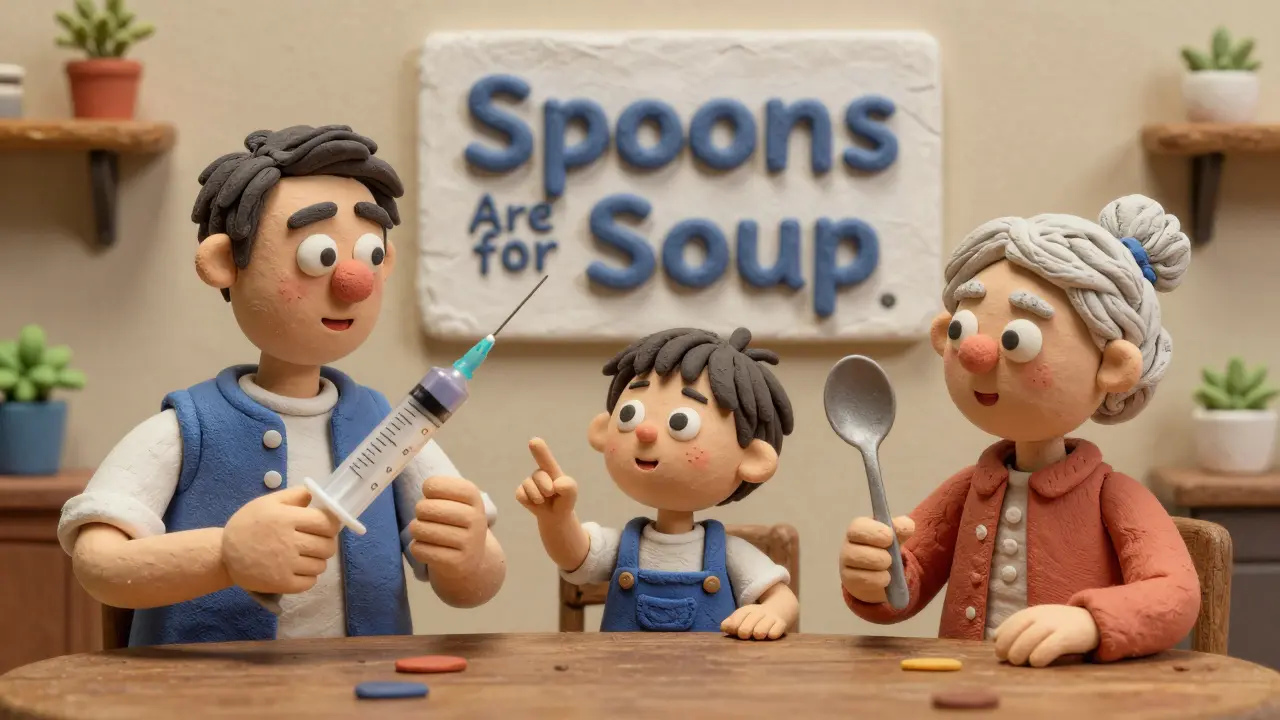
The CDC’s "Spoons Are for Soup" campaign isn’t just a slogan. It’s a call to action. If you wouldn’t use a spoon to measure oil for baking or detergent for laundry, why would you use it for medicine?
Start today. Throw out the idea that "a spoon is a spoon." Teach your partner, your babysitter, your grandma. Show them the syringe. Explain why it matters. This isn’t about being perfect. It’s about being safe.
What to Do If You Made a Mistake
If you accidentally gave your child the wrong dose-whether too much or too little-don’t panic. Don’t wait. Call your doctor or poison control immediately. In Australia, call 13 11 26. In the U.S., call 1-800-222-1222.
Even if your child seems fine, get advice. Some side effects don’t show up right away. Better safe than sorry.
And after that? Make a plan. Get the right tools. Practice measuring water with the syringe. Make it routine. Make it normal.
Medicine isn’t guesswork. It’s science. And your child deserves science, not spoonfuls.
Lydia H.
January 19, 2026 AT 04:28My grandma used to dose my sister with a spoon and she turned out fine. But then again, she also believed in chicken soup for everything and never heard of a syringe. Times change, I guess.
Phil Hillson
January 19, 2026 AT 23:57So let me get this straight-parents are dumb because they use spoons but pharmacies don’t give syringes unless you beg like a beggar? What a joke. We’re not in a hospital, we’re in the real world where you grab what’s handy
Josh Kenna
January 21, 2026 AT 23:09I used to think this was overkill until my kid threw up after I gave her 5mL with a spoon and the bottle said 5mL. Turns out my spoon held 7.5. I cried. Then I bought three syringes. Now I label them with duct tape. No more guessing. No more panic. Just science. And honestly? It’s not that hard.
Jake Rudin
January 23, 2026 AT 00:09It’s not just about the spoon-it’s about the entire cultural narrative around medical authority. We’ve normalized convenience over precision because we’ve been conditioned to distrust institutions, yet simultaneously rely on them for life-or-death decisions. The spoon becomes a symbol of autonomy gone wrong. We want control, but we don’t want responsibility. So we use a spoon. And then we feel guilty. And then we blame the system. But the system didn’t make the spoon. We did.
Christi Steinbeck
January 23, 2026 AT 15:37Just got my son’s antibiotic and the pharmacist handed me a syringe without me asking. I almost hugged her. If every pharmacy did this, we’d cut ER visits by half. Stop waiting for people to ask-just give them the tool. It’s not charity. It’s basic care.
sujit paul
January 25, 2026 AT 12:44Let me be clear: this is not about spoons. This is about the slow erosion of parental intuition by corporate medicine. They want you dependent on syringes, on apps, on labels. But what about instinct? What about the wisdom of generations who raised children without milliliter charts? You are being manipulated into believing you are incompetent. The spoon is not the enemy. Fear is.
Valerie DeLoach
January 26, 2026 AT 19:04As someone who grew up in a household where every medicine was measured with a kitchen spoon-and survived-I get the nostalgia. But here’s the thing: survival isn’t the same as safety. My brother had a seizure at age 4 because of an underdose. We thought he was just sleepy. Turns out, the antibiotic needed to hit a threshold. We missed it by 1.8 mL. That’s less than half a teaspoon. That’s the difference between healing and hospitalization. We didn’t know. But now we do. And I tell every new parent I meet: don’t wait for a crisis to learn this. Get the syringe. Even if you think you’re careful. Even if you think your spoon is fine. It’s not. It’s never been.
Astha Jain
January 27, 2026 AT 08:25lmfao who even uses a spoon anymore? like i use a dropper from the pharmacy but i also think the whole ml thing is just big pharma trying to make us feel dumb
Erwin Kodiat
January 27, 2026 AT 18:23I used to think this was dramatic. Then my niece got sick and her mom used a soup spoon. The kid ended up in the ER with a fever spike from an overdose. No one was malicious. No one was lazy. They just didn’t know. And now? We keep syringes in every medicine cabinet. I even got one for my mom. She says it’s weird. I say it’s normal. And normal is what saves lives.
Lewis Yeaple
January 29, 2026 AT 16:22The data presented is statistically significant and methodologically sound. However, the underlying assumption-that all caregivers possess equal access to measuring devices-is not addressed. Socioeconomic disparities play a critical role in compliance. A syringe is not free in all communities. A label change does not equate to equitable access. This is not a behavioral issue-it is a structural one.
Jackson Doughart
January 30, 2026 AT 16:19I remember the first time I used a syringe. I felt like a scientist. My daughter watched me measure her dose, and she asked, ‘Why don’t we use the spoon?’ I said, ‘Because this one doesn’t lie.’ She smiled. That moment-quiet, simple, sacred-changed how I saw medicine. It’s not about being perfect. It’s about being honest with the numbers. And sometimes, honesty comes in a plastic tube with a plunger.
Malikah Rajap
January 31, 2026 AT 20:43Okay but… what if you’re not rich? What if you’re single mom working two jobs and the pharmacy doesn’t have syringes in stock? Do you just not give the medicine? Or do you use the spoon and feel guilty forever? This feels like blaming the victim. The system should provide the tool-not make us beg for it like it’s a privilege.
Tracy Howard
February 2, 2026 AT 01:27Can we talk about how ridiculous it is that Americans are so terrified of a teaspoon? In Canada, we use spoons and we’re fine. We don’t need a 0.1 mL syringe to give our kids Tylenol. You people treat medicine like rocket science. It’s just a liquid. Chill out.
Aman Kumar
February 2, 2026 AT 20:11Let’s be brutally honest: the real issue is not the spoon. It’s the erosion of parental competency through medical paternalism. The pharmaceutical-industrial complex profits from your anxiety. They weaponize ‘accuracy’ to disempower you. The spoon is a quiet act of rebellion. The syringe? A tool of compliance. Ask yourself: who benefits when you doubt your own instincts?
Jacob Hill
February 3, 2026 AT 07:28My wife and I started using syringes after our second kid. We bought five. We keep one in the car, one in the diaper bag, one in the kitchen, one in the bathroom, and one in our nightstand. We label them with the kid’s name. We clean them with warm water after every use. We even taught our 7-year-old how to measure it. Now it’s just… normal. Like brushing teeth. No drama. No stress. Just safety. It’s not hard. It’s just new.