
Insulin and Beta-Blockers: How They Mask Hypoglycemia and What to Do About It
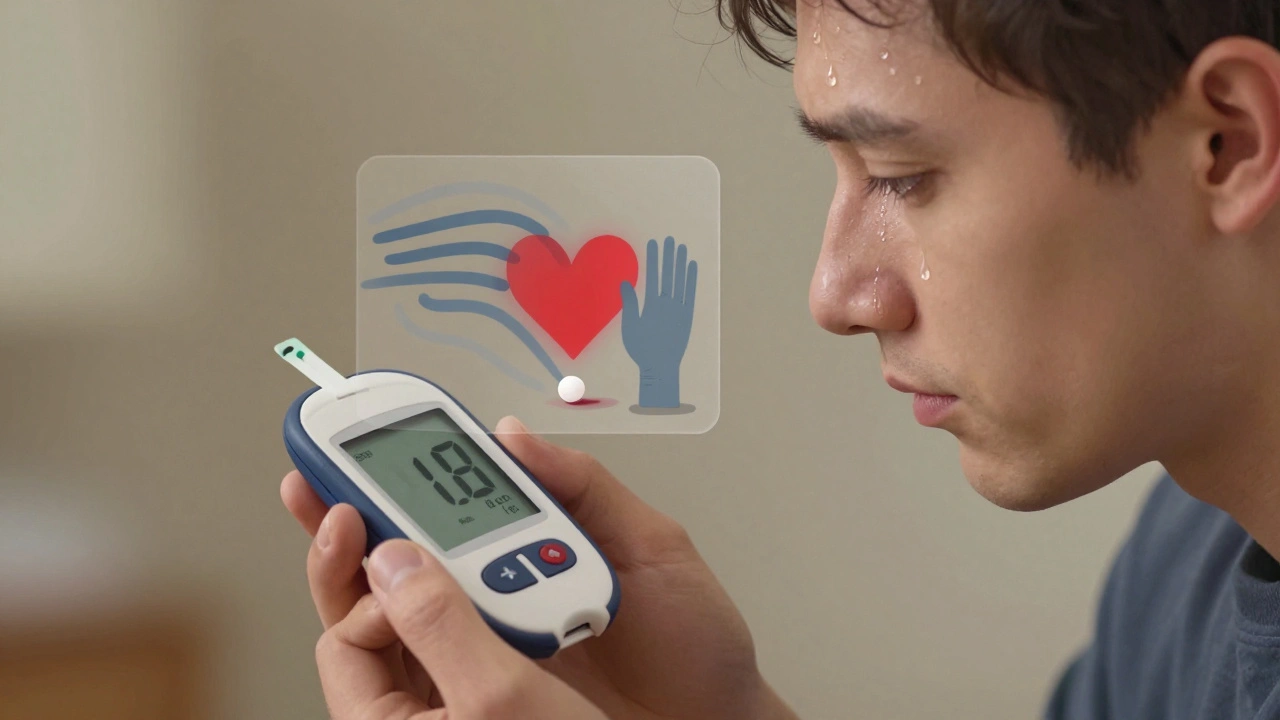
When you're managing diabetes with insulin, your body relies on warning signs to tell you when your blood sugar is dropping. Trembling, sweating, a racing heart-these are your body’s alarms. But if you’re also taking a beta-blocker for high blood pressure or heart disease, those alarms can go silent. And that’s not just inconvenient. It’s dangerous.
Why Your Body Stops Warning You
Insulin lowers blood sugar. That’s its job. But when blood sugar dips too low, your body kicks in with a fight-or-flight response: adrenaline surges, your heart pounds, you start to sweat, your hands shake. These are the classic signs of hypoglycemia. They’re not just discomfort-they’re lifesavers. They tell you to eat something before you pass out or have a seizure.
Beta-blockers, used for heart conditions, high blood pressure, and even anxiety, block adrenaline. That’s why they help lower heart rate and blood pressure. But they also block the very signals that warn you your blood sugar is crashing. The result? Hypoglycemia unawareness. You don’t feel the warning. You just suddenly feel confused, weak, or pass out.
Studies show about 40% of people with type 1 diabetes develop this unawareness over time. And if you’re on insulin and a beta-blocker? Your risk shoots up. The problem isn’t that beta-blockers make your blood sugar drop faster-they don’t. The problem is they hide the signs so you don’t know to fix it.
Not All Beta-Blockers Are the Same
There’s a big difference between types of beta-blockers. Non-selective ones like propranolol block all beta-receptors-heart, lungs, liver, even sweat glands. They’re the worst offenders for masking hypoglycemia.
Cardioselective beta-blockers like metoprolol and atenolol mainly target the heart. They’re safer, but still risky. Research shows they still increase the chance of severe low blood sugar by 2.3 times in hospitalized patients. And here’s the twist: even these can make it harder for your liver to release glucose when you’re low, slowing your recovery.
Carvedilol is different. It’s not just a beta-blocker-it also blocks alpha receptors. That gives it a unique profile. Studies show people on carvedilol have a 35% lower risk of severe hypoglycemia compared to those on metoprolol. It doesn’t mask symptoms as much, and it doesn’t interfere with glucose recovery as severely. For diabetic patients on insulin, carvedilol is now the preferred choice when a beta-blocker is needed.
One Warning Sign Still Works
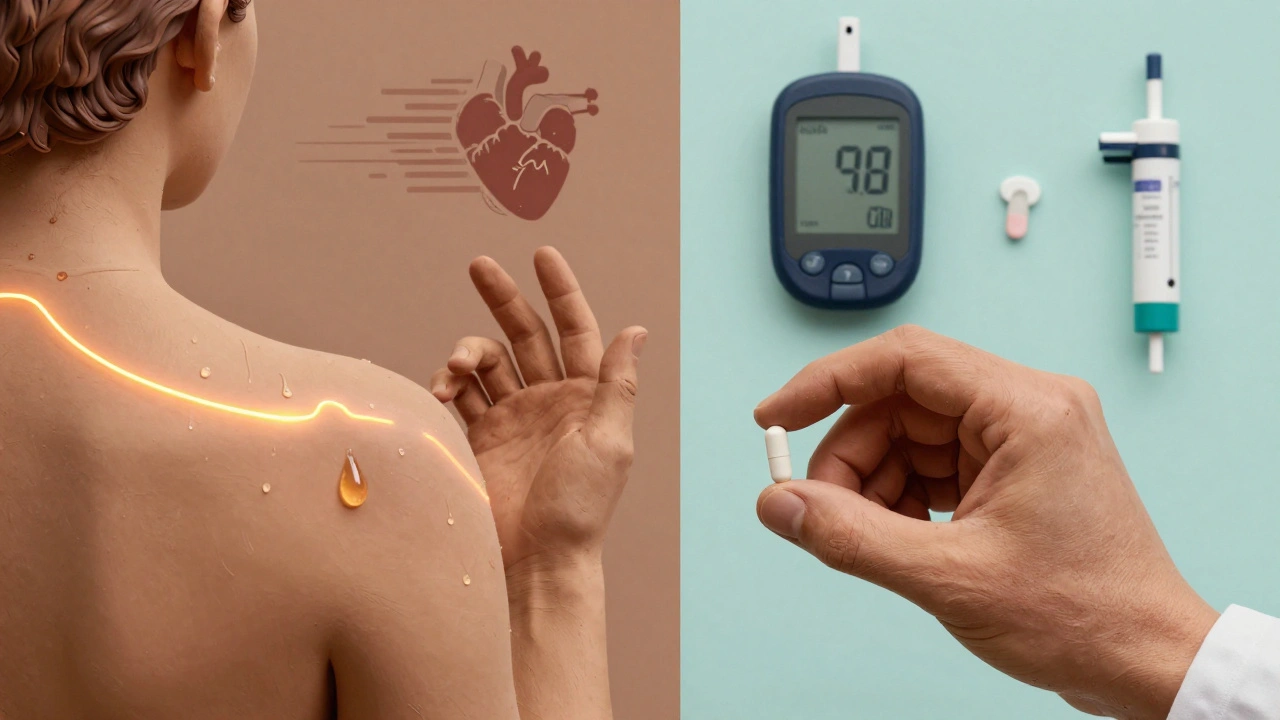
You might think all warning signs are gone. But there’s one that usually stays: sweating. Why? Because sweating isn’t controlled by adrenaline. It’s triggered by acetylcholine, a different chemical pathway. So even if your heart isn’t racing and your hands aren’t shaking, you might still break out in a cold sweat.
That’s your last line of defense. But here’s the catch: many people don’t recognize it. They think it’s just hot, or nervous, or that their shirt is damp from exercise. If you’re on insulin and a beta-blocker, you need to retrain yourself. Any sudden, unexplained sweating-especially if you haven’t been active-means check your blood sugar. Now.

The Real Danger: Silent Crashes
The biggest threat isn’t just passing out. It’s what happens after. When you don’t feel low, you don’t treat it. By the time someone notices you’re confused or unresponsive, your blood sugar could be at 30 mg/dL or lower. That’s a medical emergency. Severe hypoglycemia can cause seizures, strokes, or even sudden cardiac death.
Studies show that people on selective beta-blockers have a 28% higher risk of dying from a low blood sugar episode compared to those not taking them. And 68% of these dangerous events happen within the first 24 hours of starting or changing a beta-blocker. That’s why hospitals require blood glucose checks every 2 to 4 hours for diabetic patients on these drugs.
Even outside the hospital, the risk is real. The ADVANCE trial found no long-term difference in hypoglycemia rates between atenolol and placebo over five years-but that’s because outpatient management is different. People are more aware, check glucose more often, and adjust insulin. In the hospital? It’s chaos. Insulin doses change. Meals are delayed. Stress hormones spike. That’s when things go wrong.
What You Can Do
If you’re on insulin and a beta-blocker, here’s what you need to do right now:
- Check your blood sugar more often-at least four times a day, and before driving, exercising, or sleeping. If you’re hospitalized, insist on checks every 2-4 hours.
- Ask your doctor about carvedilol. If you’re on propranolol or metoprolol, ask if switching is an option. Carvedilol is safer for your blood sugar.
- Learn to recognize sweating as your warning. Don’t ignore it. Don’t assume it’s just heat or stress. Test your glucose every time you break out in a cold sweat without reason.
- Use a continuous glucose monitor (CGM). CGMs have reduced severe hypoglycemia by 42% in people on beta-blockers. They beep when your sugar drops-even if you don’t feel it. If you’re not using one, get one.
- Tell everyone you live with. Your partner, your kids, your coworker-teach them what to do if you look confused or unresponsive. Keep glucagon on hand. Know how to use it.
What Doctors Are Doing Differently
Guidelines from the American Diabetes Association and the American Heart Association now say: don’t avoid beta-blockers in diabetic patients. They save lives after heart attacks. But you must manage the risk.
Best practice today? Start with carvedilol. Avoid non-selective beta-blockers entirely if you have a history of hypoglycemia unawareness. Use CGMs. Monitor closely in the first 24-48 hours after starting or changing the drug. Educate patients on sweating. That’s it. Simple. But life-saving.
Quality programs in hospitals that followed these steps reduced hypoglycemia complications by 35% in just one year. That’s not magic. That’s just paying attention.
The Future: Personalized Medicine
Researchers are now looking at genetics to predict who’s most at risk. The DIAMOND trial is testing whether certain gene variants make some people more likely to lose hypoglycemia awareness when on beta-blockers. If it works, we could one day test your DNA before prescribing and choose the safest drug for you-no guesswork.
Until then, the tools we have work. CGMs. Carvedilol. Frequent checks. Education. These aren’t new. They’re just underused.
Insulin saves lives. Beta-blockers save lives. But together, without awareness, they can turn a routine treatment into a silent killer. The fix isn’t complicated. It’s just urgent.
Maria Elisha
December 10, 2025 AT 17:31Just checked my CGM and saw my sugar dropped to 62 while I was napping. No warning. Scared the hell out of me. This post? Lifesaver.
Nikhil Pattni
December 12, 2025 AT 01:23Look I’ve been on metoprolol for 8 years and insulin since I was 12 and I never had an issue until last month when I started feeling like I’m underwater every time I get low. Turns out I was having silent lows for months. My endo didn’t even mention the beta-blocker risk. I’m switching to carvedilol next week. Also, if you’re not using a CGM you’re basically flying blind with a parachute that’s been stitched by a toddler. Get one. It’s not optional anymore. I used to think they were for hypochondriacs but now I see it’s like having a seatbelt in a Ferrari. You don’t need it until you need it BADLY. And then you’re glad you had it. Also, sweating? Yeah that’s my only warning now. I’ve started carrying a sweat tracker app just to log when I break out in cold sweats at 3am. It’s weird but it works. And if you’re a doctor reading this stop assuming your patients know this stuff. Most of us didn’t. We just Google it at 2am like normal people.
precious amzy
December 13, 2025 AT 06:00One cannot help but observe the epistemological paradox inherent in the pharmacological masking of physiological autonomic signals: if the body’s alarm system is chemically silenced, does the danger still exist as an ontological truth, or is it merely a construct of medical orthodoxy? The Hegelian dialectic of insulin and beta-blockers reveals a deeper tension between technological intervention and biological integrity-a tension that modern medicine, in its hubris, continues to ignore at the peril of the patient’s phenomenological experience.
iswarya bala
December 14, 2025 AT 15:22omg i had no idea sweating was the only sign left!! i thought i was just stressed or my ac was broken lol. got my cgm yesterday and already caught a low before i passed out. thank you for this post!!
Simran Chettiar
December 15, 2025 AT 22:26It is imperative to acknowledge that the confluence of insulin therapy and beta-blocker administration constitutes a critical intersection in metabolic neurophysiology wherein the autonomic nervous system’s capacity to signal homeostatic imbalance is systematically attenuated. The clinical implications are not merely pharmacological but existential, as the patient’s corporeal autonomy is rendered contingent upon external monitoring apparatuses. The erosion of somatic awareness, therefore, represents not merely a medical oversight but a profound epistemic rupture in the patient-provider relationship.
om guru
December 16, 2025 AT 12:15Carvedilol is the way. CGM is non-negotiable. Check sugar before bed. Tell your family. Simple. Do it.
Richard Eite
December 17, 2025 AT 05:54USA makes the best insulin and the best CGMs. If you’re outside the US and still using old-school strips you’re just asking to die. Stop being lazy. Get a Dexcom. End of story.
Katherine Chan
December 18, 2025 AT 07:21I just started carvedilol last month and my CGM has been a game changer. I used to wake up at 3am with panic attacks and not know why. Now I know it’s low sugar not anxiety. I feel like I got my life back. You guys are not alone. We got this
Tim Tinh
December 18, 2025 AT 21:17my doctor said carvedilol was 'too new' for me but i did my own research and switched anyway. 3 weeks in and no more scary lows. also i spelled 'carvedilol' wrong 5 times before i got it right. sorry doc.
Olivia Portier
December 20, 2025 AT 04:42just wanted to say thank you to everyone who shared their stories. i was scared to talk about my silent lows because i thought i was just 'being dramatic.' turns out i’m not alone. and i’m getting a CGM next week. you all are my heroes
Jennifer Blandford
December 22, 2025 AT 01:30I had a seizure last year because I didn’t feel low. I woke up in the hospital with my mom screaming and glucagon in my arm. I didn’t even know I was low until they told me. Now I wear my CGM like a badge of honor. I’m not broken. I’m just smart enough to use the tools that keep me alive.
Brianna Black
December 23, 2025 AT 00:36It is a profound ethical failure of contemporary endocrinology that patients are left to self-educate on the pharmacological antagonism between life-saving modalities. The onus should not rest upon the individual to decipher the hidden risks embedded within polypharmacy. Institutional protocols must evolve to mandate glucose monitoring and patient education at the point of beta-blocker prescription-particularly in populations with known insulin dependence. This is not advocacy. This is basic medical responsibility.
Shubham Mathur
December 24, 2025 AT 01:26Why are we still talking about this? Carvedilol is better. CGM works. Sweating means check. You’re not special. You’re not immune. Do the thing. Stop waiting for someone to tell you. You’re reading this now. Do it. Now.
Stacy Tolbert
December 25, 2025 AT 07:15I used to feel guilty every time I went low. Like I failed. Like I was weak. But this post made me realize it’s not me. It’s the drugs. And I’m not broken. I’m just trying to survive a system that doesn’t warn you until it’s too late.
om guru
December 26, 2025 AT 00:59Good. Now go tell your doctor. And if they say no, get a second opinion. Your life is worth more than their inertia.