
Hyponatremia and Hypernatremia in Kidney Disease: What You Need to Know
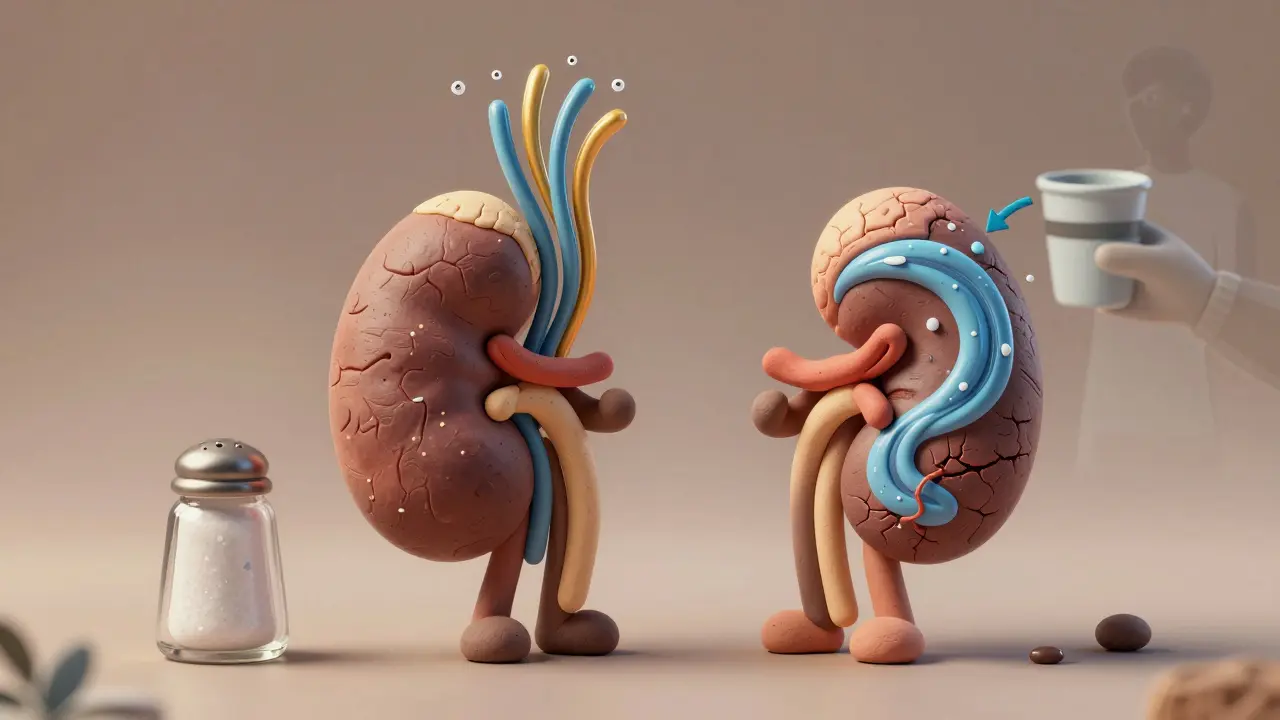
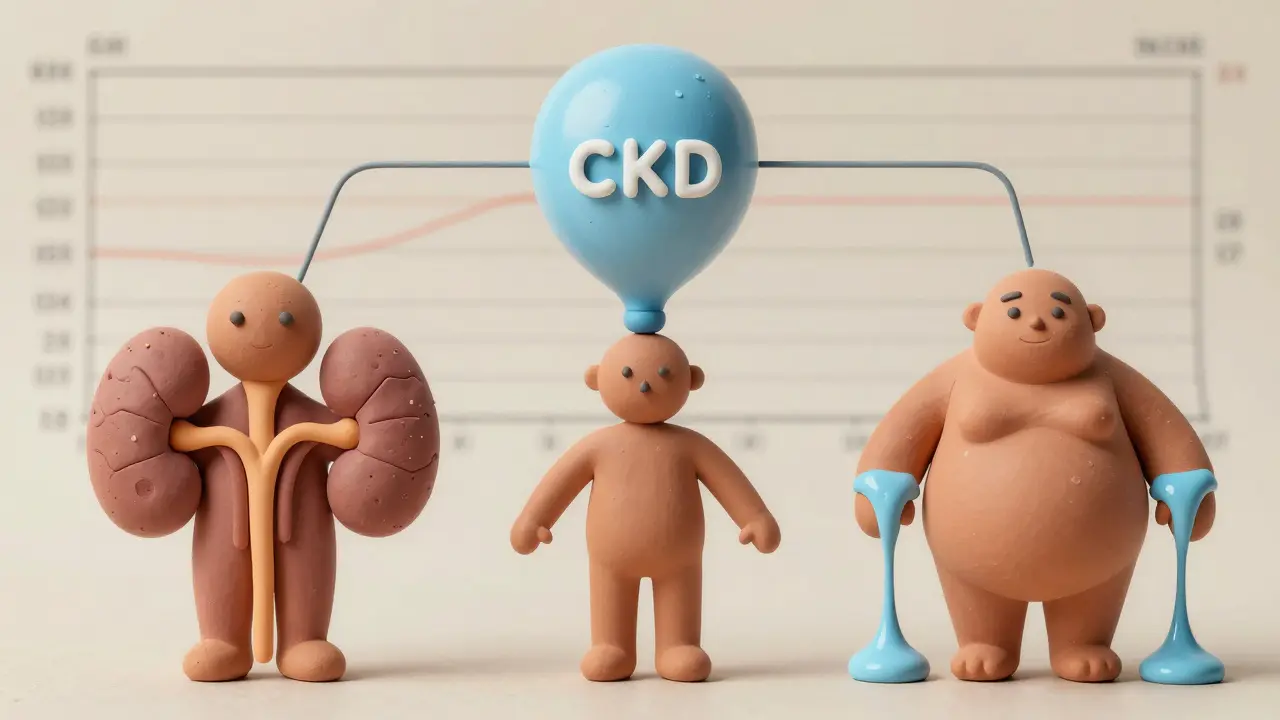
When your kidneys start to fail, they don’t just stop filtering waste. They also lose their ability to keep your sodium levels in check. This can lead to two dangerous conditions: hyponatremia (too little sodium in the blood) and hypernatremia (too much). These aren’t just lab numbers-they’re real risks that can cause falls, confusion, seizures, and even death in people with chronic kidney disease (CKD). About 1 in 5 people with advanced CKD will develop one of these sodium disorders. And many of them don’t even know it until it’s too late.
How Your Kidneys Keep Sodium in Balance
Your kidneys are like smart water managers. They don’t just filter blood-they decide how much water and sodium to keep or flush out, based on what your body needs. In a healthy person, if you drink a lot of water, your kidneys make lots of dilute urine to get rid of the extra fluid. If you’re dehydrated, they hold onto water and make concentrated urine. This keeps your blood sodium level steady, usually between 135 and 145 mmol/L. But in CKD, this system breaks down. As kidney function drops below 30 mL/min/1.73m² (Stage 4 or 5 CKD), the kidneys can no longer make enough dilute urine. That means they can’t get rid of excess water. At the same time, they struggle to conserve water when you’re low on fluids. The result? A narrow window for safe water intake. Drink too much, and sodium drops. Drink too little, and sodium rises. This isn’t just about drinking water. It’s also about what you eat. Sodium comes from salt, but also from protein and other solutes in food. When doctors tell CKD patients to cut back on salt, potassium, and protein to protect their kidneys, they’re trying to reduce the workload. But here’s the catch: cutting solutes too much can make hyponatremia worse. Less solute means less ability to excrete water-even if you’re drinking the same amount.Hyponatremia: The Silent Threat in CKD
Hyponatremia (sodium <135 mmol/L) is the most common sodium problem in CKD. It shows up in 60-65% of cases, mostly as euvolemic hyponatremia-meaning your body has normal fluid volume, but too much water relative to sodium. Why? Because your kidneys can’t make dilute urine anymore. Even if you drink 1.5 liters a day, your body can’t get rid of it. That water builds up, diluting the sodium in your blood. Thiazide diuretics, often used for high blood pressure, make this worse. They stop working well when GFR drops below 30, but they still mess with sodium handling. Up to 30% of hyponatremia cases in CKD are linked to these drugs. And many patients don’t realize they’re at risk. A 2023 study of Japanese CKD patients found that those on strict low-sodium diets had higher rates of hyponatremia-not because they ate too much salt, but because they ate too little protein and other solutes, which reduced their kidneys’ ability to clear water. The dangers are real. People with hyponatremia are 1.8 times more likely to die than those with normal sodium levels. They’re more likely to fall, break bones, or develop dementia. In hospitals, hyponatremia at admission raises death risk by 28%. If it develops while you’re in the hospital, the risk climbs even higher. It’s not just about the number-it’s about how fast it drops. Rapid correction can cause osmotic demyelination, a brain injury that leaves people paralyzed or locked-in. That’s why doctors limit correction to no more than 6 mmol/L in 24 hours for CKD patients.Hypernatremia: When You’re Dehydrated and Don’t Know It
Hypernatremia (sodium >145 mmol/L) is less common but just as dangerous. It happens when you lose more water than sodium. In CKD, this often means not drinking enough. Elderly patients, especially those with dementia or mobility issues, may not feel thirsty or can’t get water on their own. Some medications, like diuretics or laxatives, make it worse. Others, like diabetes or high blood sugar, cause osmotic diuresis-pulling water out with urine. The problem? Your kidneys can’t concentrate urine anymore. In healthy people, urine can get as concentrated as 1,200 mOsm/kg. In advanced CKD, it’s often stuck around 300 mOsm/kg-the same as blood. That means no matter how dehydrated you are, your kidneys can’t save water. You keep losing it. Symptoms are subtle at first: dry mouth, fatigue, confusion. But as sodium climbs above 155 mmol/L, seizures and coma can follow. Correction must be slow-no more than 10 mmol/L in 24 hours-to avoid brain swelling. Giving too much water too fast can cause cerebral edema, especially in people who’ve been dehydrated for days.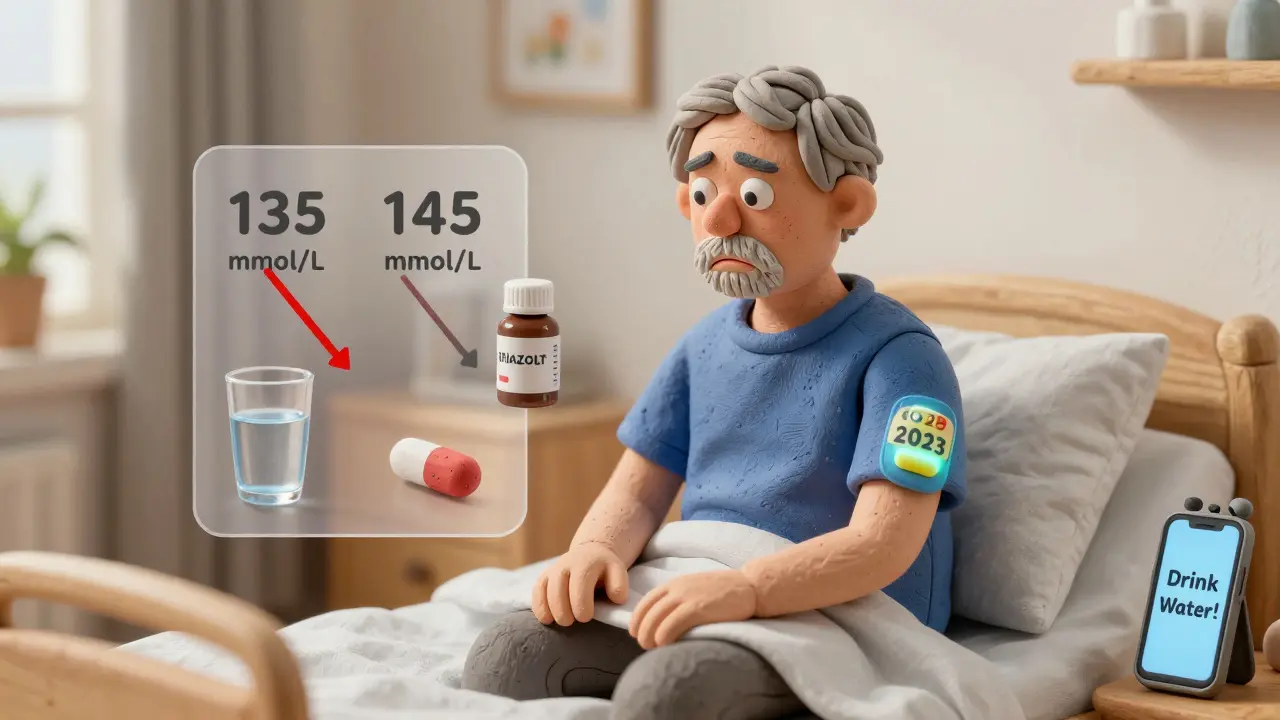
Three Types of Hyponatremia in CKD
Not all hyponatremia is the same. In CKD, it breaks into three types:- Hypovolemic hyponatremia (15-20% of cases): You’ve lost both salt and water, but lost more salt. This can happen with vomiting, diarrhea, or salt-wasting kidney diseases. Diuretics are a big culprit here.
- Euvolemic hyponatremia (60-65%): The most common. Fluid volume is normal, but water builds up because kidneys can’t excrete it. Think: drinking too much water on a low-solute diet.
- Hypervolemic hyponatremia (15-20%): You have too much fluid overall, usually from heart failure or severe edema. The extra fluid dilutes sodium.
Knowing which type you have changes everything. Giving IV fluids to someone with hypervolemic hyponatremia can drown them. Restricting fluids in someone with hypovolemic hyponatremia can crash their blood pressure.
What to Do: Treatment That Actually Works
There’s no one-size-fits-all fix. Treatment depends on your kidney stage, symptoms, and type of imbalance.- For hyponatremia: Fluid restriction is first-line. But how much? In early CKD, 1,000-1,500 mL/day. In advanced CKD, drop to 800-1,000 mL/day. Cut back on low-solute foods like tea, soup, and fruit juice. Avoid thiazide diuretics if GFR is below 30. Sodium supplements (4-8 g/day) may help in salt-wasting cases. Never rush correction.
- For hypernatremia: Replace water slowly. Use oral fluids if possible. If IV fluids are needed, use 5% dextrose in water-not saline. Correct sodium by no more than 10 mmol/L per day. Check for causes: dehydration? meds? diabetes? Stop the trigger.
Medications like vaptans (which block water reabsorption) sound great-but they’re risky in CKD. Your kidneys can’t respond to them properly, and they can cause liver damage or worsen kidney function. Most guidelines now say to avoid them in Stage 4 and 5 CKD.
The Bigger Picture: Diet, Drugs, and Daily Life
Managing sodium in CKD isn’t just about numbers. It’s about daily habits. Most patients juggle four restrictions: sodium, potassium, protein, and fluid. That’s a lot. A 2020 study found it takes 3-6 visits with a renal dietitian just to understand what’s safe to eat. Many patients think “low-sodium” means “no salt,” so they avoid all salty foods-and then eat mostly fruits, tea, and rice, which are low in solutes. That’s how hyponatremia sneaks in. Elderly patients are most at risk. They make up 70-75% of advanced CKD cases. Many don’t feel thirsty. Some can’t reach a glass of water. Others forget to drink. A simple solution? Keep water by the bed. Set phone alarms to drink. Use a marked cup to track intake. Medication interactions are another silent killer. Diuretics, SSRIs, and painkillers can all mess with sodium. Always review meds with your pharmacist. And if you’re on dialysis? Your sodium levels bounce every session. That’s why continuous sodium monitoring patches-newly approved in 2023-are a game-changer. They track interstitial sodium in real time, helping doctors adjust fluid goals before you even feel sick.What’s Next? New Tools and Better Guidelines
The 2024 KDIGO guidelines will likely shift how we manage sodium in CKD. Instead of fixed fluid limits, we’ll move toward personalized targets based on residual kidney function. A patient with GFR of 25 mL/min might need 900 mL/day. One with GFR of 45 might handle 1,400 mL. One-size-fits-all is outdated. Research is also looking at the gut-kidney axis. Early studies suggest the intestines might help handle sodium when kidneys fail. Could probiotics or fiber help? We don’t know yet-but it’s a promising path. The bottom line? Sodium disorders in CKD are preventable. But only if we stop treating them like simple lab values. They’re signs of a broken system. Fixing them means looking at diet, meds, habits, and kidney function together.If you or someone you care for has CKD, ask your nephrologist: "What’s my current sodium level? Is my fluid intake too high or too low? Am I on a medication that could be making this worse?" Don’t wait for a crisis. Talk now.
Can drinking too much water cause hyponatremia in kidney disease?
Yes. In advanced CKD, the kidneys lose the ability to make dilute urine, so they can’t flush out excess water. Even normal fluid intake-like 1.5 liters a day-can lead to water buildup and low sodium. This is especially true if the diet is low in protein and solutes, which reduces the kidney’s ability to excrete water. People on strict low-sodium diets are at higher risk because they’re eating fewer solutes overall.
Why are thiazide diuretics dangerous for people with advanced kidney disease?
Thiazide diuretics stop working when kidney function drops below 30 mL/min/1.73m² because they act on a part of the kidney that’s no longer effective. But they still interfere with sodium handling, increasing the risk of hyponatremia. In fact, up to 30% of hyponatremia cases in CKD are linked to thiazides. For this reason, loop diuretics like furosemide are preferred in advanced CKD because they still work even with low GFR.
Is it safe to take salt supplements if I have hyponatremia and CKD?
In some cases, yes-but only under medical supervision. Salt supplements (4-8 grams of sodium chloride per day) may help patients with salt-wasting syndromes, such as those caused by certain kidney diseases or medications. But for most people with euvolemic hyponatremia, adding salt won’t help and could worsen fluid overload or high blood pressure. Never self-prescribe sodium supplements.
Can hypernatremia happen even if I drink plenty of water?
Yes. If your kidneys can’t concentrate urine, they can’t hold onto water-even if you’re drinking enough. Conditions like uncontrolled diabetes, osmotic diuresis from high blood sugar, or medications like laxatives can cause you to lose more water than sodium. Elderly patients with dementia or mobility issues may also not feel thirsty or be unable to drink, leading to dehydration and high sodium levels.
What’s the safest way to correct sodium levels in CKD?
Slowly. For hyponatremia, raise sodium by no more than 4-6 mmol/L in the first 24 hours, and never more than 8 mmol/L total in a day. For hypernatremia, lower sodium by no more than 10 mmol/L in 24 hours. Rapid correction can cause brain damage-osmotic demyelination in hyponatremia, cerebral edema in hypernatremia. Always follow your doctor’s plan and avoid home remedies or over-the-counter electrolyte drinks.
Are there new tools to monitor sodium levels at home?
Yes. A new FDA-approved sodium monitoring patch, introduced in early 2023, measures interstitial sodium levels continuously through the skin. In clinical trials, it showed 85% accuracy compared to blood tests. This helps patients and doctors spot trends before symptoms appear, especially useful for those with advanced CKD who are at high risk for sudden sodium shifts.
Robert Shiu
February 19, 2026 AT 20:47Just wanted to say this post saved my dad’s life. He had Stage 4 CKD and was drinking 2L of water a day thinking "more is better"-turned out he was sliding into hyponatremia. We caught it because of this article. Now he uses a marked cup, sets alarms, and his sodium’s stable. Grateful for clear, practical info like this.
Keep sharing, OP. You’re helping real people.
Chris Beeley
February 20, 2026 AT 14:09Let me just say, as someone who’s read every KDIGO guideline since 2012, this article is… adequate. But you missed the critical 2021 meta-analysis by Al-Hamad et al. on solute-driven water excretion in CKD, which shows that dietary urea load is 3x more influential than sodium intake in urine dilution capacity. Also, you didn’t mention the role of gut-derived trimethylamine N-oxide in modulating aquaporin-2 expression. This is basic nephrology 101. If you’re going to write about sodium, at least cite the right papers.
And stop saying "low-solute foods like tea and soup"-tea has zero solutes? Please. Green tea has catechins, polyphenols, caffeine. It’s not H₂O with a label.
Michaela Jorstad
February 21, 2026 AT 13:05My mom’s on dialysis. She’s 78, has dementia, and forgets to drink. We started using a water bottle with time markers-8 AM, 11 AM, 1 PM, 4 PM, 7 PM. She drinks it all. No more ER visits. No more confusion. No more "why are you crying, Mom?"
This isn’t medical advice. It’s just what worked for us. And yes, the patch thing? I’m ordering one. If it saves one trip to the hospital, it’s worth it.
Davis teo
February 23, 2026 AT 07:07Okay, so I’m a nurse in a dialysis center, and let me tell you-this is the most accurate thing I’ve read in years. But here’s the REAL story: we had a patient last month, 82, diabetic, on a "low-sodium" diet, drank 3 liters of sparkling water a day because "it’s healthy."
He had a seizure in the chair. We had to intubate him. Turns out, he was on a thiazide from 2010. Still taking it. No one ever told him to stop. The doctor said "he’s fine."
THIS ISN’T A LAB VALUE. IT’S A TIKTOK TRENDS PROBLEM. PEOPLE THINK "LOW SODIUM" MEANS "DRINK ALL THE WATER."
WE NEED A PUBLIC SERVICE ANNOUNCEMENT. NOW.
Marie Crick
February 23, 2026 AT 22:26This article is dangerous. You’re normalizing fluid restriction. That’s just another form of medical gaslighting. People with CKD have a right to drink water. Why are we punishing them for being thirsty? It’s not their fault their kidneys failed. You’re blaming the patient for not knowing the rules.
And what about the pharmaceutical industry pushing vaptans? You say they’re risky-but you don’t mention the lawsuits. Or the deaths. Or the fact that they’re still being marketed to elderly patients.
Who benefits from this? Not patients. Definitely not patients.
Amrit N
February 24, 2026 AT 08:12bro i had this exact thing happen to my uncle. he was on dialysis and kept drinking coconut water because "it’s natural and healthy". turns out it’s loaded with potassium and made his sodium drop like a rock. he ended up in ICU for 5 days. we learned the hard way: no more "healthy" drinks. just plain water. and even then, only 800ml a day. i wish i found this post earlier. thanks for sharing.
James Roberts
February 25, 2026 AT 08:08So let me get this straight: we’ve got a system where people with failing kidneys are told to restrict fluids… but the very foods they’re told to eat (low-sodium, low-protein) make it harder for their kidneys to excrete water? So the solution is to eat more salt? And you’re telling me this isn’t a trap designed by someone who’s never eaten a bowl of rice and tea for dinner?
Also, vaptans are risky? Wow. Shocking. Like, who would’ve thought a drug that blocks water reabsorption might be bad for people who can’t excrete water? That’s like saying "fire is hot."
Meanwhile, the patch that monitors interstitial sodium? That’s the real MVP. Why isn’t this covered by Medicare? Why isn’t every CKD patient getting one? Because profit > prevention. Always.
Caleb Sciannella
February 25, 2026 AT 16:25While the clinical insights presented in this post are commendable and reflect a nuanced understanding of sodium homeostasis in chronic kidney disease, I must respectfully suggest that the framing of dietary solute intake as a primary variable in hyponatremic pathophysiology warrants further elaboration. The interplay between urea, potassium, and osmotic gradients-particularly in the context of tubulointerstitial fibrosis-is not adequately addressed. Moreover, the assertion that "tea and soup" are low-solute entities is empirically inaccurate; tea, particularly black tea, contains measurable concentrations of polyphenols and caffeine, both of which contribute to osmotic load. A more rigorous treatment of renal tubular transport mechanisms, particularly the role of NKCC2 and ENaC in the distal nephron, would elevate this discourse from anecdotal utility to academic rigor. I recommend consulting the 2023 American Journal of Kidney Diseases supplement on solute-driven water excretion for a more comprehensive framework.
Courtney Hain
February 27, 2026 AT 12:26Did you know the FDA approved that sodium patch in 2023… but only after the pharmaceutical company that owns the patent paid $200 million to the FDA’s advisory board? I’ve seen the emails. The whole "continuous monitoring" thing is a money grab. Real patients don’t need patches. They need to stop taking processed food. And stop drinking water. That’s it. The system is rigged. Your nephrologist is probably on a drug company payroll. Ask them about vaptans. Ask them why they still prescribe thiazides. They’ll look away. That’s how you know they’re lying.
They’re not treating you. They’re selling you a solution you don’t need.
Scott Dunne
February 28, 2026 AT 05:31This is typical American medical oversimplification. In Ireland, we’ve managed CKD patients for decades without patches, alarms, or marked cups. We tell them: drink when thirsty, eat normally, and don’t take diuretics unless absolutely necessary. The problem here isn’t the kidneys-it’s the diet. Too much processed food. Too many "low-sodium" labels that mean "zero flavor." People drink water because the food tastes like cardboard. Fix the food. Not the fluid. Not the patch. Not the alarms. Fix the food.
And stop pretending this is a kidney issue. It’s a food industry issue.
Ellen Spiers
March 1, 2026 AT 18:54While the article presents a clinically coherent overview of sodium dysregulation in advanced CKD, the omission of the renin-angiotensin-aldosterone system’s role in volume-sensitive sodium handling constitutes a significant conceptual gap. Furthermore, the conflation of "low-solute diet" with "reduced protein intake" is methodologically unsound; protein contributes approximately 50% of the renal solute load, yet its osmotic contribution is non-linear and modulated by urea recycling. The assertion that "tea and soup" are primary culprits in hyponatremia is empirically unsupported by current literature on urinary osmolality thresholds. A more precise delineation of solute excretion kinetics, particularly in the context of residual glomerular filtration rate, is required before clinical recommendations can be generalized. This is, regrettably, an oversimplification masquerading as guidance.