
How to Understand Narrow Therapeutic Index Drugs and Generics

When you're prescribed a medication like warfarin, tacrolimus, or levothyroxine, you might not realize you're taking a narrow therapeutic index drug. These aren't just any pills-they're high-stakes medications where even tiny changes in dose can mean the difference between healing and hospitalization. The gap between the right dose and a dangerous one is razor-thin. That’s why switching from a brand-name version to a generic isn't as simple as saving a few dollars. It’s a decision that can affect your life.
What Exactly Is a Narrow Therapeutic Index Drug?
A narrow therapeutic index (NTI) drug is one where the amount needed to work is almost the same as the amount that can hurt you. The FDA defines it clearly: small changes in blood concentration can cause serious side effects, treatment failure, or even death. Think of it like walking a tightrope. One misstep, and you fall. These drugs are used for life-critical conditions:- Immunosuppressants like tacrolimus and cyclosporine-used after organ transplants to prevent rejection
- Anticoagulants like warfarin-to prevent strokes and blood clots
- Anticonvulsants like phenytoin and carbamazepine-to control seizures
- Antiarrhythmics like digoxin and flecainide-to regulate heart rhythm
- Thyroid hormones like levothyroxine-to maintain metabolic balance
Why Generic NTI Drugs Are Different
Most generic drugs are considered interchangeable with brand names if they’re within 80% to 125% of the original drug’s blood levels. That’s called bioequivalence. But for NTI drugs, that range is way too wide. The FDA requires much tighter standards. For many NTI drugs, generics must match the brand within 90% to 111% of the original. For some, like levothyroxine, the standard is even stricter-95% to 105%. That’s not a small tweak. It’s a major upgrade in quality control. Why? Because NTI drugs have steep dose-response curves. A 5% drop in blood level might make your seizure come back. A 5% rise could cause kidney damage or heart rhythm problems. Standard bioequivalence rules just don’t cut it here. This is why the FDA created special testing rules. Instead of single-dose studies, manufacturers must run replicate-design studies. These involve giving the same person the brand and generic multiple times to measure how consistent the absorption is. It’s more expensive and time-consuming, but it’s the only way to be sure.What Happens When You Switch Generics?
Many patients assume all generics are the same. They’re not. Two different generic versions of tacrolimus might both meet FDA standards, but they can still behave differently in your body. Why? Because of tiny differences in fillers, coatings, or manufacturing processes. For a non-NTI drug, that doesn’t matter. For an NTI drug, it can. Real stories prove this isn’t theoretical:- A kidney transplant patient switched from brand Prograf to a generic tacrolimus. Within three weeks, their creatinine levels doubled-signaling kidney stress. They ended up hospitalized.
- A woman on levothyroxine had her TSH levels swing from 2.1 to 8.9 after switching generics. She went from feeling fine to exhausted, depressed, and gaining weight. It took three adjustments to stabilize her.
- On the other hand, a man with epilepsy has been on generic phenytoin for five years. His seizures are controlled. His blood levels are stable. He saves $300 a month.
Pharmacists Are Cautious-And So Should You Be
A national survey of pharmacists found only 28% would automatically substitute a generic for an NTI drug, compared to 78% for regular medications. Why? Because they’ve seen the fallout. Sixty-four percent of pharmacists believe switching NTI generics can lead to therapeutic failure. That’s not fear-it’s experience. In Australia, where I’m based, the rules are strict. Automatic substitution of NTI drugs is restricted in most states. Prescribers must write “dispense as written” if they want to prevent switching. Pharmacists are trained to flag these prescriptions. They don’t just fill them-they question them. If you’re on an NTI drug, always ask:- Is this a brand or generic?
- Has my dose been adjusted since I last switched?
- Have I had my blood levels checked recently?
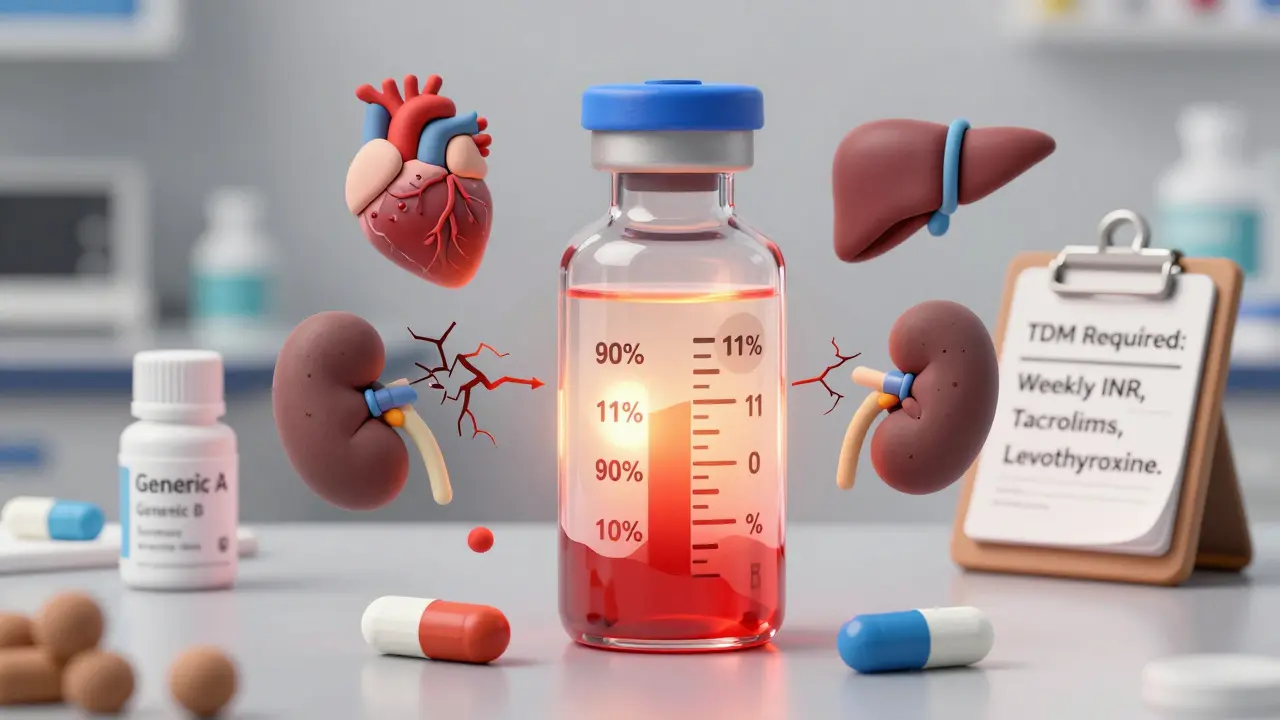
Therapeutic Drug Monitoring Is Non-Negotiable
If you’re on an NTI drug, regular blood tests aren’t optional-they’re essential. This is called therapeutic drug monitoring (TDM). It’s how doctors know if your dose is still safe and effective. For example:- Warfarin users get INR tests weekly or biweekly, especially after a dose change.
- Tacrolimus levels are checked every few days after a transplant, then monthly once stable.
- Levothyroxine patients need TSH tests every 6-8 weeks after a switch.
The Cost Trade-Off
Generic NTI drugs can cost 70-90% less than brand names. That’s huge for people on fixed incomes. But the savings come with risk. A $300 monthly saving sounds great-until you need an emergency room visit because your drug level dropped too low. Insurance companies love generics. They push them hard. But for NTI drugs, that push can backfire. Many insurers now require prior authorization before switching you off a brand. Some even require proof of stable blood levels before approving a switch. The bottom line: Don’t let cost drive this decision alone. Talk to your doctor and pharmacist. Ask: “Is the savings worth the risk?”What’s Changing in 2025?
The FDA is expanding its NTI list. By the end of 2025, they plan to release 12 new product-specific guidances-mostly for cancer drugs. More drugs will be classified as NTI, meaning stricter rules ahead. Pharmacogenomics is also entering the picture. By 2028, experts predict 40% of NTI prescriptions will include genetic testing. Why? Because your genes affect how you metabolize these drugs. Two people on the same dose can have wildly different blood levels. Genetic testing helps personalize dosing before it becomes dangerous. International standards are still messy. The U.S., Europe, and Japan don’t all agree on what counts as NTI. That makes global drug development harder. But in Australia, we follow the FDA’s lead closely. If the FDA says it’s NTI, we treat it as NTI.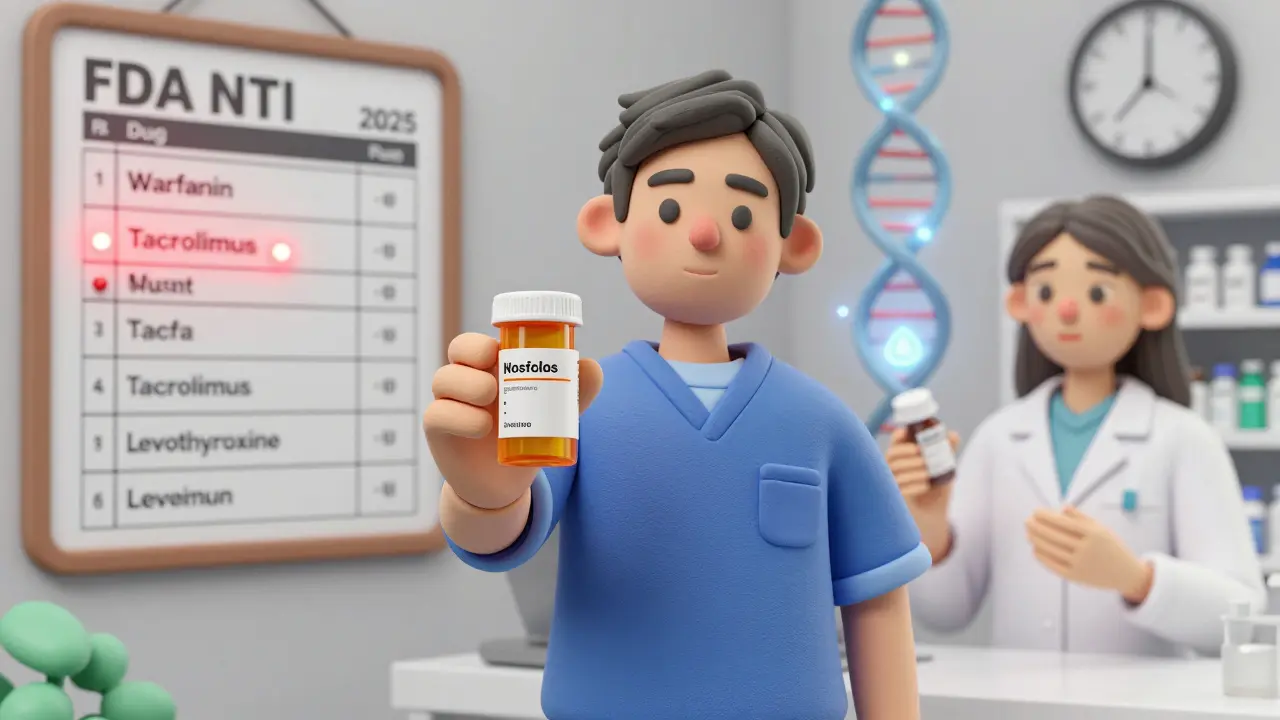
What You Can Do Right Now
If you take an NTI drug, here’s your action plan:- Know your drug. Is it on the FDA’s NTI list? Check the official list-don’t guess.
- Know your manufacturer. Keep the name of the brand or generic on your prescription bottle. Don’t let it change without your knowledge.
- Get blood tests. Ask for your last TDM result at every appointment. If you don’t have one, request it.
- Ask for “dispense as written” on your prescription if you’ve had stability issues.
- Report any side effects or changes in how you feel. Even small changes matter.
Final Thought: Generics Can Work-But Not Always
Generic NTI drugs aren’t bad. Many are safe, effective, and life-saving. But they’re not all the same. And switching them without monitoring is risky. The goal isn’t to ban generics. It’s to use them wisely. With the right monitoring, communication, and caution, you can save money without sacrificing safety. Your health isn’t a commodity. It’s your most valuable asset. Treat your NTI drugs that way.Are all generic drugs the same as brand names?
No-not all generics are the same, especially for narrow therapeutic index (NTI) drugs. While most generics meet FDA standards for bioequivalence, NTI drugs require much tighter tolerances. Two different generic versions of the same NTI drug can behave differently in your body due to variations in inactive ingredients or manufacturing. For drugs like tacrolimus or levothyroxine, even small differences can affect blood levels and lead to serious side effects or treatment failure.
Can I switch between generic NTI drugs safely?
Switching between different generic versions of an NTI drug is not recommended without medical supervision. Even if both generics meet FDA standards, they may have different absorption rates. Patients who switch between generics often report unstable blood levels, requiring dose adjustments. The safest approach is to stay on the same manufacturer’s product once your dose is stable. Always inform your doctor if your pharmacy changes your medication.
Why do some doctors refuse to allow generic substitution for NTI drugs?
Doctors avoid switching NTI drugs because small changes in drug levels can cause life-threatening outcomes. For example, a slight drop in tacrolimus can trigger organ rejection in transplant patients. A small rise in digoxin can cause fatal heart rhythms. Clinical evidence shows NTI drugs have higher rates of adverse events after switching. Many doctors prefer to keep patients on the same formulation-brand or generic-as long as it’s working safely.
How often should I get blood tests if I’m on an NTI drug?
Blood testing frequency depends on the drug and your condition. After starting or switching an NTI drug, tests are usually done weekly or biweekly until levels stabilize. Once stable, testing may drop to monthly or every 3-6 months. For drugs like warfarin, INR tests are often done every 1-4 weeks. Always follow your doctor’s schedule-don’t skip tests just because you feel fine. Blood levels can change without symptoms.
Is it legal for my pharmacy to switch my NTI drug without telling me?
In most U.S. states and in Australia, pharmacists are not allowed to automatically substitute NTI drugs without the prescriber’s approval. Many states require the doctor to write “dispense as written” or “no substitution” on the prescription. Even if substitution is legal, pharmacies should notify you before switching. If you’re unsure, ask your pharmacist whether your medication was changed-and why. You have the right to know.
Do insurance companies cover brand-name NTI drugs?
Many insurance plans require prior authorization before covering brand-name NTI drugs. They often push for generics to cut costs. However, if you’ve had problems with generics-like unstable blood levels or side effects-you can appeal. Your doctor can submit documentation showing medical necessity. In many cases, insurers will approve the brand if there’s clear evidence that generics have caused issues for you.
Joanne Smith
December 26, 2025 AT 23:23So let me get this straight - we’re trusting our lives to pills that might as well be different shades of the same color because the FDA says ‘close enough’? 😏 I’ve been on levothyroxine for a decade and switched generics twice. First time, I turned into a zombie. Second time, my heart started doing the cha-cha. Now I hand-deliver my script to the pharmacist with a photo of my last bottle. They know me by name. And yes, I pay extra. Worth it.
Generics aren’t evil. But treating NTI drugs like they’re toothpaste? That’s just lazy.
Also, if your pharmacist ‘automatically substitutes’ without asking, fire them. Or better yet - file a complaint. Someone’s gotta keep the system honest.
Ryan Cheng
December 27, 2025 AT 03:38Really glad you laid this out so clearly. A lot of people think ‘generic = same’ and it’s dangerous. I’m a pharmacist in Ohio, and I’ve seen way too many patients come in confused after a switch - fatigue, brain fog, palpitations. It’s not ‘all in their head.’ It’s pharmacokinetics.
The key is consistency. Once you find a generic that works, stick with it. Don’t let the pharmacy switch you unless you’re in a crisis. And if your doctor doesn’t order regular bloodwork? Push back. TDM isn’t optional - it’s your safety net.
Also, shoutout to Australia for getting this right. We should be doing the same here.
Ellie Stretshberry
December 28, 2025 AT 02:12i just started on tacrolimus after my transplant last month and i had no idea any of this
my dr just handed me a script and said ‘take this’
now im scared to even take it without checking the label every time
also why does my pharmacy keep changing the color of the pill??
help
Zina Constantin
December 28, 2025 AT 19:27As a nurse who’s worked in transplant units for 15 years, I’ve seen lives saved by generics - and lives lost because someone switched without monitoring.
It’s not about being anti-generic. It’s about being pro-safety.
My patients get a printed card with their drug name, manufacturer, and last TDM result. They carry it like a passport. I tell them: ‘If the pill looks different, ask. If you feel different, call.’
And yes - if your insurance pushes you to switch, say NO. You have rights. Write ‘dispense as written’ on the script. Do it now. Don’t wait for a crisis.
Jay Ara
December 28, 2025 AT 22:29in india we dont even have this problem because most ntis are still brand only
but when we do get generics they are way cheaper and people take them without testing
my uncle took generic phenytoin and had a seizure in public
now he just pays extra for the brand
money is important but not when your brain is involved
Kuldipsinh Rathod
December 28, 2025 AT 23:22bro this is real
i was on warfarin and switched to generic
one week later i had a blood clot in my leg
they said it was 'coincidence'
my INR was off by 3 points
now i only take the brand and i pay out of pocket
no one cares until it's your leg
SHAKTI BHARDWAJ
December 30, 2025 AT 09:04OH MY GOD YOU PEOPLE ARE SO PARANOID
IT'S JUST A PILLLLLLL
if you can't handle generics then maybe you shouldn't be on medicine at all
the system is designed to save money not to coddle you
and why are you all so obsessed with blood tests like you're in a sci fi movie
my dog takes generics and he's fine
you're all overreacting
also i hate doctors
they just want to make money off your fear
david jackson
December 30, 2025 AT 10:18Let me just say - this entire thread is a masterclass in how modern medicine has become a high-stakes game of Russian roulette with pills.
Imagine if your car’s fuel injection system had a 5% margin of error - you’d never drive it. But we’re okay with that same margin for drugs that regulate our hearts, our immune systems, our brains?
And don’t even get me started on the fact that the FDA’s ‘tighter’ standards for NTI generics are still 90–111%. That’s a 22% swing. That’s not tight - that’s a carnival ride.
Meanwhile, the pharmaceutical industry is laughing all the way to the bank, selling us the same active ingredient in a different capsule and calling it ‘equivalent.’
It’s not equivalence. It’s exploitation wrapped in a lab coat.
And yet - we’re told to trust the system.
Who’s protecting us? Not the insurers. Not the pharmacists. Not even the FDA.
Only us. And our blood tests.
So yes - write ‘dispense as written.’
Carry your pill bottle like a sacred relic.
And if you feel weird after a switch?
Don’t wait.
Call your doctor.
Now.
Jody Kennedy
December 31, 2025 AT 01:22YES YES YES. I’ve been telling everyone this for years!
My mom switched from brand to generic levothyroxine and started crying for no reason, gained 20 pounds, and couldn’t get out of bed. We thought it was depression. Turns out her TSH was 14. She was basically hypothyroid.
She went back to the brand and within 3 weeks, she was her old self.
Doctors don’t always know this stuff. Pharmacists are too busy. So YOU have to be the advocate.
Keep a log. Take pictures of your pills. Ask for your INR/TSH levels every time. Don’t be shy.
You’re not being difficult - you’re being smart.
christian ebongue
January 1, 2026 AT 14:06generic =/= same. period.
learned this the hard way with digoxin.
now i only take the one i started on.
and i screenshot the label.
also, tell your doc to write ‘no substitution’.
it’s not hard.
your life is worth it.
jesse chen
January 3, 2026 AT 07:22Thank you for this incredibly thoughtful, thorough, and necessary post. I’ve been on cyclosporine since my kidney transplant in 2019, and I’ve had to fight my insurance company three times to keep the brand. They wanted to switch me to a generic that was ‘FDA-approved’ - but my levels were stable, and my nephrologist said no.
It’s not about being anti-generic. It’s about being pro-stability. Pro-safety. Pro-living.
I keep a binder with every pill I’ve ever taken, the manufacturer, the date of switch, and my bloodwork. I bring it to every appointment. My doctors say it’s the most organized patient they’ve ever had.
And honestly? I think that’s the real secret. We’re not just patients - we’re data points. And we have to protect our own data.
Please, if you’re on an NTI drug - be that person. Be the one who asks. Be the one who records. Be the one who refuses to be a statistic.
Prasanthi Kontemukkala
January 4, 2026 AT 01:56thank you for sharing this. i have a friend on levothyroxine and she never knew any of this. i’m going to send her this right away.
also, i work in a pharmacy and i never realized how much responsibility we have with these meds. i’m going to start asking more questions before filling them.
small changes can make a big difference. i’m glad we’re talking about this.
Alex Ragen
January 4, 2026 AT 20:08Ah, yes - the myth of bioequivalence. A beautifully constructed illusion, engineered by regulatory capture and the commodification of human physiology.
The FDA, in its infinite wisdom, has reduced the human body to a statistical curve - a Gaussian distribution of plasma concentration - and declared that ‘within 90–111%’ is ‘equivalent.’
But the body is not a lab rat. It is not a machine. It is a complex, dynamic, epigenetically shaped ecosystem - and to treat it as if it were a linear pharmacokinetic model is not science. It is hubris.
And yet, we are expected to swallow this - literally and figuratively - with the same passive obedience we give to our smartphones and our credit scores.
Perhaps the real NTI drug is trust itself.
And we are all running dangerously low on it.