
Hemodialysis vs. Peritoneal Dialysis: Which Treatment Is Right for You?
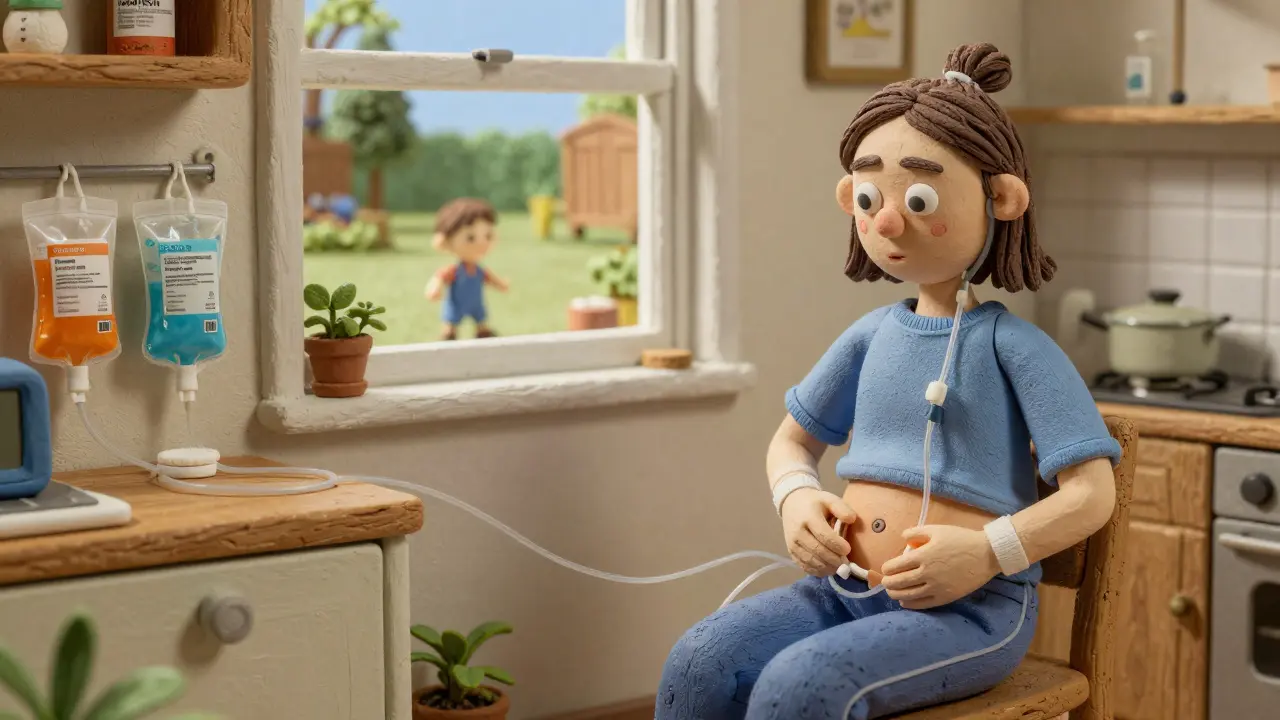
When your kidneys fail, life doesn’t stop-but how you manage it does. Two main treatments keep people alive: hemodialysis and peritoneal dialysis. Both do the same job: cleaning your blood when your kidneys can’t. But they do it in completely different ways. One uses a machine outside your body. The other uses the lining of your belly as a filter. Choosing between them isn’t just about medical facts. It’s about your lifestyle, your body, and what you can realistically live with every single day.
How Hemodialysis Works
How Peritoneal Dialysis Works
Peritoneal dialysis uses your own peritoneum-the membrane lining your abdominal cavity-as a natural filter. A soft, flexible tube called a Tenckhoff catheter is surgically placed in your abdomen. Through this, a special fluid called dialysate is introduced. This fluid pulls waste and extra fluid from your blood across the peritoneal membrane. After a few hours, the fluid is drained out and replaced with fresh solution. This process is called an exchange.
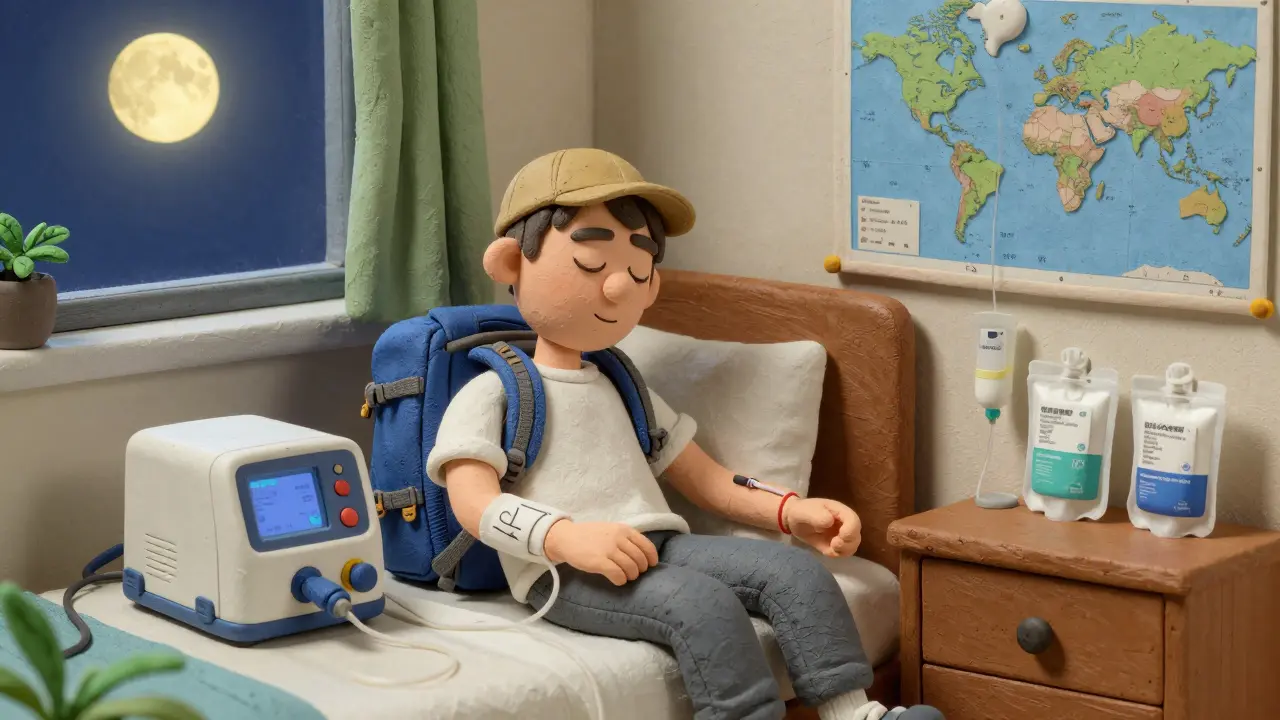
There are two types: Continuous Ambulatory Peritoneal Dialysis (CAPD) and Automated Peritoneal Dialysis (APD). CAPD is done by hand, usually 3 to 5 times a day, no machine needed. You drain the old fluid, fill your belly with new fluid, and go about your day. APD uses a machine, called a cycler, that does the exchanges automatically while you sleep. This gives you more freedom during the day but requires you to connect to the device every night.
Unlike hemodialysis, peritoneal dialysis works slowly and continuously. There’s no sudden drop in blood pressure or shock to your system. That’s why many patients report feeling better between treatments. You don’t get that post-dialysis fatigue that so many hemodialysis patients describe.
Clearance and Efficiency
At first glance, hemodialysis looks more powerful. In a single 4-hour session, it can remove a lot of waste quickly. The Kt/V-a standard measure of dialysis efficiency-typically hits 1.2 to 1.4 per session. Peritoneal dialysis doesn’t clear as much in one go. But because it runs 24/7, the total weekly clearance (Kt/V) ends up being similar: 1.7 to 2.1. The difference isn’t in how much gets removed-it’s in how it’s removed.
Studies show PD provides more stable removal of toxins like urea and creatinine. It also handles fluid better. With hemodialysis, you build up fluid between sessions, which can lead to swelling, high blood pressure, and heart strain. PD removes fluid gradually, so your body doesn’t get overwhelmed. A 2023 study from the First People’s Hospital of Tonglu County found PD patients had significantly lower systolic and diastolic blood pressure than HD patients after treatment. Their heart rates stayed steadier too.
Peritoneal dialysis also helps preserve what’s left of your natural kidney function longer. That’s a big deal. Even a little bit of remaining kidney function improves survival rates and reduces the need for extra medications. Hemodialysis can accelerate the loss of that function because of the stress it puts on your body.
Side Effects and Risks
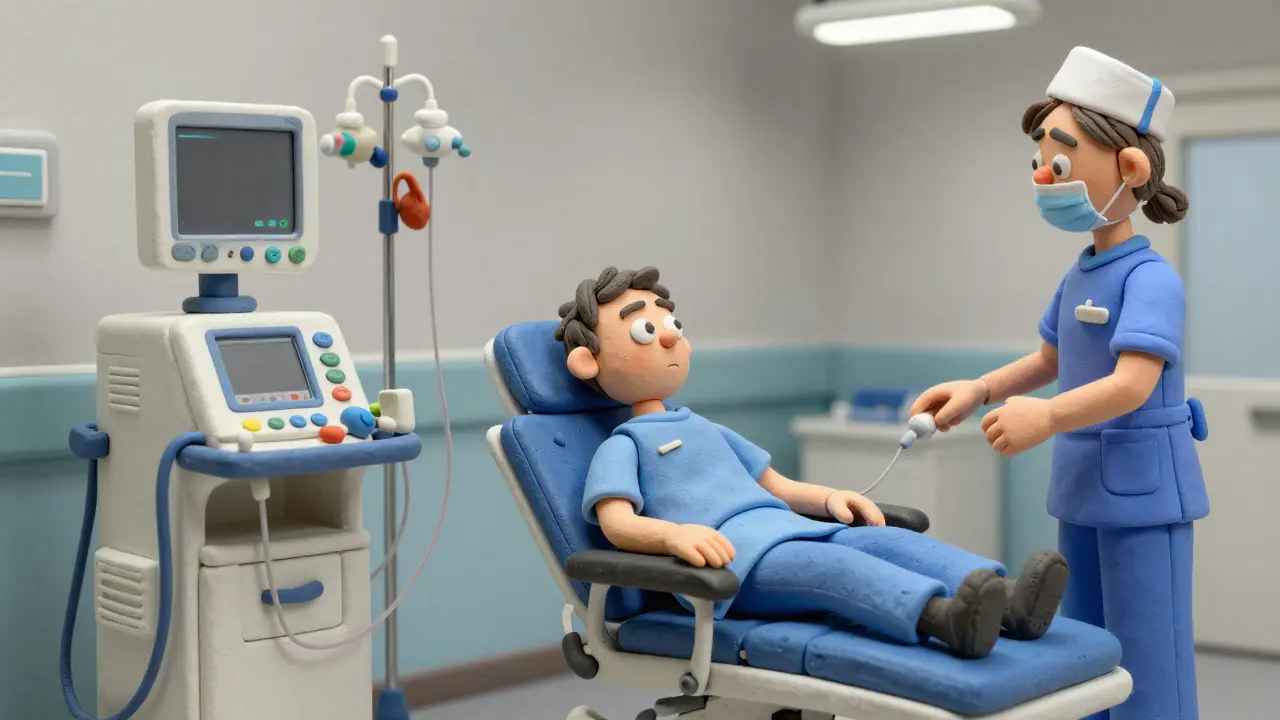
Every treatment has downsides. Hemodialysis carries risks tied to vascular access. About 40% of patients develop complications with their fistulas or grafts-blockages, infections, or poor blood flow. Catheters used for emergency access are even riskier, with higher infection rates. During treatment, rapid fluid removal can cause cramps, dizziness, and even heart rhythm problems. Many patients say they feel wiped out for hours afterward.
Peritoneal dialysis doesn’t touch your blood vessels, so it avoids those problems. But it has its own dangers. The biggest risk is peritonitis-an infection in the abdominal cavity. It happens in about 0.3 to 0.7 episodes per patient per year. Most cases are treatable with antibiotics, but repeated infections can damage the peritoneal membrane and force a switch to hemodialysis. Strict hygiene during exchanges is non-negotiable. If you forget to wash your hands or touch the catheter with dirty gloves, you’re putting yourself at risk.
Other PD issues include hernias from pressure in the abdomen, weight gain from glucose in the dialysate, and difficulty with manual dexterity. If you have arthritis, tremors, or poor eyesight, doing daily exchanges can be nearly impossible. Hemodialysis doesn’t ask you to do anything yourself-you sit in a chair, and the machine does the work.
Lifestyle and Flexibility
This is where the choice gets personal. Hemodialysis means fixed appointments. Three times a week. Four to five hours each time. You’re tied to a clinic. Travel becomes complicated. Miss a session? You feel awful. That rigidity is why so many patients on Reddit say they hate the schedule. One user wrote: “I miss my kids’ school plays because I’m hooked up to a machine.”
Peritoneal dialysis gives you control. You can do it at home, at work, even while traveling. CAPD lets you swap fluid during lunch breaks. APD runs while you sleep. You don’t need to rearrange your life around dialysis-you fit dialysis into your life. A 2022 National Kidney Foundation survey found 68% of PD users rated their flexibility as “excellent,” compared to just 32% of HD users.
But freedom comes with responsibility. PD requires training. You’ll spend 10 to 14 days learning sterile technique, how to handle catheters, recognize infection signs, and manage supplies. You need space to store dialysate bags. You need a clean, quiet area to do exchanges. You can’t just walk in and start. Hemodialysis doesn’t ask you to learn anything-you show up, and the staff takes over.
Cost and Accessibility
Peritoneal dialysis is cheaper. The equipment is simpler. No need for massive dialysis machines, water purification systems, or large staff teams. A 2023 study in the Journal of Peritoneal Therapy and Clinical Practice found PD offered better value for money, especially in the first two years of treatment. In countries like Hong Kong and the UK, PD adoption is much higher-77% and 22% respectively-because healthcare systems recognize its cost savings.
In the U.S., though, hemodialysis dominates. About 70% of patients get in-center HD. Why? Infrastructure. Most clinics are built for HD. Nephrologists are trained in HD. Insurance systems are set up to reimburse HD more easily. Only 34% of U.S. nephrology fellows get proper PD training, according to the American Society of Nephrology. That means many doctors don’t feel confident recommending it-even when it’s a better fit.
But things are shifting. The Centers for Medicare & Medicaid Services launched the ESRD Treatment Choices Model in 2021, pushing for 80% of new patients to get educated on home dialysis or transplant by 2025. That’s changing the game. More clinics are now offering PD training. More patients are choosing it. The American Journal of Kidney Diseases predicts PD use in the U.S. will rise to 18-22% by 2027.
Who Should Choose Which?
There’s no universal answer. But here’s what experts agree on:
- Choose PD if: You’re medically stable, have good manual dexterity, live in a clean environment, want independence, and don’t mind doing daily treatments. PD is ideal for younger patients, those with mild heart disease, or anyone who wants to keep working or traveling.
- Choose HD if: You have severe heart problems, fluid overload, or can’t manage sterile technique. It’s also preferred for older patients with dementia or those who don’t want the responsibility of self-care. If you’re in acute kidney failure or need rapid toxin removal, HD is faster and safer.
Some people start with HD because it’s the default-and later switch to PD once they adjust. Others begin with PD and move to HD if infections become too frequent. The decision isn’t always permanent.
What Patients Really Say
Real people, real experiences. On r/kidneydisease, HD users complain about the schedule, the fatigue, the needles. One wrote: “I feel like a zombie for 12 hours after each session. I miss my life.”
PD users talk about the catheter. “It’s always there,” one said. “I can’t wear tight clothes. I worry about it getting pulled.” Another added: “I had peritonitis three times. It scared me half to death.”
But the same group also said: “I did my exchange while watching my grandkid’s soccer game.” “I went to Europe for two weeks and did PD in my hotel room.” “I don’t have to miss work anymore.”
It’s not about which is better. It’s about which fits you.
The Future of Dialysis
The dialysis market is worth nearly $100 billion. But the future isn’t in bigger machines or faster cycles. It’s in personalization. New dialysate solutions, like icodextrin, are helping reduce glucose exposure and protect the peritoneal membrane longer. Wearable artificial kidneys are in early trials. Home hemodialysis is growing too, with more compact machines and remote monitoring.
But right now, the most important advance is awareness. More patients are learning that PD isn’t a “second choice.” It’s a valid, effective, and often superior option. The data doesn’t lie: PD offers better blood pressure control, less strain on the heart, and more independence. It’s not perfect. But for many, it’s the better life.
Can I switch from hemodialysis to peritoneal dialysis?
Yes, many patients switch, especially if they’re struggling with the side effects of hemodialysis or want more independence. But it’s not automatic. Your doctor will check your abdominal health, make sure you don’t have scarring or hernias, and ensure you’re physically and mentally ready for the self-care required. Training takes 10-14 days, and your catheter needs time to heal before starting.
Is peritoneal dialysis safer than hemodialysis?
It depends on what you mean by “safer.” PD avoids the risks of vascular access and hemodynamic crashes that come with hemodialysis. But it introduces the risk of peritonitis, which can be serious if not caught early. Studies show PD has lower overall complication rates, especially for patients with heart conditions. For someone who can manage sterile technique, PD is often the safer long-term option.
Does peritoneal dialysis hurt?
The catheter placement is done under local anesthesia, so you won’t feel pain during surgery. Afterward, there’s some discomfort for a few days, but it fades. During exchanges, you might feel pressure or fullness in your belly, like you’ve eaten too much. Most people say it’s not painful, just unusual at first. If you feel sharp pain, fever, or cloudy fluid, that’s a sign of infection-you need to call your doctor right away.
Can I travel with peritoneal dialysis?
Absolutely. Many PD patients travel internationally. You can ship dialysate bags ahead of time, carry them in your luggage (they’re not considered liquids by airlines), or buy them locally in most countries. For APD users, portable cyclers are available. Some patients even do CAPD in hotel rooms or airport bathrooms. As long as you have clean hands and a clean space, you can do it anywhere.
Why isn’t peritoneal dialysis more common if it’s better?
Because the system is built for hemodialysis. Most clinics are designed for HD machines. Doctors are trained in HD. Insurance billing is easier for HD. Many patients don’t even know PD exists until they’re already on HD. But that’s changing. With new government incentives and growing evidence, more nephrologists are now offering PD as a first-line option. The number of PD users in the U.S. is slowly rising-and it’s expected to grow significantly over the next few years.
Chloe Hadland
January 23, 2026 AT 18:23no more 4-hour trips to the clinic, no more feeling like a zombie after
i do my exchanges while watching netflix and it feels so normal now
Amelia Williams
January 24, 2026 AT 22:25she sleeps better, her blood pressure is stable, and she actually has energy to walk the dog now
if you're on hd and feeling drained, please consider asking your doc about pd
Viola Li
January 25, 2026 AT 21:34the system wants you to do it at home so they save money not because it's better
Dolores Rider
January 26, 2026 AT 03:35every time i feel a little bloated i think im gonna die 😭
venkatesh karumanchi
January 26, 2026 AT 10:45we get hd because its what the hospital has
but i heard from a patient in canada that pd lets you work and travel
i wish we had more options here
Sharon Biggins
January 28, 2026 AT 03:36but i live alone and this is the only way i can keep my job
so i try harder now
John McGuirk
January 28, 2026 AT 15:48the system is rigged to push hd because big pharma makes more money off machines
Michael Camilleri
January 30, 2026 AT 01:43hd is a schedule pd is a 24/7 responsibility
neither is living
lorraine england
January 31, 2026 AT 13:01she was meticulous about her hygiene and it made all the difference
its not about the treatment its about how you do it
Darren Links
February 2, 2026 AT 02:07in america we have the best healthcare in the world
if you cant handle pd then just stick with hd like everyone else
Kevin Waters
February 3, 2026 AT 16:35the first month is rough but after that it becomes routine
and yes you can travel with it
i did pd in japan and it worked fine
Kat Peterson
February 5, 2026 AT 09:31