
Heart Failure Medications: ACEIs, ARNI, Beta Blockers, and Diuretics Explained
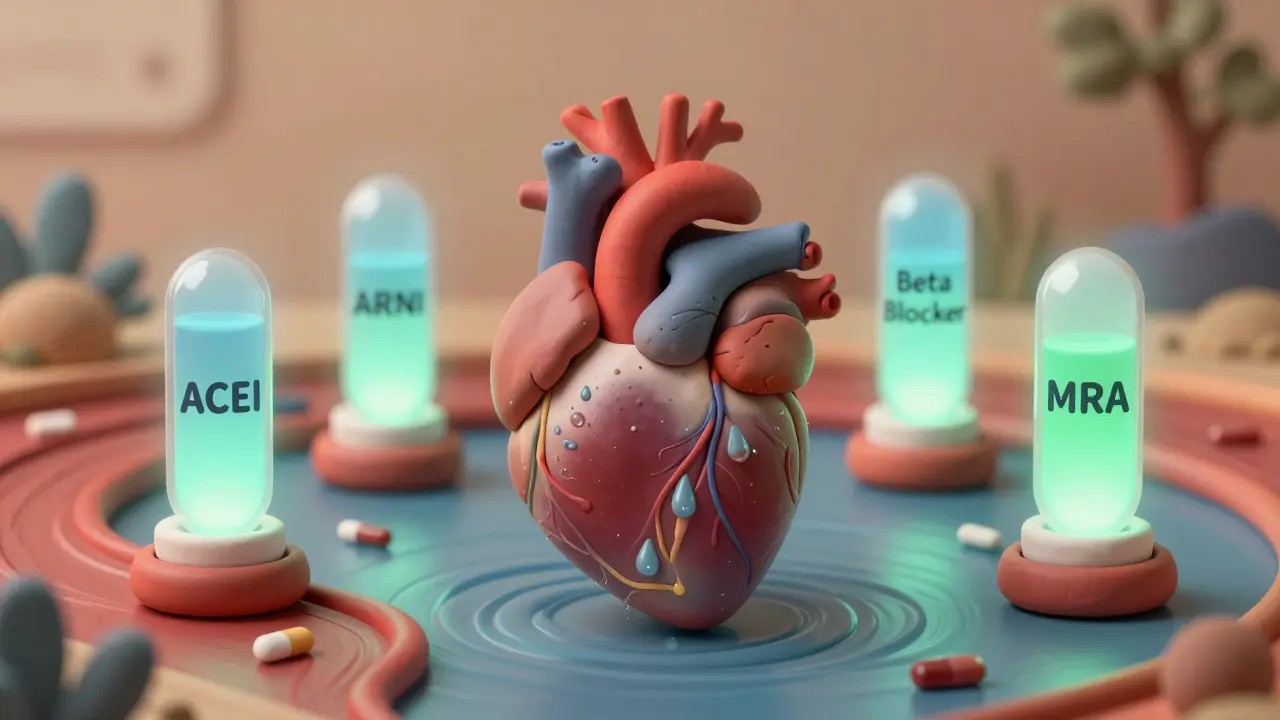
When you're diagnosed with heart failure, the list of medications can feel overwhelming. ACE inhibitors, ARNI, beta blockers, diuretics - these aren’t just fancy names. They’re the backbone of modern treatment, proven to save lives and help people breathe easier. The truth is, most people with heart failure with reduced ejection fraction (HFrEF) need to be on at least four of these drugs together. Yet, studies show fewer than 1 in 3 patients actually get all four. Why? Cost, side effects, confusion, or just not knowing how to start. This isn’t about guessing. It’s about knowing what works, how it works, and what to expect.
What ACE Inhibitors Do and Why They Still Matter
ACE inhibitors were the first real breakthrough in heart failure treatment. Back in the 1980s, doctors saw that blocking a hormone called angiotensin II could take pressure off the heart. Drugs like enalapril, lisinopril, and ramipril do exactly that. They stop the body from turning angiotensin I into angiotensin II, which normally tightens blood vessels and makes the heart work harder.
The results were dramatic. In the CONSENSUS trial, patients with severe heart failure who took enalapril had a 27% lower chance of dying compared to those on placebo. That’s not a small win. It changed everything. Today, these drugs are still used - but mostly as a backup. Why? Because there’s now something better.
But ACE inhibitors aren’t perfect. About 1 in 5 people get a dry, annoying cough. Some develop high potassium levels, which can be dangerous. Rarely, swelling in the face or throat (angioedema) happens - and that’s an emergency. If you’ve had this reaction before, you’ll never take an ACE inhibitor again.
ARNI: The New Gold Standard Replacing ACEIs
Enter ARNI - specifically, sacubitril/valsartan (brand name Entresto). Approved in 2015, it’s not just another pill. It’s two drugs in one: a neprilysin inhibitor that boosts natural heart-protecting chemicals, and an ARB that blocks bad hormones. Think of it as giving your heart both a boost and a break.
The PARADIGM-HF trial followed nearly 8,400 people across 47 countries. Those on ARNI had 20% fewer heart-related deaths and 21% fewer hospital stays than those on enalapril. That’s the biggest jump in survival we’ve seen in heart failure in decades. The 2022 guidelines now say: if you’re eligible, start with ARNI - not an ACE inhibitor.
There’s a catch. You can’t switch directly from an ACE inhibitor to ARNI. You need to wait at least 36 hours. Why? Because mixing them too soon raises the risk of angioedema by half a percent. That’s rare, but serious. Also, ARNI costs about $550 a month without insurance. That’s why many patients still start on cheaper ACE inhibitors - but if you can get ARNI, it’s the better choice.
Real patients notice the difference. One Reddit user switched from lisinopril to Entresto and said their shortness of breath improved in two weeks. Another said they felt more energy, even if they had to pee more often. Side effects like dizziness are common at first, but 82% of people stick with it because they feel better.
Beta Blockers: Slowing Down to Save the Heart
It sounds backwards, right? You have a weak heart, so you give it a drug that slows it down? But that’s exactly what works. Beta blockers like carvedilol, metoprolol succinate, and bisoprolol block adrenaline’s effects. That means less strain on the heart muscle, slower heart rate, and lower blood pressure.
The evidence is solid. In the MERIT-HF trial, metoprolol cut death risk by 34%. In COPERNICUS, carvedilol did the same in severe cases. These aren’t quick fixes. You start with tiny doses - like 3.125 mg of carvedilol twice a day - and slowly double it every few weeks. Rushing this can make heart failure worse before it gets better.
Side effects? Fatigue, low blood pressure, dizziness, and a slow pulse. Many patients quit because they feel too tired. But here’s the twist: those who stick with it often see their ejection fraction improve. One patient reported his EF went from 25% to 45% over 18 months. That’s not magic. That’s science.
Don’t stop these drugs if you feel worse at first. Work with your doctor to adjust the dose. The goal isn’t to feel perfect right away - it’s to survive longer and avoid hospital trips.

Diuretics: Managing Fluid, Not Fixing the Heart
Diuretics don’t fix your heart. They fix the swelling. When your heart can’t pump well, fluid backs up - in your lungs, legs, belly. That’s when you feel short of breath, swollen, and heavy. Diuretics help you pee out the extra water.
Loop diuretics like furosemide, bumetanide, and torsemide are the go-to. Start with 20-80 mg of furosemide, and adjust based on how you feel. Torsemide may be better long-term - one study showed 18% fewer hospitalizations than furosemide. Thiazides like hydrochlorothiazide are milder, used for mild swelling or with other diuretics.
But here’s what most people don’t tell you: diuretics can mess with your electrolytes. Low potassium, low magnesium, low sodium - all common. That’s why leg cramps happen. Many patients fix this with supplements, but only under a doctor’s watch.
Spironolactone is a special case. It’s a diuretic, but also a mineralocorticoid receptor antagonist (MRA). It blocks a hormone that causes salt and water retention - and it cuts death risk by 30%. But it can spike potassium. So you need blood tests every few weeks, especially when starting.
Diuretics get high ratings for symptom relief - 4.1 out of 5 on Amazon reviews. But people hate the constant need to pee. That’s the trade-off. You trade bathroom trips for breathability.
The Four-Pillar Approach: Why All Four Together Work
Heart failure isn’t treated with one drug. It’s treated with a team. The current gold standard is called quadruple therapy:
- ARNI (or ACEI/ARB if ARNI isn’t possible)
- Beta blocker
- MRA (like spironolactone or eplerenone)
- SGLT2 inhibitor (like dapagliflozin or empagliflozin)
Diuretics are added as needed for symptoms - they’re not part of the core four because they don’t improve survival. But they’re essential for quality of life.
Studies show people on all four drugs live longer, stay out of the hospital, and feel better. The 2022 guidelines say this combo reduces death risk by up to 20% compared to old-school treatments. But here’s the hard truth: only 35% of eligible patients get all four within a year of diagnosis. Why? Cost, fear of side effects, or doctors not pushing hard enough.
Specialized heart failure clinics get 85% adherence. General practices? Only 52%. That gap matters. If you’re not on all four, ask why.
What to Watch For: Side Effects and Monitoring
All these drugs need careful monitoring. Here’s what your doctor should check regularly:
- Potassium levels: Keep under 5.0 mmol/L. Too high = dangerous heart rhythms.
- Creatinine: A 30% rise from baseline means your kidneys might be stressed.
- Blood pressure: Systolic should stay above 100 mmHg. If it drops too low, doses may need lowering.
- Ejection fraction: Get an echo at 3-6 months to see if your heart is improving.
Don’t ignore symptoms. Dizziness? Tell your doctor. Swelling returning? Maybe your diuretic dose needs tweaking. Cough? Might be time to switch from ACEI to ARNI. Fatigue? Don’t quit beta blockers - adjust the dose.
Many patients think side effects mean the drug isn’t working. Sometimes, it just means you’re not on the right dose yet. Patience and communication are key.
What’s Next? The Future of Heart Failure Treatment
ARNI is now approved not just for HFrEF (EF ≤40%), but also for HFmrEF (EF 41-49%). That means millions more people are eligible. SGLT2 inhibitors - originally diabetes drugs - are now recommended for all heart failure types, even when the heart pumps normally. They cut hospitalizations and death across the board.
Next up? Drugs like vericiguat, which help the heart respond better to signals. And research is testing whether starting ARNI faster - even right after diagnosis - reduces side effects and speeds recovery.
But the biggest challenge isn’t science. It’s access. In rural areas, only 28% of eligible patients get guideline-recommended therapy. Cost, lack of specialists, and poor follow-up hold people back. If you’re struggling to afford ARNI, ask about patient assistance programs. Medicare covers 85% of it, but you’ll need prior authorization.
Heart failure isn’t a death sentence anymore. With the right meds, taken the right way, most people live longer, feel better, and stay out of the hospital. It’s not about one miracle pill. It’s about four proven ones - working together.
Kuldipsinh Rathod
December 26, 2025 AT 16:37I was diagnosed last year and honestly thought I’d be on oxygen by now. But after getting on ARNI and carvedilol, I can walk to the store without stopping. Still take furosemide when I feel puffy, but the difference is night and day. Thanks for laying this out so clearly.
SHAKTI BHARDWAJ
December 27, 2025 AT 15:34THIS IS ALL A LIE. THEY JUST WANT YOU TO BUY DRUGS. MY UNCLE DIED FROM HEART FAILURE AND HE WAS ON ALL FOUR AND STILL DIED. DOCTORS ARE IN THE PAY OF PHARMA. I STOPPED ALL MY MEDS AND NOW I EAT CAYENNE PEPPER AND DO YOGA. I FEEL BETTER. TRUST ME. I’M A NATURAL HEALER.
Sarah Holmes
December 29, 2025 AT 13:55One cannot help but observe the alarming epistemological fragility of contemporary medical paradigms, wherein pharmacological intervention is fetishized as the sole locus of therapeutic agency, thereby obfuscating the profound ontological dimensions of cardiac health as an embodied, socio-political phenomenon. The commodification of survival via ARNI and SGLT2 inhibitors-while statistically significant-represents a neoliberal co-optation of bodily vulnerability.
Jay Ara
December 29, 2025 AT 21:00Been on this combo for 2 years now. Started with 3.125 mg carvedilol and thought I was gonna die. Now I hike on weekends. Just take it slow. Your doc knows what theyre doing. Dont quit. Its worth it.
Michael Bond
December 30, 2025 AT 13:26ARNI over ACEI. No debate. The data speaks.
Matthew Ingersoll
December 30, 2025 AT 18:45In India, where I’m from, most people can’t even afford a monthly prescription for lisinopril, let alone Entresto. The fact that guidelines recommend ARNI as first-line is brilliant science-but it’s a luxury in many places. We need global access, not just elite protocols.
carissa projo
December 30, 2025 AT 23:58There’s something quietly revolutionary about treating heart failure not as a crisis to be crushed, but as a rhythm to be recalibrated. These medications don’t just lower numbers-they restore dignity. The slow, patient doubling of beta blocker doses? That’s not medicine. That’s love in pill form. And the fact that someone, somewhere, is peeing more to breathe easier? That’s not a side effect. That’s a symphony of survival.
josue robert figueroa salazar
December 31, 2025 AT 04:37Diuretics make you thirsty and tired. ARNI gives you dizziness. Beta blockers make you feel like a zombie. And SGLT2s? They give you UTIs. So what’s the point? You trade one hell for another. The system is rigged. You’re just paying to be mildly less dead.
david jackson
December 31, 2025 AT 14:15Okay so I read this whole thing and I’m just sitting here thinking about how the human body is this insane, delicate machine that’s been hacked by evolution and then patched by pharmaceutical companies using decades of clinical trials and molecular biology and it’s wild that we can actually slow down the ticking of a failing heart with a cocktail of four drugs that each target different pathways like a team of surgeons working in sync. I mean, think about it-angiotensin II, neprilysin, beta-adrenergic receptors, sodium-glucose cotransporters-all these tiny biological levers being pulled just right to keep someone alive. And yet we still have people saying ‘just eat less salt’ like that’s a cure. It’s not. It’s a bandaid on a bullet wound. This is real science. This is hope in a pill bottle.
Jody Kennedy
January 1, 2026 AT 08:44If you’re reading this and you’re on the fence about starting one of these meds-just talk to your doctor. Don’t let fear win. I was scared too. But I started low, stayed consistent, and now I’m playing with my grandkids again. You’ve got this. One pill at a time.