
First Generic Approval: Why It Matters and What It Means for Drug Prices and Patient Access
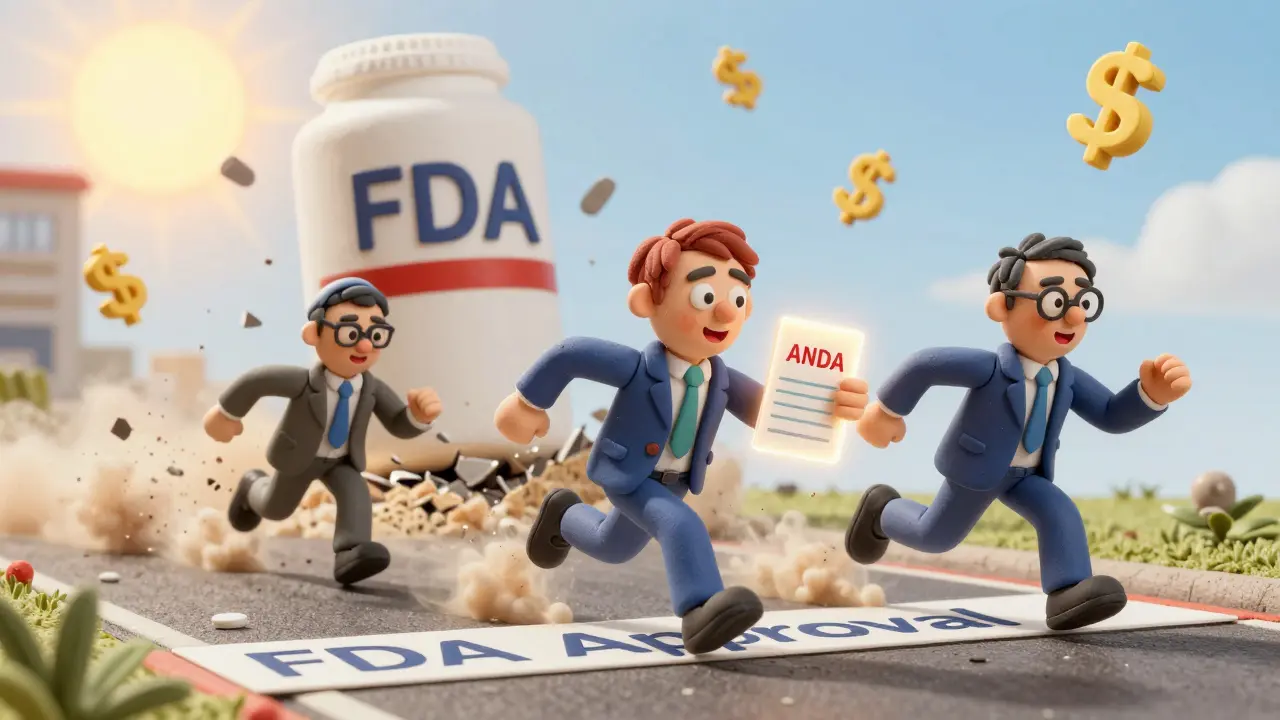
When a brand-name drug loses its patent, the first company to get FDA approval for its generic version doesn’t just get a head start - it gets a 180-day monopoly on the market. That’s not a loophole. It’s the core of how the U.S. drug system pushes prices down. This is what first generic approval means, why it matters, and how it changes everything for patients, pharmacies, and the healthcare system.
What Exactly Is a First Generic Approval?
A first generic approval isn’t just the first time a generic version of a drug hits the market. It’s the FDA’s official recognition that a company was the first to file a complete and legally valid application - called an ANDA (Abbreviated New Drug Application) - to copy a brand-name drug after its patent expires. The FDA doesn’t pick who gets it. It’s a race. Whoever submits first, meets all the rules, and clears the patent hurdles wins.
This system was created by the Hatch-Waxman Act of 1984. Before that, generic companies had to run full clinical trials to prove a drug worked - the same expensive tests the brand-name maker did. That made generics nearly impossible to produce. Hatch-Waxman changed that. It said: if you can prove your generic is the same as the brand in the body - same active ingredient, same dose, same way it’s taken - you don’t need to repeat the trials. You just need to show bioequivalence.
The FDA requires that the generic’s absorption into the bloodstream falls within 80-125% of the brand’s. That’s not a wide gap. Studies show the average difference between brand and generic is just 3.5%. That’s less than the variation you’d see between two batches of the same brand drug.
Why the 180-Day Exclusivity Matters
The real power of first generic approval isn’t speed - it’s exclusivity. The first company to file gets 180 days where no other generic can enter the market. That’s not a reward. It’s an incentive to take the risk.
Why take the risk? Because patent challenges are expensive. To get first-to-file status, a company must file what’s called a Paragraph IV certification. That’s a legal notice saying: "We believe your patent is invalid or we don’t infringe it." The brand-name company then has 45 days to sue. If they do, the FDA can’t approve the generic for up to 30 months while the court case plays out. Legal fees? $5 million to $15 million per case.
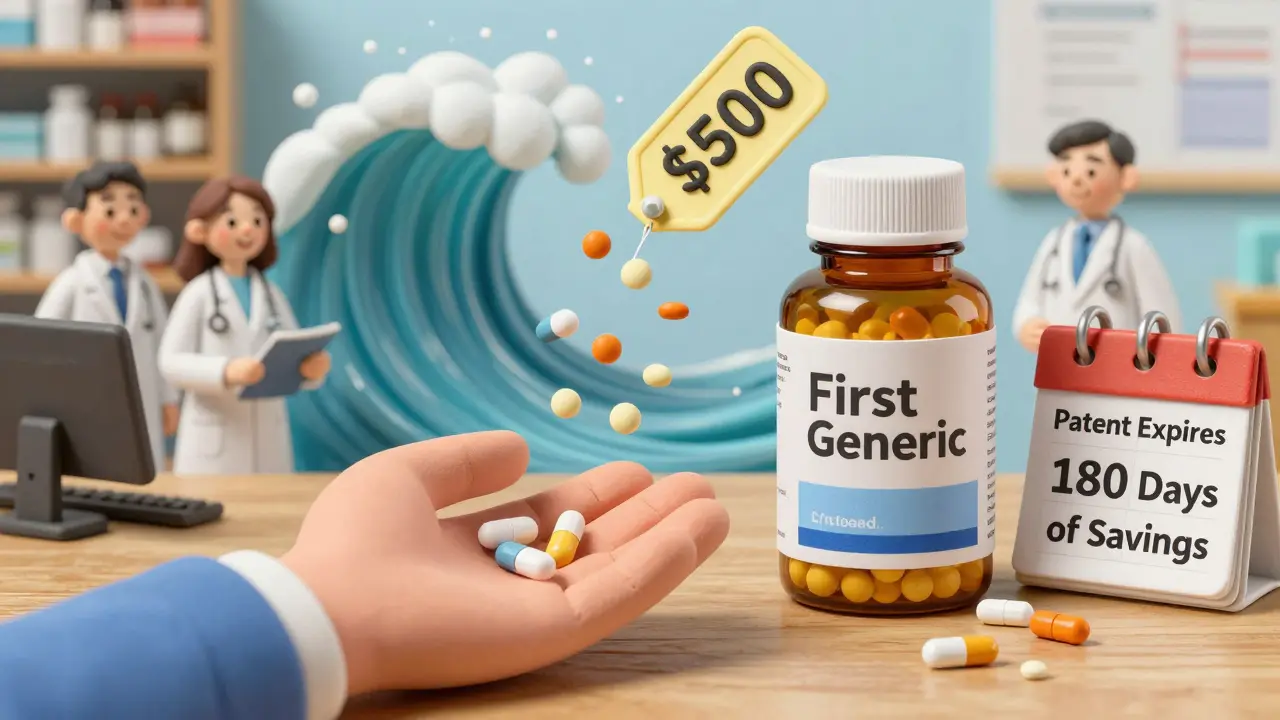
But if they win, the payoff is huge. During those 180 days, the first generic can capture 70-80% of the market. For a blockbuster drug like Humira - which made $20 billion a year before generics - the first generic maker can earn $100 million to $500 million in those six months. They price it 15-20% below the brand. No competition. High demand. Massive profit.
Who Wins When a First Generic Hits the Market?
Patients win. Pharmacists win. The system wins.
Within six months of a first generic launch, prices for that drug typically drop 70-90%. Compare that to after multiple generics enter - prices only fall 30-40%. That’s because the first generic breaks the brand’s grip. Once the exclusivity ends, more companies jump in. Prices tumble even further.
Since Hatch-Waxman passed, generics have gone from 19% of prescriptions in 1984 to over 90% today. That’s saved the U.S. healthcare system more than $1.7 trillion. The FDA estimates first generics alone account for $13 billion in annual savings.
Pharmacists see it every day. A 2024 survey of 1,200 U.S. pharmacists found 87% said first generics improved patient access. Seventy-three percent reported better medication adherence - people stick with their prescriptions because they can afford them. On Drugs.com, first generics average 4.2 out of 5 stars. Patients write: "Same as the brand, but half the price." "No side effects changed." "I can finally refill without choosing between meds and groceries."
What Can Go Wrong?
It’s not all smooth sailing. The system has cracks.
First, the "authorized generic" loophole. Sometimes, the brand-name company launches its own unbranded version of the drug - same factory, same formula - right when the first generic hits. These authorized generics aren’t counted as competitors, so they don’t trigger the end of the 180-day clock. But they eat into the first generic’s market share by 20-30%. In 38% of cases between 2015 and 2022, authorized generics showed up during exclusivity. That’s not competition. It’s a tactic.
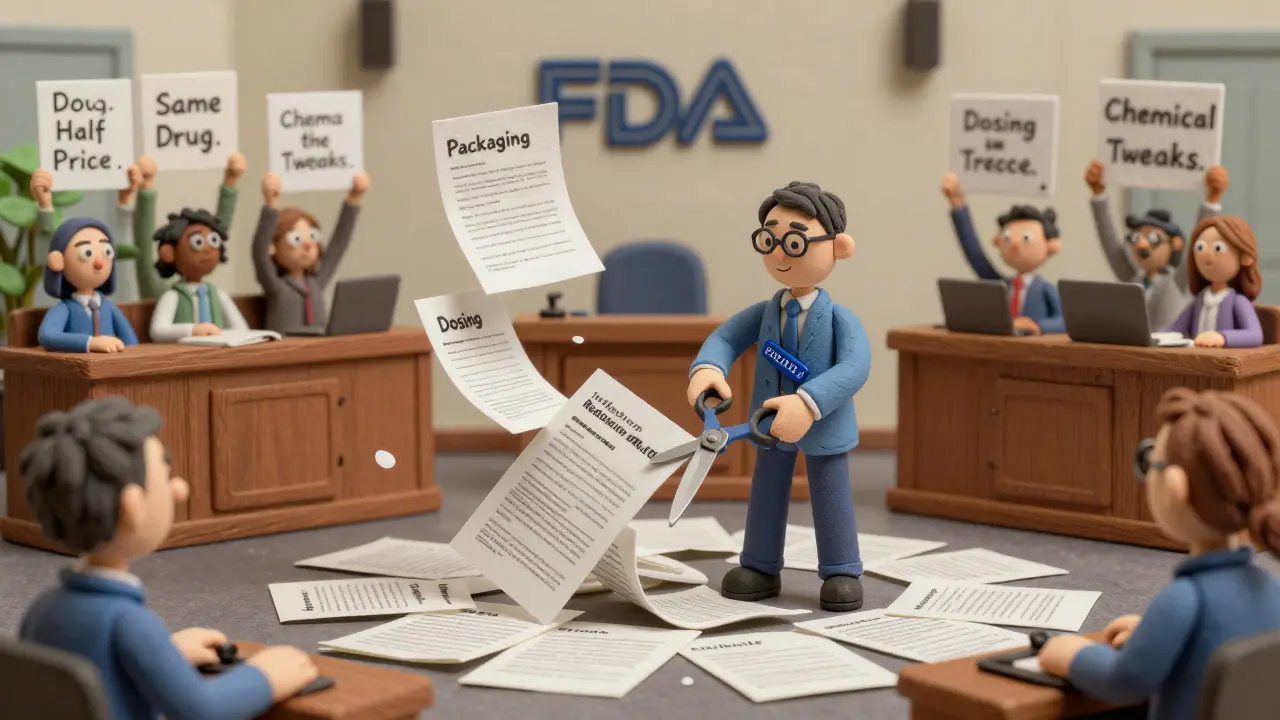
Second, patent thickets. Brand-name companies pile on dozens of patents - for packaging, dosing schedules, even minor chemical tweaks - to delay generics. A single drug can have over seven patents blocking entry. Between 2010 and 2020, 42% of first generics were delayed by these tactics.
Third, multiple first filers. Sometimes, two or more companies file on the same day. The FDA says: "You both get exclusivity." But here’s the catch: they have to launch at the same time. If one delays, they lose it. That’s led to legal battles, delays, and sometimes no generic at all for months.
And then there’s supply. When a first generic launches, demand spikes. Manufacturers scramble. In 2023, the first generic for Eliquis (apixaban) faced manufacturing delays that pushed the launch back 90 days. Prices stayed high. Patients waited. Pharmacists scrambled to find alternatives.
Who’s Winning the Race?
It’s not just big pharma. The leaders in first generic approvals are companies built for this game.
Teva, based in Israel, led the pack in 2023 with 14 first generic approvals. Hikma Pharmaceuticals got 11. Both specialize in complex generics - pills with tricky release profiles, injectables, inhalers. In 2023, the FDA approved 17 complex generics as first-to-file, up from just 9 in 2022. That’s a sign the system is adapting.
These companies don’t just have labs. They have legal teams, regulatory experts, and manufacturing plants ready to scale overnight. A single first generic can cost $50 million to $100 million to develop. Bioequivalence studies alone run $2-5 million. That’s why only a handful of firms play.
What’s Changing in 2026?
The rules are shifting. The 2022 Inflation Reduction Act ended the rule that paused the 180-day clock for drugs with safety programs called REMS. That means more generics can launch faster.
The FDA’s 2024 plan says accelerating first generics for complex drugs - like inhalers, creams, and injectables - is now a top priority. That’s huge. These drugs are harder to copy. Until now, many stayed brand-only long after patents expired.
And the pipeline? Over $156 billion worth of brand-name drugs will lose patent protection by 2028. That’s a wave of first generics coming. The FDA expects approvals to rise 8.3% each year through 2028.
But the biggest threat? Delay tactics. The CREATES Act of 2022 was passed to stop brand-name companies from refusing to sell samples to generic makers - a trick used to block testing. Enforcement is still patchy. Until that changes, the race will always be rigged.
What This Means for You
If you’re on a brand-name drug with a patent expiring soon, don’t panic. But do pay attention. Your pharmacist will know when a first generic is coming. They’ll tell you it’s safe. It’s the same drug. Just cheaper.
If you’re paying $500 a month for a medication, and a first generic hits at $150 - that’s $4,200 saved in a year. That’s rent. That’s groceries. That’s peace of mind.
First generic approval isn’t about corporate profits. It’s about fairness. It’s about making sure innovation doesn’t lock people out of life-saving medicine. The system isn’t perfect. But without it, generics wouldn’t exist. And without generics, most Americans couldn’t afford their prescriptions.
When you see "generic" on your prescription bottle, thank the company that filed first. And thank the law that made it possible.
What is the difference between a first generic approval and a regular generic approval?
A first generic approval goes to the first company to file a complete ANDA with a Paragraph IV patent challenge. It comes with 180 days of market exclusivity. Regular generic approvals happen after that exclusivity ends, when other companies can enter the market. Those generics don’t get exclusivity - they just compete on price.
Can a brand-name drug company launch its own generic?
Yes. These are called "authorized generics." They’re made by the original brand-name company but sold without the brand name or logo. They’re identical to the brand drug. They can launch during the first generic’s 180-day exclusivity period, which cuts into the first generic’s profits. This is legal and common - and a major reason why some first generics never capture the full market.
Why do some first generics take years to launch even after approval?
Approval doesn’t mean immediate availability. Companies need to set up manufacturing, get FDA facility inspections, and arrange distribution. Sometimes, they delay on purpose to extend exclusivity. Other times, there are supply chain issues - like with the first generic of Eliquis, which faced a 90-day delay due to production problems. Legal battles over patent disputes can also push back launch dates.
Are first generics as safe and effective as brand-name drugs?
Yes. The FDA requires first generics to meet the same strict standards as brand-name drugs. They must have the same active ingredient, strength, dosage form, and route of administration. Bioequivalence testing proves they work the same way in the body. Studies show the average difference in absorption is just 3.5%. Over 14,500 patient reviews on Drugs.com show first generics rated nearly identical to brand-name drugs in effectiveness and side effects.
What happens if two companies file for first generic approval on the same day?
If two or more companies file identical ANDAs on the same day and both successfully challenge the patent, the FDA grants shared 180-day exclusivity. But both must start selling within 75 days of approval. If one delays, they lose their exclusivity. This has caused delays and lawsuits - sometimes leaving patients without a generic for months.
How does first generic approval affect drug prices long-term?
First generics trigger the biggest price drops. Within six months, prices fall 70-90%. Once other generics enter, prices drop further - but not as sharply. The first generic breaks the brand’s monopoly. Without it, many drugs would stay expensive for years. The FDA estimates that first generics account for the majority of the $1.7 trillion in savings since 1984.
First generic approval is the engine that keeps generic drugs affordable. It’s not perfect. It’s not fair. But it’s the best tool we have to make sure no one has to choose between medicine and rent.
Gregory Parschauer
January 15, 2026 AT 03:10Let’s be real - this whole ‘first generic’ system is a corporate welfare scheme dressed up as consumer protection. The 180-day exclusivity isn’t an incentive, it’s a monopoly handout. Companies aren’t innovating - they’re gaming the patent system with Paragraph IV filings like it’s a high-stakes poker game. And don’t get me started on authorized generics - that’s not competition, that’s collusion with a side of hypocrisy. We’re told this saves money, but the real winners are the same pharma giants who invented the patent thickets in the first place. It’s a rigged race where the finish line is moved every time someone gets close.
mike swinchoski
January 16, 2026 AT 07:06This is why medicine is broken. The system rewards lawyers, not patients. If you can’t afford your pills, it’s not your fault - it’s because the rules were written by people who don’t care if you live or die.
Nelly Oruko
January 16, 2026 AT 13:26It’s fascinating how the Hatch-Waxman Act created a paradox: the very mechanism designed to democratize access to medication also institutionalized strategic delay. The 180-day exclusivity period, while economically rational for firms, introduces a temporal distortion in market dynamics - where scarcity is artificially engineered to maximize profit before competition arrives. The ethical tension here isn’t subtle: innovation is incentivized, but equity is sacrificed. And yet, without it, generics wouldn’t exist at all. A necessary evil? Or a systemic failure masked as policy?
vishnu priyanka
January 18, 2026 AT 00:50Back home in India, we call this ‘patent evergreening’ - same game, different country. Big pharma here puts up 10 patents for one pill just to keep generics out. I’ve seen people wait months for insulin because the first generic got delayed by a legal hiccup. It’s not just America - it’s global. The real heroes? The labs in Hyderabad and Chennai that build these generics for pennies. They don’t get headlines. But they keep millions alive.
Pankaj Singh
January 18, 2026 AT 03:36You people are delusional if you think this system is fair. The 180-day window isn’t a reward - it’s a bribe to the highest bidder. Companies don’t win because they’re better. They win because they have the deepest pockets to fund 15 lawsuits. And when the FDA approves a first generic, it’s not a victory for patients - it’s a victory for Wall Street. The real scandal? Nobody’s talking about how the first filer often sells the rights to a big pharma subsidiary before launch. So the ‘generic’ is still owned by the brand. This isn’t competition. It’s theater.
Acacia Hendrix
January 18, 2026 AT 11:00The structural inefficiencies embedded within the ANDA framework are non-trivial. The 80-125% bioequivalence threshold, while statistically defensible, lacks clinical granularity. We’re essentially permitting pharmacokinetic variance that could, in theory, impact therapeutic outcomes in narrow-therapeutic-index drugs - yet the FDA continues to conflate statistical equivalence with clinical equivalence. This is a classic case of regulatory capture masquerading as scientific rigor. The 180-day exclusivity? A rent-seeking mechanism disguised as market incentive. We need a paradigm shift - perhaps a prize-based model incentivizing first-to-market without exclusivity.
James Castner
January 19, 2026 AT 22:22I’ve spent 20 years in healthcare policy, and let me tell you - this is the single most important mechanism we have to control drug costs. Yes, it’s messy. Yes, there are loopholes. But without the first generic approval system, we’d still be paying $500 for metformin. Think about that. The average American takes 4-5 prescriptions a month. Multiply that by 330 million people. That’s $600 billion in annual spending. Generics cut that by 80%. The 180-day exclusivity? It’s the price we pay to get the ball rolling. The real villains aren’t the generic manufacturers - they’re the brand companies that use patent thickets and authorized generics to game the system. The CREATES Act was a step. But we need to fund the FDA to audit these delays. We need to punish companies that refuse to provide samples. We need to stop treating medicine like a commodity and start treating it like a human right. This isn’t just policy. It’s survival.
lucy cooke
January 19, 2026 AT 23:41Oh, darling - this whole thing is just Shakespearean tragedy with a side of FDA paperwork. The first generic is the tragic hero: brave, bold, risking everything - only to be stabbed in the back by authorized generics and patent trolls. And the audience? We, the patients, are left sobbing in the pharmacy aisle, clutching our $150 co-pay like it’s a lifeline. The system didn’t fail us - it was designed to make us feel grateful for crumbs. I want to scream into the void, but instead I just whisper to my pharmacist: ‘Is this the real thing?’ And she nods. And that’s enough. For now.
Trevor Davis
January 21, 2026 AT 10:47Just wanted to say - I’ve been on a generic for my blood pressure for three years now. Same exact pill as the brand, but I pay $12 instead of $140. I’ve got a 9-year-old daughter. That $128 a month? That’s her piano lessons. That’s her shoes. That’s her birthday cake. I don’t know who filed first - but thank you. From the bottom of my heart.
John Tran
January 21, 2026 AT 15:22Okay so like, I read this whole thing and honestly? The system is kind of a mess. Like, sure, the first generic saves money - but then the brand just launches their own ‘generic’ and suddenly the first guy gets screwed? And what if two companies file on the same day? That’s like a tie in a race where the prize is a billion dollars. And then they sit there for months arguing? That’s insane. And the FDA just… lets it happen? I mean, come on. Also, I think ‘bioequivalence’ is just a fancy word for ‘close enough’ and I’m not sure that’s good enough when you’re talking about your life. Also, typos lol.
Trevor Whipple
January 21, 2026 AT 17:07Wow, you really think this is about patients? Nah. This is about who can afford the best lawyers. The ‘first generic’ isn’t a hero - it’s a speculator. They don’t care if you live - they care if their stock goes up. And don’t even get me started on Teva - they’re basically pharma’s middleman with a better PR team. The real solution? Nationalize drug manufacturing. Let the government make generics. No exclusivity. No lawsuits. Just pills. Cheap. For everyone. But nope - we’d rather let billionaires play monopoly with our medicine.
Lethabo Phalafala
January 21, 2026 AT 23:02I’m from South Africa - we don’t have this 180-day nonsense. Our generics come in fast and cheap because the government doesn’t play games. We lost so many to HIV because brand-name drugs cost more than a person’s monthly salary. I remember standing in a clinic, watching a woman cry because she couldn’t afford her ARVs. Then the generic came. She hugged the pharmacist. That’s the real victory. Not the money. Not the patents. The hug. The fact that someone didn’t have to choose between medicine and food. This system? It’s broken. But the idea behind it? Pure gold. We just need to stop letting greed get in the way.
Lance Nickie
January 22, 2026 AT 23:07First generic my ass. It’s just a delay tactic with a fancy name.
Milla Masliy
January 24, 2026 AT 03:48I work in a community pharmacy in Ohio, and I see this every day. A patient comes in, panicking because their $400 pill just got replaced with a $45 generic. They’re scared. They think it’s fake. We sit down. Show them the FDA’s bioequivalence data. Show them the reviews. We tell them: ‘It’s the same drug. Same factory, same chemistry. Just no marketing budget.’ And then - they cry. Not from sadness. From relief. That’s what this is about. Not patents. Not profits. People. So yes - the system’s flawed. But when it works? It’s the closest thing we have to justice in healthcare.