
First-Episode Psychosis: Why Early Intervention and Family Support Save Lives

When someone experiences their first episode of psychosis, everything changes-fast. They might hear voices no one else can hear, believe things that aren’t true, or struggle to speak clearly. It’s terrifying-for them, and for everyone around them. But here’s the truth most people don’t know: first-episode psychosis is not a life sentence. With the right help, delivered quickly and with family support, most people don’t just recover-they rebuild their lives.
What Exactly Is First-Episode Psychosis?
First-episode psychosis isn’t a diagnosis itself. It’s the first time someone shows clear signs that their brain is losing touch with reality. This usually happens between ages 15 and 35. Symptoms include hearing or seeing things that aren’t there (hallucinations), holding false beliefs despite evidence (delusions), speaking in ways that don’t make sense, or acting in ways that seem strange or withdrawn. It’s not rare. About 1 in 100 people will experience it at some point. And it’s not caused by weakness, bad parenting, or drug use alone-though substances can trigger it in vulnerable people. The key is timing. The longer psychosis goes untreated, the harder it is to recover. Research shows that if someone gets help within 12 weeks of symptoms starting, their chances of returning to school, work, or normal social life jump dramatically. After six months without treatment, brain changes can become harder to reverse. That’s why every day counts.The Gold Standard: Coordinated Specialty Care
Forget the old model of just handing someone a pill and sending them on their way. The best approach today is called Coordinated Specialty Care (CSC). It’s not one treatment-it’s a team working together. CSC programs bring together psychiatrists, therapists, case managers, peer support specialists, and employment coaches-all trained specifically in early psychosis. Five core parts make CSC work:- Case management: A dedicated person helps the individual navigate appointments, insurance, housing, and daily needs. They check in 2-3 times a week during the early, unstable phase.
- Medication management: Antipsychotic meds are used, but carefully. Doctors start with the lowest effective dose-never high doses. First-generation drugs like chlorpromazine are used only when needed. Second-generation meds are preferred, but metabolic risks (weight gain, diabetes) are monitored from day one.
- Recovery-focused therapy: Cognitive behavioral therapy adapted for psychosis helps people understand their symptoms, reduce distress, and build coping skills. Weekly sessions are standard for the first six months.
- Family psychoeducation: This isn’t optional. Families get 8-12 structured sessions over six months. They learn what psychosis is, how to respond without panic, and how to support without enabling. Studies show this alone cuts relapse rates by 25%.
- Supported employment and education: The goal isn’t just symptom control-it’s life reconnection. Programs use Individual Placement and Support (IPS), which helps people find real jobs or return to school with coaching. At least 50-60% of CSC participants end up working or studying, compared to 20-30% with traditional care.
Why Family Support Isn’t Just Helpful-It’s Essential
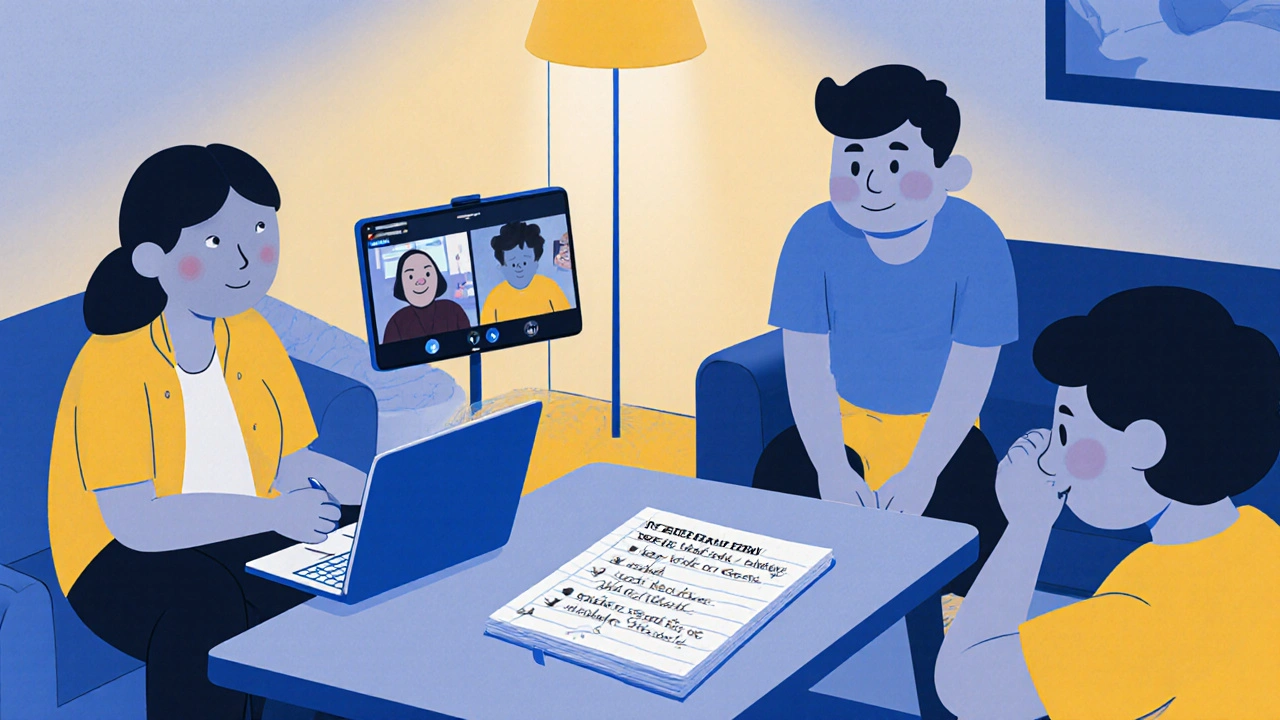
Families are the first line of defense. They’re often the ones who notice the changes: the sleepless nights, the sudden silence, the strange comments. But they’re also the most confused. Many think they’re to blame. Others panic and push the person away. Family psychoeducation changes that. It teaches families that psychosis is a medical condition, not a personality flaw. It gives them tools to respond calmly when someone is experiencing delusions-not by arguing, but by saying, “I know this feels real to you, and I’m here with you.” In Louisiana’s FEP program, families who attended at least six sessions had 35% fewer hospitalizations over two years. In Washington State’s New Journeys program, family participation rose from 40% to 75% after they started offering sessions via Zoom. That’s huge. Many families live hours away, work multiple jobs, or feel ashamed. Telehealth and flexible timing remove those barriers. And it’s not just about what families do-it’s about what they stop doing. Studies show that high levels of criticism or emotional over-involvement from family members increase relapse risk. Psychoeducation helps families shift from frustration to understanding.
What Happens If You Wait?
Delaying treatment doesn’t just mean more symptoms-it means lost years. The average person in the U.S. waits 78 weeks (almost two years) before getting help. That’s not normal. It’s a system failure. The longer psychosis goes untreated:- Symptoms get stronger and more fixed
- Brain changes become harder to reverse
- Education and jobs are abandoned
- Relationships break down
- Substance use increases as a coping mechanism
The Gaps: Why Most People Still Don’t Get Help
CSC works. But only 347 programs exist in the U.S.-and only 35% of counties have one. In rural areas, that number drops to zero. Only 18% of people with first-episode psychosis get treated within the 12-week window the World Health Organization says is critical. Why?- Insurance won’t cover it: Only 31 states have Medicaid waivers that fully pay for all CSC services. Many families are told, “We don’t have a program for that.”
- Doctors don’t know: Many primary care providers still think psychosis means “schizophrenia = lifelong disability.” They don’t know about CSC or early intervention.
- Stigma: Families hide symptoms. Teens fear being labeled. Schools don’t know what to do.
- Workforce shortage: CSC teams need specialized training. Only 35% of U.S. counties have even one trained clinician.
What You Can Do Right Now
If you suspect someone is having their first episode:- Don’t panic, don’t argue. Say, “I’m worried about you. Let’s get you checked out.”
- Go to the ER or a mental health clinic immediately. Tell them you suspect first-episode psychosis. Ask for a referral to a CSC program.
- Find a CSC program near you. Use the Early Psychosis Intervention Network (EPINET) directory. If there isn’t one, call your county mental health department and demand they connect you.
- Join a family support group. NAMI (National Alliance on Mental Illness) offers free family education courses. You’re not alone.
- Track symptoms. Keep a simple log: sleep, mood, strange thoughts, behavior changes. This helps clinicians act faster.
The Future Is Here-If We Push for It
New tools are emerging. The PRIME Care app, used in 22 CSC programs, lets patients log symptoms daily. It flags worsening signs before a crisis hits-and has cut hospitalizations by 30%. The National Institute of Mental Health is spending $50 million through 2026 to find biological markers that can predict psychosis before it starts. But technology won’t fix this alone. We need funding. We need training. We need families to speak up. We need schools to teach mental health literacy. We need insurance companies to pay for early care, not just crisis care. The evidence is clear: first-episode psychosis doesn’t have to be the end of someone’s story. With timely, compassionate, family-inclusive care, it can be the beginning of a new one.What are the early warning signs of first-episode psychosis?
Early signs include social withdrawal, trouble sleeping, declining school or work performance, strange beliefs or suspicions, talking to oneself, unusual speech patterns, and a sudden drop in personal hygiene. These often appear gradually over weeks or months-not suddenly. It’s not paranoia alone-it’s a cluster of changes that feel “off” to those close to the person.
Is psychosis the same as schizophrenia?
No. Psychosis is a symptom, not a diagnosis. Schizophrenia is one possible diagnosis that may follow repeated episodes. Many people who have one episode of psychosis never have another. Others may develop schizophrenia, bipolar disorder, or another condition. Early intervention reduces the chance of progression. The goal isn’t to label-it’s to heal.
Can drugs cause first-episode psychosis?
Yes-especially marijuana, methamphetamine, and hallucinogens. But substance use doesn’t cause psychosis in everyone. It triggers it in people already vulnerable due to genetics, trauma, or brain development. That’s why doctors always check for substance use-but don’t assume it’s the only cause. Treatment focuses on the psychosis, regardless of the trigger.
Are antipsychotic medications dangerous for young people?
They carry risks-weight gain, diabetes, movement issues-but so does untreated psychosis. The key is using the lowest effective dose, monitoring closely, and choosing second-generation meds first. NICE guidelines say never to start above 400mg chlorpromazine equivalent. Most community providers still overprescribe. A good CSC team will check weight, blood sugar, and cholesterol every three months from day one.
How do I find a Coordinated Specialty Care program near me?
Visit the Early Psychosis Intervention Network (EPINET) website and use their program locator. If you’re in a rural area, call your state’s mental health department or the National Alliance on Mental Illness (NAMI) helpline. Even if no program exists nearby, they can help connect you to telehealth options or mobile crisis teams. Don’t wait-early access saves years of life.
Deborah Williams
November 25, 2025 AT 12:57So we’ve got a medical emergency disguised as a moral failing, and the system responds with bureaucracy and a shrug. Fascinating. We’ll spend billions on prisons, but when someone’s brain is literally misfiring? ‘Sorry, no funding.’ I mean, if your car started hallucinating traffic cones, you’d take it to a mechanic-not a theologian. But humans? We still think psychosis is a character flaw wrapped in a bad hoodie.
And don’t even get me started on the families. They’re told to ‘stay calm’ while their child whispers to the TV. No wonder they’re terrified. No wonder they hide it. We’ve trained them to see mental illness like a family secret-something to whisper about at Thanksgiving, not treat like a broken leg.
Meanwhile, the WHO says 12 weeks. We average 78. That’s not a gap. That’s a canyon. And we’re throwing pamphlets into it like it’s a wishing well.
Micaela Yarman
November 27, 2025 AT 11:14It is imperative to underscore, with the utmost gravity and scholarly rigor, that the early intervention paradigm for first-episode psychosis represents not merely a clinical advancement, but a paradigmatic rupture in the epistemological framework of psychiatric care. The integration of multidisciplinary, recovery-oriented modalities-particularly the inclusion of family psychoeducation as a non-negotiable, evidence-based pillar-constitutes a radical departure from the paternalistic, pharmacologically reductionist models of the twentieth century.
Moreover, the statistical divergence in functional outcomes between CSC and traditional care is not merely statistically significant-it is morally exigent. To delay treatment is to perpetuate structural violence against neurodivergent youth. The data are unequivocal. The ethical imperative, therefore, is unambiguous.
Aaron Whong
November 28, 2025 AT 05:27Let’s deconstruct the CSC model through a Foucauldian lens: the team-based approach is just disciplinary power repackaged as compassion. Case managers aren’t helping-they’re surveilling. Employment coaches aren’t empowering-they’re normalizing. The whole thing is a neoliberal techne to produce docile, productive subjects who don’t disrupt the labor market.
And don’t get me started on ‘family psychoeducation.’ Who decided families are the solution? What about the state? The pharmaceutical-industrial complex? The fact that we’re blaming mom for not attending Zoom sessions while ignoring that she works three jobs? This isn’t care-it’s guilt-tripping with a clinical gloss.
Also, why are we assuming psychosis is always pathological? Maybe it’s a developmental adaptation. Maybe the brain’s just trying to rewire under late-stage capitalism. We pathologize the messenger because we’re too scared to listen to the message.
Brittany Medley
November 28, 2025 AT 23:49My brother had his first episode at 19. We didn’t know what was happening. Thought he was just being dramatic. Then he started talking to the ceiling fan. That’s when we called the ER.
They had no idea what to do. Sent us to a general psychiatrist who prescribed a high-dose antipsychotic and said, ‘Come back in six weeks.’ He gained 40 pounds in three months. We felt helpless.
Then we found a CSC program 90 minutes away. The case manager came to our house. The therapist didn’t act like he was broken-he acted like he was learning. My mom cried in the family session because she finally understood: it wasn’t about being ‘strong.’ It was about being informed.
He’s working at a coffee shop now. Still takes meds. Still has bad days. But he’s alive. And that’s not luck. That’s access.
Stop waiting for someone to ‘snap out of it.’ They can’t. But the system can change.
Marissa Coratti
November 29, 2025 AT 19:45It is absolutely critical to recognize, with full acknowledgment of the overwhelming empirical evidence presented in this comprehensive and deeply insightful exposition, that the current systemic failure to implement Coordinated Specialty Care on a national scale constitutes not merely a policy gap, but a profound moral and humanitarian crisis that demands immediate, coordinated, and adequately funded intervention across all levels of governance, public health infrastructure, and community-based service delivery networks.
Furthermore, the staggering disparity in outcomes-where individuals who receive timely, multidimensional, recovery-oriented care demonstrate a 45% greater improvement in symptomatology and a 20–25 point gain on the Global Assessment of Functioning scale, compared to those languishing in traditional, fragmented, and often punitive care models-represents not just a statistical anomaly, but a compelling, irrefutable, and ethically non-negotiable imperative for universal adoption of CSC protocols, particularly in rural, under-resourced, and marginalized communities where the need is greatest and the access is least.
Moreover, the economic argument is not merely persuasive-it is decisive: a five-to-one return on investment, translating to $126.5 billion in annual savings, is not a cost-saving measure-it is a societal lifeline. Why, then, do we continue to fund crisis response over prevention? Why do we wait for collapse before we act? Why do we treat mental health as a luxury rather than a human right?
The answer, I fear, lies not in ignorance, but in indifference. And indifference, in the face of such clear, actionable, and life-saving knowledge, is not just negligent-it is complicit.
Ezequiel adrian
December 1, 2025 AT 09:26Bro this is real. I seen my cousin go through this in Lagos. No help. Just got locked up in a church for 3 months. Prayed till he screamed. Now he’s fine but lost 2 years.
USA got programs? Cool. But why you letting people wait 2 years? 😒
My aunt had to sell her car to pay for meds. No insurance. No help. Just silence.
Y’all need to fix this. Not just talk. Fix it. 🙏
Joe bailey
December 3, 2025 AT 06:57My sister got diagnosed at 22. We were terrified. But we found a CSC program through NAMI-thank god for them. The family sessions were the game-changer. I used to say, ‘Why are you acting like that?’ Now I say, ‘I’m here.’
She’s back in college. Has a part-time job. Still takes meds. Still has bad days.
But she’s alive. And that’s all that matters.
Don’t wait. Call your county mental health line today. Even if you’re scared. Even if you’re not sure. Just call.
They’ve got people who know what to do.
Amanda Wong
December 3, 2025 AT 19:04Oh please. This is just another woke mental health cult pushing pharmaceutical dependency under the guise of ‘compassion.’
Psychosis isn’t a medical condition-it’s a spiritual awakening gone wrong. You medicate it, you kill the person’s potential. Look at all these ‘recovered’ people-still on drugs, still dependent, still broken.
And family ‘psychoeducation’? That’s just guilt-tripping parents into compliance. What about personal responsibility? What about discipline? What about prayer?
My cousin had a ‘psychotic episode’ after watching too much TikTok. He went to a monastery for six months. Came back a monk. No meds. No team. Just peace.
Stop pathologizing the weird. Stop medicating the misunderstood.
This isn’t medicine. It’s control.
james thomas
December 5, 2025 AT 00:02Let’s be real-this CSC stuff is a government scam. You think they care about recovery? Nah. They care about controlling who’s ‘normal.’
They got apps tracking your sleep? Surveillance. They got ‘peer specialists’? Informants. They got ‘family sessions’? Mind control.
And don’t get me started on the ‘research.’ NIMH’s spending $50 million to ‘predict psychosis’? That’s just pre-crime for the mentally ill. Next thing you know, teens get flagged for ‘high risk’ because they listen to sad music and don’t shower.
They’re not saving lives. They’re building a database.
And the media? They’re just the PR department.
Wake up. This isn’t help. It’s the new eugenics.
Kaushik Das
December 5, 2025 AT 07:29Man, this hits different. I’m from Mumbai, and we don’t even have the word for psychosis here. We say ‘dimaag kharab hua’-brain got broken. No doctors, no programs, just silence.
My cousin had his first episode in college. We hid it for months. Thought he was possessed. Took him to a tantrik. He got worse.
Finally, a friend’s uncle who studied in the US told us about CSC. We found a telehealth program. Took 6 months to get meds. But he’s working now. Still talks to his ‘voice friends.’ But he calls them by name now. Like they’re roommates, not demons.
It’s not perfect. But it’s something.
Global mental health ain’t just a slogan. It’s someone’s brother. Someone’s sister. Someone’s future.
Don’t wait for a program. Start a conversation. Even if it’s awkward. Even if you’re scared.
Just talk.
Asia Roveda
December 6, 2025 AT 07:42Let’s cut the BS. This isn’t about ‘early intervention.’ It’s about controlling poor people. Black kids. Brown kids. Kids who don’t fit in.
They call it ‘psychosis’ when a kid talks to himself. But if a rich kid says he’s ‘channeling his muse’? He’s an artist.
They push meds because it’s cheaper than housing. They push ‘family support’ because they don’t want to fund real care.
And now they want us to trust ‘apps’ and ‘coaches’? Please. This is the same system that let kids die in foster care while they wrote grant proposals.
This isn’t compassion. It’s capitalism with a therapist’s couch.
Deborah Williams
December 7, 2025 AT 16:03And yet, here we are-still waiting for the system to catch up to common sense. Meanwhile, the kids are still whispering to the walls, and the parents are still apologizing for existing.
Maybe the real psychosis isn’t in the brain.
Maybe it’s in the silence.